

South Africa putters along


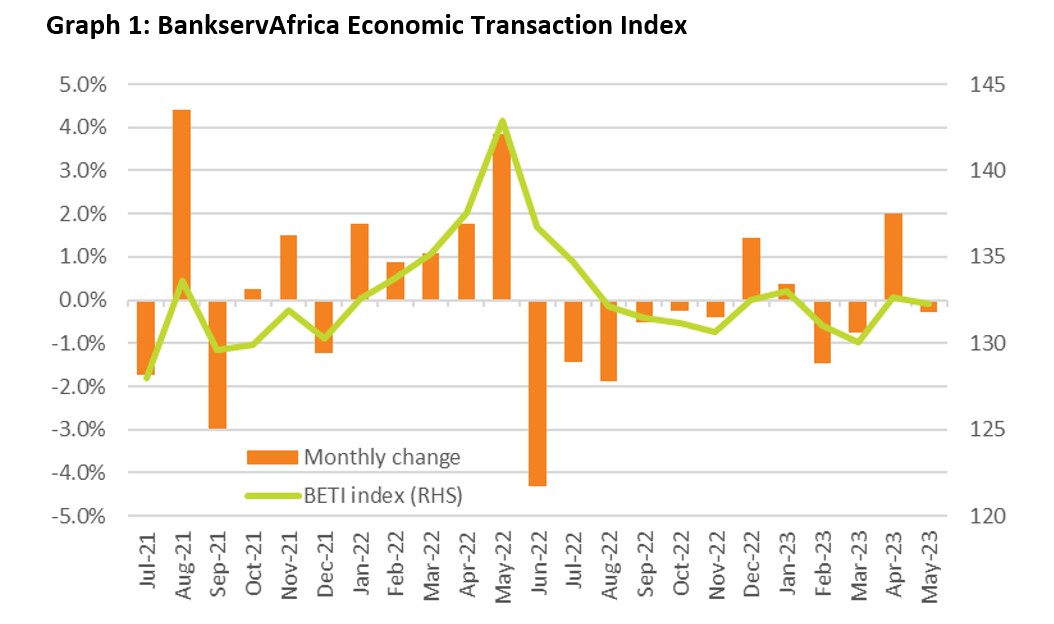
The BankservAfrica Economic Transactions Index (BETI) dropped slightly in May 2023, marking the third decline in four months and signalling the economy’s flat growth trend.
The BETI reflects the standardised value of all the economic transactions in the South African economy at seasonally adjusted real prices.
“The BETI slipped to an index level of 132.3 in May compared to 132.7 in the previous month,” said Shergeran Naidoo, BankservAfrica’s Head of Stakeholder Engagements.
“On an annual basis, the BETI weakened by a notable 7.4% in May 2023 compared to the revised decline of 3.6% in April.”
BankservAfrica said that the drop in May shows that the recovery in April would not kickstart a sustainable upward trend.
In May 2022, the BETI jumped by a 3.9% month-on-month to reach a then record high of 142.9, which was driven by the strong post-Covid recovery.
“In the past year, the BETI has moved sideways with some volatility from month to month. From June 2022 – May 2023, the BETI declined on a monthly basis in nine out of the twelve months, suggesting an economic scenario of stagnation,” independent economist Elize Kruger added.
She added that the economy is continuing with its “muddle-along-little-thriving” narrative.
BankservAfrica said that the economic environment in May was extremely challenging, with recent statistics showing that South Africa have spent 27% of the year without power compared to the 9.5% in 2022.
Moreover, the South African Reserve Bank up interest rates to a 14-year high, whilst the rand hit record new lows amidst the tensions with the West that South Africa supplied arms to Russia.
The cost of living in South Africa remains high, and the global economic slowdown is still having an effect.
BankservAfrica said that the BETI’s drop is in line with other nowcast indicators. The Absa Purchasing Managers’ Index (PMI) declined from 49.8 in April to 49.2 in May. The PMI has now been below its neutral 50 level for four consecutive months, which also signals a stagnation.
In addition, the standardised nominal value of transactions cleared through BankservAfrica dropped from April’s R1.22 trillion to R1.18 trillion in May.
Although the number of transactions increased from 35.9 million in April to 147.2 million in May 2023, this was due to more trading days in May.
In prior months, BankservAfrica said that Q1 2023 could see negative quarterly growth, with the March BETI 1.9% lower than the previous quarter. However, the finance, mining and manufacturing sectors pushed the economy to grow by 0.4% in Q1, avoiding a technical recession.
Although eight of the ten economic sectors recorded growth in Q1, BankservAfrica describes the growth as subdued, tieing into the results found in the BETI.
“The economy remains in a muddle-along scenario and unable to meaningfully alleviate South Africa’s social and unemployment issues,” Kruger said.
Read: South Africa’s new retirement system – big questions hang in the air

















 Loading ...