

An Eskom nightmare come true


Energy experts and analysts have been warning for some time that Eskom’s failure to consistently supply electricity will push energy users to alternatives – costing the power utility millions, if not billions, of rands in lost revenue.
Analysis of the latest supply/demand data shows that this is already happening.
Former Eskom chief executive Andre de Ruyter is just the most recent commentator to flag the fundamental flaw in Eskom’s business operations, saying recently that South Africans are likely to turn away from the ailing power company, leaving it with a user base that simply won’t be able to pay.
“If you extrapolate from current trends, Eskom will eventually be left with a customer base of people who cannot afford electricity and therefore don’t pay for it,” he said.
This was echoed by other experts who warned that the group would eventually price itself out of the market, as it was likely to continue seeking higher tariff hikes to make up for the lost sales and the exorbitant costs of securing energy through measures like open-cycle gas turbines.
According to the latest plant performance data, compiled by independent analyst Pieter Jordaan, this nightmare scenario for the company is already happening.
Looking at the energy demand profile for the first two weeks of 2024, Jordaan noted that even though demand is picking up – as is the historical seasonal trend – it is still falling far short of what it was in the past, lagging the baseline by around 1,400MW.
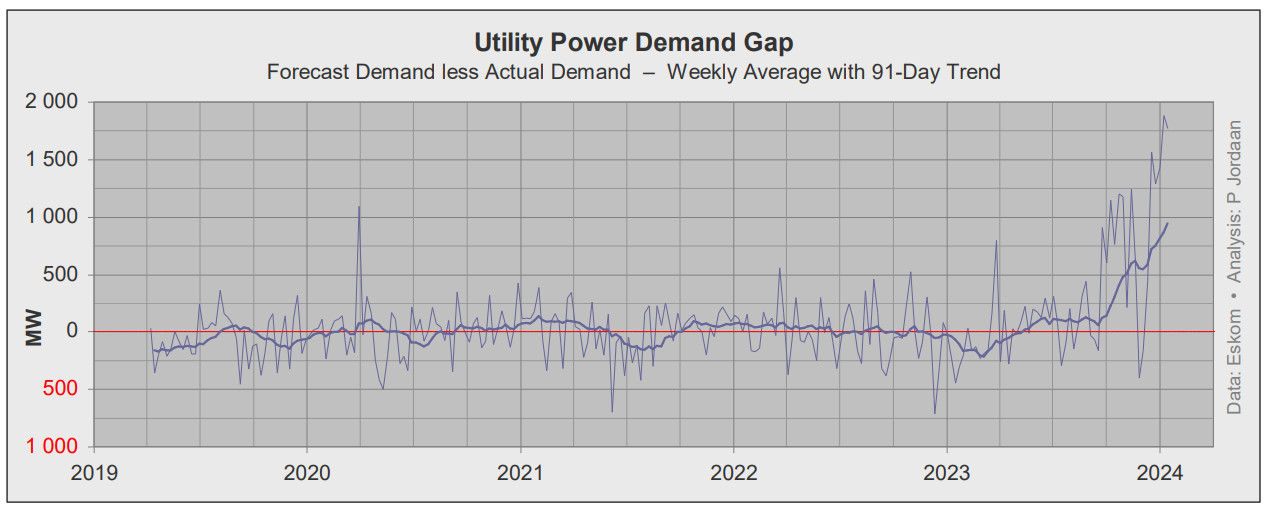
Given the insane levels of load shedding experienced in 2023 and frequent warnings about pushing load shedding to stage 8, South Africans heeded the call to cut demand – to the point that the last time the country consistently exhibited a “typical” demand profile was in the first quarter of 2023.
But it’s not just users cutting demand, Jordaan said – South Africans are shopping elsewhere.
“Constant load shedding disruptions, tax incentives and low panel prices convinced many consumers to embrace solar PV as a viable alternative to utility power. A steep tariff increase in 2023 also tamped down demand from some large power users,” he said.
This has resulted in a near-permanent shift in demand which is likely to only get more pronounced the longer load shedding is in effect and the energy market opens up to alternatives.

While a permanent shift in demand is positive at face value – ie, Eskom has more room to cut load shedding – it also signifies a significant loss of revenue for the group.
An analysis of Eskom data shows that average demand destruction has escalated from 250 MW per hour in September 2023 to 1500 MW per hour over the past five weeks.
“Without a further escalation, this near-permanent demand loss translates to 13 TWh, or 6.5%, of lost sales for Eskom in 2024.
“Even though Eskom’s power production levels are on par with those in 2023, the dramatic shift in demand has pushed the blackout rate two-thirds lower than this time last year,” Jordaan said.
The kicker for energy users is that the group’s current methodology to calculate tariff hikes allows the company to ‘claw back’ this lost revenue in future price increases.
Under the current MYPD methodology, regulator Nersa allows Eskom to apply for tariff hikes based on the costs of its operations as well as projected revenues from sales. Controversially, the methodology also includes a ‘clawback’ clause, which allows the utility to recover ‘lost’ revenues in future tariff hikes.
These clawbacks and recoveries have led to Eskom applying for increasingly higher tariff hikes each year.
As more South Africans dump Eskom for alternative power sources – leading to fewer sales and less revenue – those who remain are likely to be saddled with ever-increasing rates to make up for losses.
Read: Eskom’s big turnaround plan is happening – 25 years after it was first recommended

















 Loading ...