

Tough times for chocolate lovers in South Africa



South African chocolate lovers have experienced a challenging year, with cocoa prices soaring to unprecedented levels.
Although these high prices have recently started to stabilise, relief for consumers remains distant, as the quality and quantity of chocolates are expected to decrease further in the near future.
Over the past few years, chocolate prices have skyrocketed both globally and locally in South Africa.
This surge is largely due to poor harvests in key cocoa-producing countries in West Africa, particularly the Ivory Coast and Ghana, which collectively account for 70% of the world’s cocoa supply.
These poor yields have been driven by adverse weather conditions and diseases, including heavy rains, dry heat, and black pod disease.
This price increase has rippled through the global market, prompting major manufacturers like Mondelēz and Nestlé to raise prices in an attempt to offset skyrocketing input costs.
South African chocolate producers have been hit even harder, facing additional challenges such as rising sugar prices, sugar taxes, load-shedding, and other infrastructure problems.
These factors have further compounded the pressure on local manufacturers, resulting in significant price hikes for consumers.
According to the Consumer Price Index (CPI), the cost of a standard 48g chocolate bar rose by 21.43% in the last two years, increasing from R11.90 in September 2022 to R14.45 by August 2024.
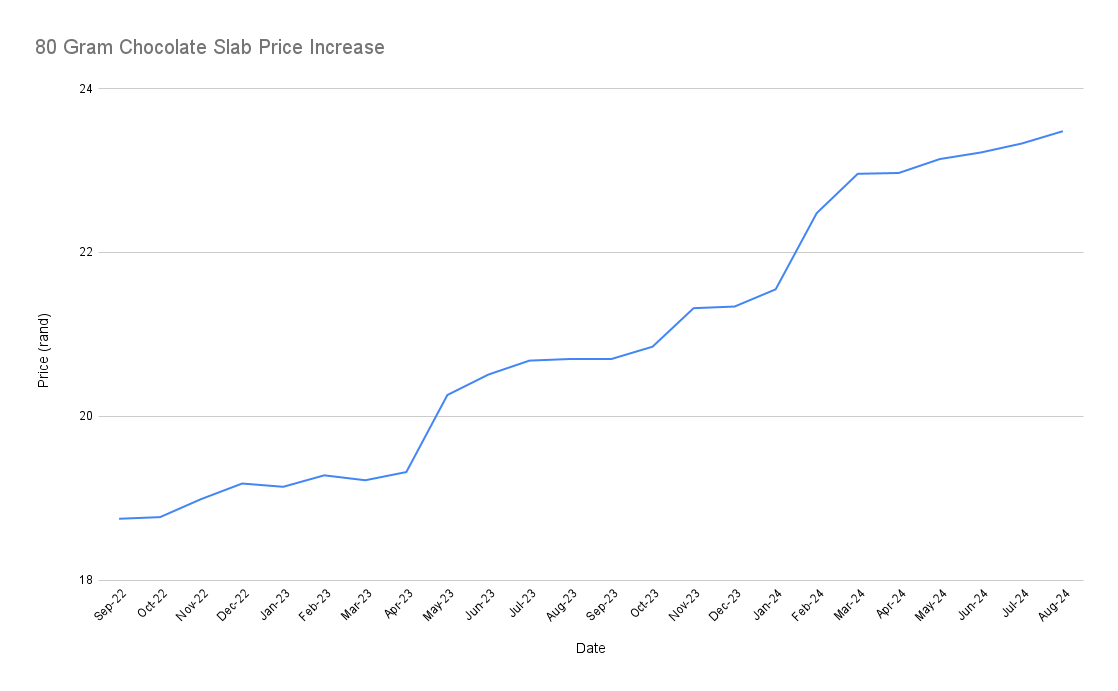
Similarly, an 80g chocolate slab saw an even steeper rise of 25.23%, from R18.75 to R23.48 during the same period.
Fortunately, after reaching a peak of $12,261 per tonne in April 2024, cocoa prices have begun to ease.

According to Trading Economics, cocoa recently traded just below $7,000 (R122,150) per tonne, marking its lowest level since mid-March.
This drop can be attributed to traders liquidating long positions and improving weather conditions in key cocoa-producing regions like the Ivory Coast and Ghana.
Farmers have reported that, despite receiving below-average rainfall in most regions, it was still sufficient to support the development of the upcoming main crop, which runs from October to March.
Locally, the situation has improved as well, with load-shedding being suspended for more than six months.
However, consumers will not be feeling this relief since prices are still significantly higher than they were two years ago, and chocolate lovers in South Africa should brace themselves for further increases.
On top of paying more, they will likely experience a decline in the quality of chocolates available in stores.
Experts predict that in response to ongoing cost pressures, many manufacturers will reduce the size of chocolate bars (also known as ‘shrinkflation’), lower cocoa content, and incorporate cheaper ingredients like nuts, fruit, or fillings to absorb the higher costs.
According to a BBC report, this shift may become a widespread strategy in the industry to cope with soaring cocoa prices.
All of these wide-scale challenges will mean that South Africans will likely have to curb their chocolate cravings and start looking for cheaper alternatives as this accessible snack becomes an unaffordable luxury.
Chocolate price increase
The chart below, courtesy of Trading Economics, shows the metric ton price of cocoa over the last five years.

The next chart shows the increasing price of a 48g chocolate bar from September 2022 to August 2024, based on the CPI.

Finally, the chart below shows the increasing price of an 80g chocolate slab from September 2022 to August 2024, based on the CPI.
Read: This is how much sugar is packed into South Africa’s favourite cereals in 2024

















 Loading ...