

6 months of good news for salaries in South Africa


South African salaries have risen for the sixth consecutive month, highlighting a gradual improvement in economic activity and reflecting the labour market’s resilience.
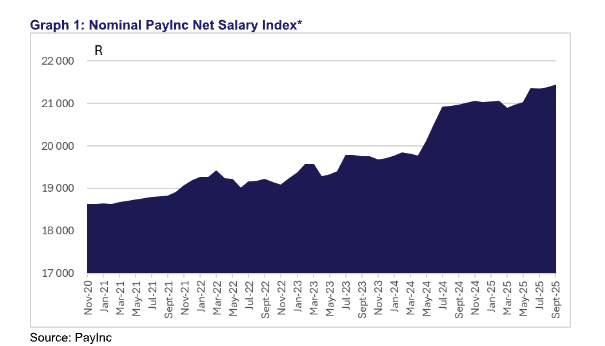
The latest PayInc Net Salary Index reached R21,428, which was 0.3% up on August’s level and 2.3% higher than a year ago.
The average net salary continues to strengthen, showing a rise of 4.3% in the first nine months of 2025 compared to the same period in 2024.
The PayInc Net Salary Index showed that the number of salaries paid increased by over 175,000 during the first nine months of 2025.
However, while the data points to good news, there are still major problems with South Africa’s labour market.
“The official unemployment rate remains stuck at around 33%, as the economy is simply unable to create enough new opportunities to absorb all new entrants into the job market on an annual basis,” said Elize Kruger, an Independent Economist.
That said, the PayInc Net Salary index signals improved labour conditions in Q3 2025, with the average net salary increasing by 0.4% quarter-on-quarter, with around 48,000 new salaries paid over the quarter.
“The refreshed PayInc Net Salary Index confirms the narrative that 2025 will, on average, be a good salary year, despite uncertainties and challenges impacting the economic outlook,” said Kruger.
In real terms, which accounts for inflation, the PayInc Net Salary Index increased by 0.2% month-on-month to R20,806 in September 2025.
This was the third straight month that real net salaries dropped below year-ago levels.
That said, with consumer inflation on average only 3.1% in the first nine months of 2025, the average real net salary as measured by the PayInc Net Salary Index is up by 1.2% compared to 2024.
“With average consumer inflation forecast at 3.3% in 2025 and industry data suggesting an average salary increase above 5%, 2025 will likely be the second consecutive year of a real increase in earnings,” said Kruger.
“This is a welcome tailwind for salary earners, supporting consumption expenditure and could assist in softening the impact of global headwinds on the local economy.”
Where to next for salaries
The South African Reserve Bank (SARB) recently announced that it preferred to see consumer inflation anchored around the lower end of the current 3%-6% target band.
The SARB and National Treasury are currently working on creating a new inflation targeting framework, with National Treasury agreeing that the current range is too wide.
It remains to be seen what would be needed to steer the economy towards such a low inflation environment.
“One aspect that could potentially be a near-term hurdle is the fact that trade unions and the business sector still believe that inflation will average around 4.3% in the next five years,” said Kruger.
In recent years, many wage agreements have been extended to three- or five-year terms, often resulting in higher pay levels compared to today’s low inflation environment.
“While adjusting to a lower inflation environment will be challenging and take time, recent data show early signs of moderating inflation expectations and salary adjustments becoming more aligned with this trend.”
This includes the recent Motor Industry Bargaining Council’s three-year agreement, which grants employees a 6% increase in the first year in 2026, followed by 5% in subsequent years.
In automotive retail, workers will receive 5% annual increases over three years, while petrol attendants will see 6%, 5%, and 4% increases, plus a 1% annual medical insurance allowance.
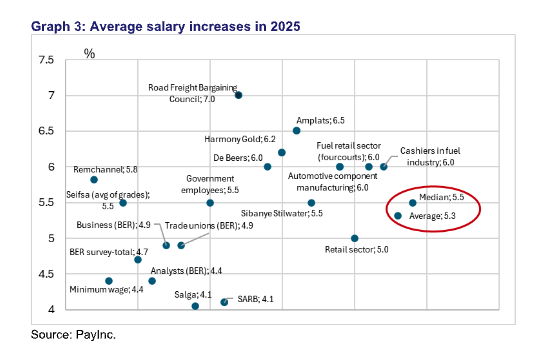
“For 2025, industry indications suggest an average salary increase of around 5.3%, compared to a forecast inflation rate of 3.3%. While this could boost spending, it will only be sustainable if productivity growth keeps pace,” ends Kruger.


















 Loading ...