

Proposal to change the official petrol price every two weeks in South Africa


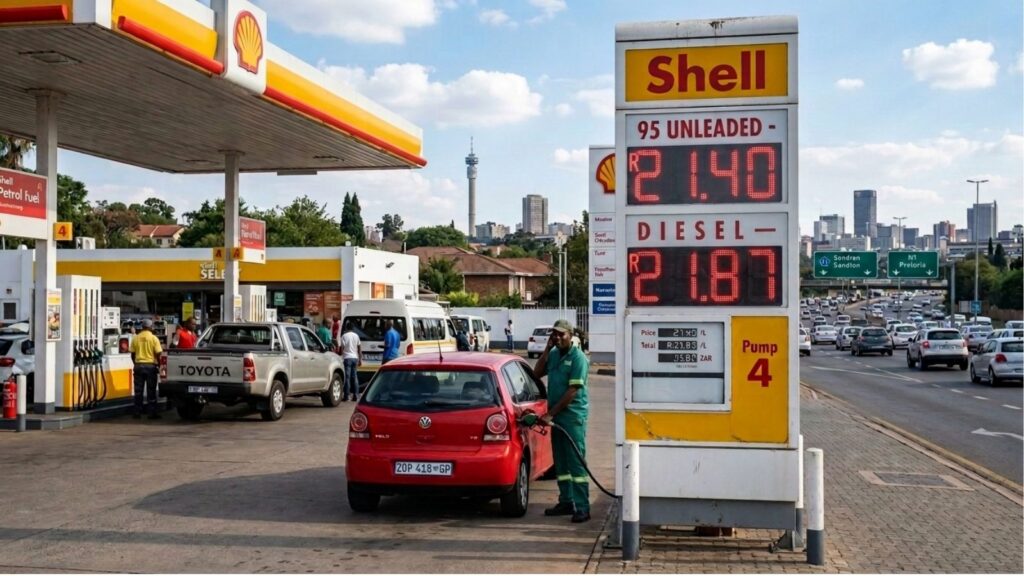
South Africa could move away from its long-standing monthly fuel price adjustment, following a proposal to introduce bi-weekly price changes to better respond to rapid swings in global oil markets.
The proposal was raised by Fasiha Hassan-Duma during a meeting of Parliament’s Portfolio Committee on Mineral and Petroleum Resources, as lawmakers debated ways to soften the impact of severe fuel price shocks on consumers and businesses.
The discussion followed one of the sharpest fuel price increases in recent years. After war broke out at the end of February, petrol prices climbed by R6.53 per litre between March and May, while diesel surged by R13.43 per litre.
June brought some relief for diesel, with wholesale prices cut by R2.62 per litre, but petrol prices jumped by another R1.43 per litre as Treasury relief ended.
July was the first month with cuts for both petrol and diesel, despite the Treasury relief ending completely, bringing prices down by R1.96 and R3.59 per litre, respectively.
Despite the trend turning, petrol prices are still currently R6.00 per litre higher than before the war, and diesel prices are still R7.22 per litre higher.
If the early projections for August hold, prices would fall closer to pre-war levels but would still be around R3.50 per litre higher than in February.
Because South Africa relies heavily on diesel for transport, freight, and agricultural operations, the fuel spike triggered significant cost-push inflation in food production, fertilisers, and general supply-chain logistics.
The pressure has also weighed heavily on smaller businesses. This was noted in the Business Partners SME Confidence Index.
According to the index, many small and medium-sized enterprises shifted their focus from expansion to managing rising operating costs and ensuring survival, leading to weaker business confidence.
Additionally, the Fuel Retailers Association warned that fuel price shocks threatened the sustainability of petrol stations due to fixed margins, rising working capital needs, and declining sales.
The conditions even forced operators to consider reducing trading hours or cutting jobs to avoid bankruptcy.
Bi-weekly fuel price changes will allow the government to react more quickly to oil price fluctuations

These issues were raised in a Portfolio Committee on Mineral and Petroleum Resources meeting amid the crisis.
Committee members warned that the effects of fuel inflation extend throughout the economy. They noted that “once the prices of fuel rise, food prices and essentials are also affected, and the poorest of the poor bear the brunt of that.”
Members also criticised government communication during the crisis, and argued that uncertainty “created an artificial supply problem” as anxious motorists rushed to fill their vehicles.
To reduce the impact of future price shocks, Hassan-Duma proposed moving away from monthly fuel price adjustments in favour of reviews every two weeks.
Fasiha Hassan-Duma said that while South Africa cannot control global oil prices, it can change how it responds to rapid fluctuations by adjusting fuel prices more frequently.
“We understand that this is a global problem, an international one, but there are a number of interventions that we can put in place that I think we need to push for,” she said.
Rather than implementing the full increase in one go, Hassan-Duma suggested reviewing prices every two weeks.
“Instead of increasing diesel by R10 or R7, or whatever the case may be now, you don’t do it immediately. You don’t look at it once a month, you look at it every two weeks,” she said.
“You say, ‘Okay, this is the two-week price, this is the next two weeks,’ because the price of crude oil is fluctuating so quickly,” she said.
She argued that although South Africa has little control over the international factors driving oil prices, it can respond more quickly to changing market conditions.
“Based on factors we may not be able to control, we can actually adapt faster. Even if the price increase is going to be horrific in the next 24 hours, let’s relook at it in two weeks’ time. Let’s push to do that so that maybe we can bring it down by a rand or two,” she said.
Hassan-Duma acknowledged that introducing bi-weekly price adjustments would create challenges, but said the benefits would outweigh the drawbacks.
“I know this will create some challenges, but what it does do is it manages the problem a little bit better, it creates a staggered approach, and it shows that you have a government that is very responsive to what people are going through,” she said.
She added that a more flexible pricing system could help reduce the impact of rising fuel costs on households and ease pressure from the cost-of-living crisis.
“It can therefore manage the cost-of-living crisis that’s about to get much worse, particularly for the working class, particularly for the poor,” she said.
No further details where given on the proposal. BusinessTech has reached out to the Department of Mineral and Petroleum Resources to confirm whether it will consider this proposal, and will add its response to this article once received.

















 Loading ...