

The ‘real’ value of the rand in 2026


The rand is currently trading at approximately R16.53 to the dollar, but the Big Mac Index indicates it is significantly undervalued.
The rand has enjoyed a period of relative resilience against the dollar, consistently trading below R17 per dollar.
Its value was recently weakened by the South African Reserve Bank’s (SARB) decision to hold interest rates and geopolitical conflicts in the Middle East and Ukraine, but the unit has still managed to hold its value fairly well.
Traditionally, many economists consider the South African currency volatile compared with stable currencies such as the US dollar or the British pound.
This volatility can be seen over a longer period, as the rand was trading at close to R18 to the dollar one year ago.
The currency also reached one of its strongest levels in years earlier in 2026, hitting R15.19 against the dollar at the end of May 2026, demonstrating how widely its value can swing.
But even at these highs and lows, the Big Mac index indicates that the rand should actually be trading closer to R11.43 to the dollar, based on a direct comparison between the two currencies.
The Big Mac index was developed by The Economist to compare currencies by looking at the cost of a McDonald’s Big Mac in each country.
Comparing these prices illustrates the exchange rate for a specific item and highlights the purchasing power of different currencies.
It is based on purchasing power parity, which holds that exchange rates should, in theory, equalise the prices of identical goods in the long run.
The Big Mac Index is by no means an exact economic measure and was originally developed by The Economist to make purchasing power parity an easily understandable concept.
One of the system’s biggest issues is that it fails to account for the relative cost of making a Big Mac in different countries.
This issue is acknowledged by The Economist through its parallel index, which accounts for each country’s GDP per capita to create a more accurate comparison.
What the rand should be worth
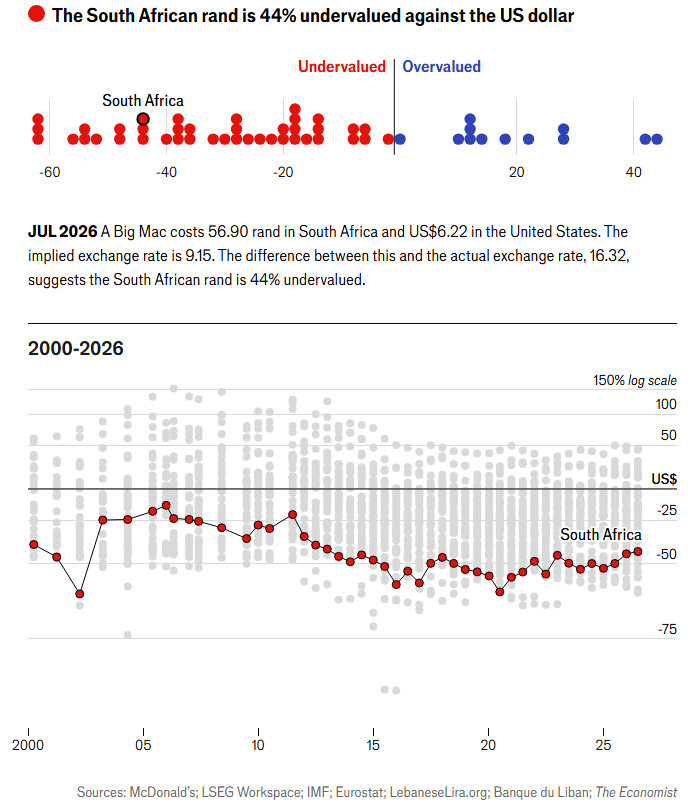
According to the Big Mac Index, the rand should trade at approximately R9.15 to the dollar, without adjusting for each country’s GDP per capita.
This is significantly stronger than the rand’s current value, and indicates that it is roughly 44% undervalued.
This makes the rand the 10th most undervalued currency against the dollar, behind currencies such as the Ukrainian hryvnia and the Hong Kong dollar.
Because the Big Mac would be cheaper to produce in South Africa, The Economist includes an additional measure of purchasing power parity that adjusts for a country’s GDP per capita.
When the South African and US GDP per capita are taken into account, the rand is approximately 30% undervalued.
This would represent a “real” exchange rate of R11.43 per dollar in the adjusted index, instead of the current rate of approximately R16.53 per dollar.
This change would make the rand the 12th-most undervalued currency, as Big Macs have considerably lower manufacturing costs in South Africa.
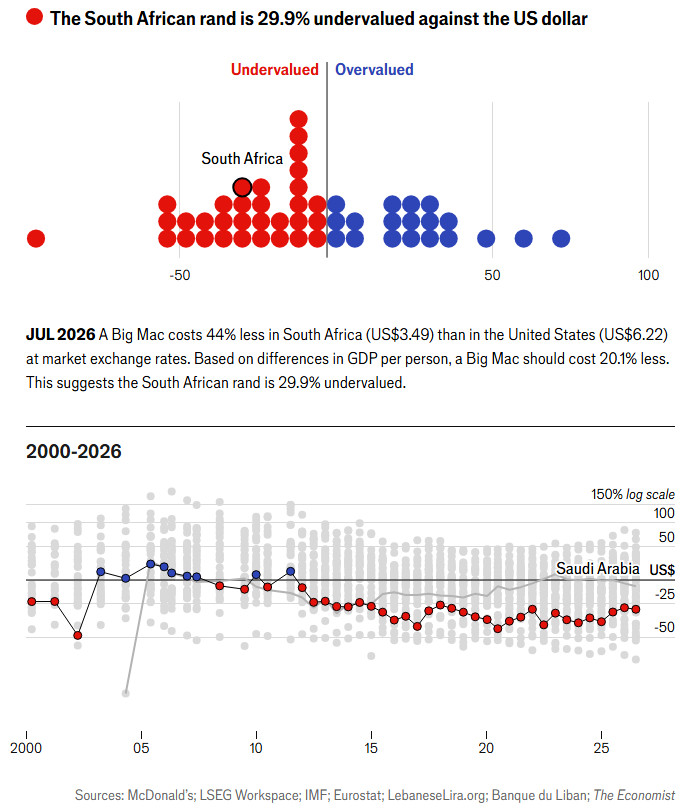
According to the raw index, the Swiss Franc is the most overvalued currency, with the Big Mac index indicating it is approximately 45% overvalued.
When adjusted for inflation, the Uruguayan Peso is the most overvalued currency at 77.4%, considerably higher than the second most overvalued—Colombia.
The most undervalued currency on the raw index is the Indonesian Rupiah, and the New Taiwan Dollar when the index is GDP-adjusted.
While the Big Mac index gives an interesting overview of purchasing power parities, there are several reasons why the disparities could exist.
The value of a currency is largely driven by a country’s economic sentiment regarding its current trajectory.
In South Africa, the rand’s undervaluation can largely be attributed to its stagnant GDP and incredibly high unemployment rate.
Improving South Africa’s economic outlook and implementing measures that boost GDP growth could help the rand move towards its “real” value.

















 Loading ...