

Cape Town sends a warning to residents



The City of Cape Town has warned residents about new scams targeting them and urged them to stay alert.
The scams cover a range of issues from service disconnections to fake jobs and housing opportunities.
“Residents are urged to always pause and verify any request through official City channels,” said the City of Cape Town.
City of Cape Town’s Mayoral Committee Member for Finance, Siseko Mbandezi, said that officials had been alerted about various incidents where residents were contacted, often via WhatsApp, by individuals falsely claiming to represent the City.
He said that scammers have recently been contacting residents, falsely claiming that their municipal accounts are overdue and demanding immediate payment to avoid disconnection of water or electricity services.
Mbandezi said that the scammers also promise job or housing opportunities to residents in exchange for payment, as well as pretending to be responsible for traffic fines payments.
“These are not real, and residents should always take a moment to pause and verify. Remember, if an offer sounds too good to be true, it usually is,” said Mbandezi.
The City of Cape Town urged residents to remember that payments should only be made through official City payment channels.
The City emphasised that it does not use WhatsApp to notify residents of account arrears or service disconnections.
Mbandezi warned residents that no City official is permitted to request payment into a personal bank account, via e-wallet or through other informal payment methods.
“We thank our residents for always being cautious when approached by anyone purporting to be a City official and asking for payment,” said Mbandezi.
He said that residents should pause and verify any messages that claim to be from the City of Cape Town or any of its authorities, as this could help bring an end to this crime.
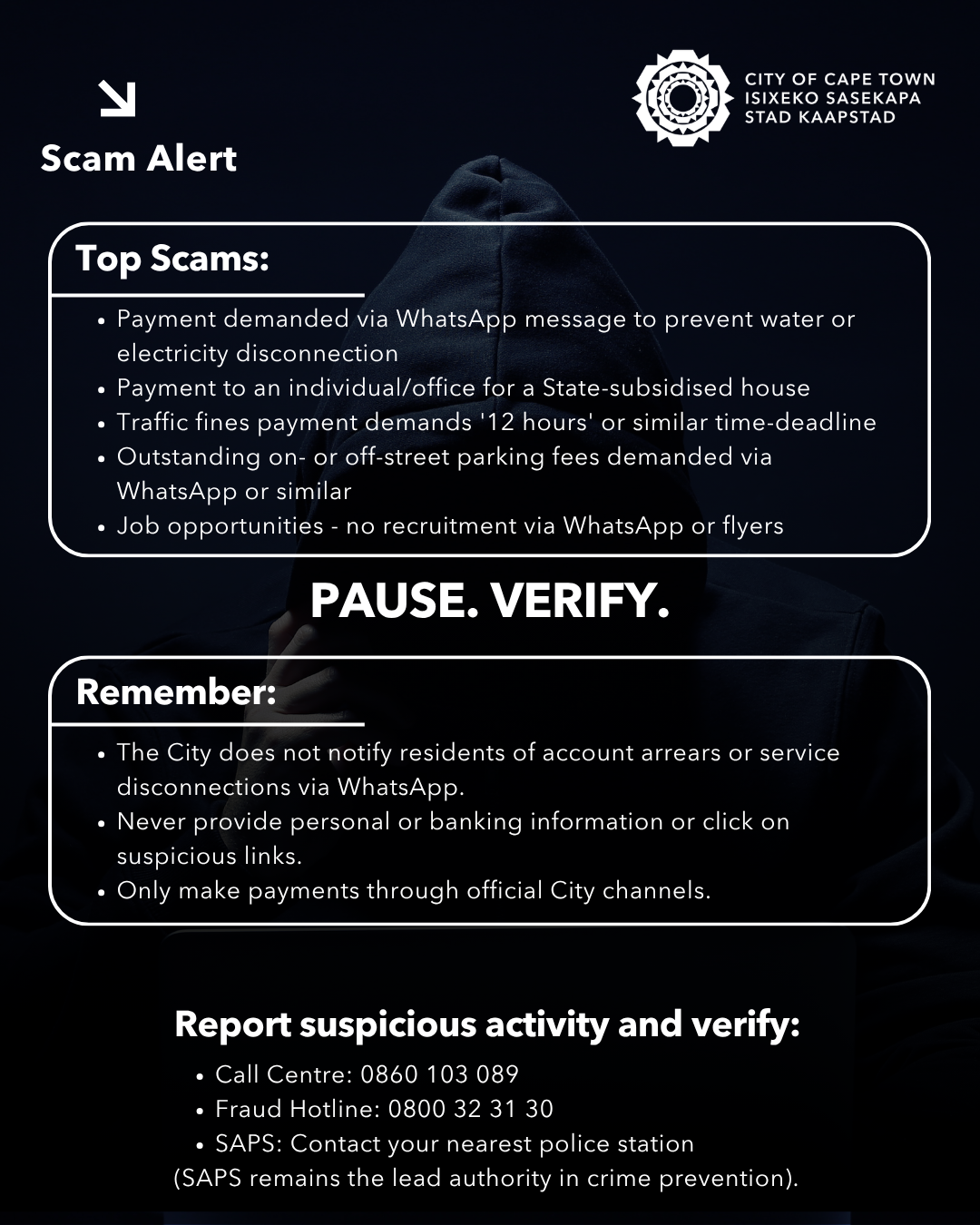
The top five new scams happening in Cape Town

- Any messages regarding payment to prevent water or electricity disconnection are a scam.
The City said it does not notify residents of service disconnections via WhatsApp or social media, and a municipal employee or contractor will never ask residents to pay via e-Wallet, CashSend, or a personal bank account.
- If a resident is alerted to make a payment for a state-subsidised house, it is a scam.
The City warned that it does not request payment from residents to register on the Housing Needs Register or to receive a state-subsidised home.
- Residents are urged to remain vigilant regarding traffic fine alerts, as scammers use this to target residents.
Mbandezi said that the City does not request payment for unpaid traffic violations via SMS, email, or WhatsApp.
The City urged residents to check on cityofctviewfines.co.za and to make payment through paythat.co.za.
- Scammers are sending outstanding on-or-off street parking fee alerts to residents.
Mbandezi said that parking fees should be paid directly to the official parking marshals at the time of parking.
He said in instances where parking has not been paid for, residents are encouraged to log a query to make arrangements.
- Scammers are sending fake job opportunities to residents. Mbandezi reminded residents that the City does not recruit via WhatsApp messages, flyers, or word of mouth.
The City does not charge a fee for job opportunities, which include completing or updating jobseeker forms, interviews, contracts, EPWP and internship opportunities.
“If you receive a message threatening disconnection and demanding immediate payment, contact the City first to verify the claim.”
The City of Cape Town urged residents never to make an urgent payment without first confirming the request is legitimate.


















 Loading ...