

Trillion dollar IPOs and the new Magnificent 10



By Siobhan Simpson, Head of Retail, and Anton du Plooy, Analyst, Ninety One
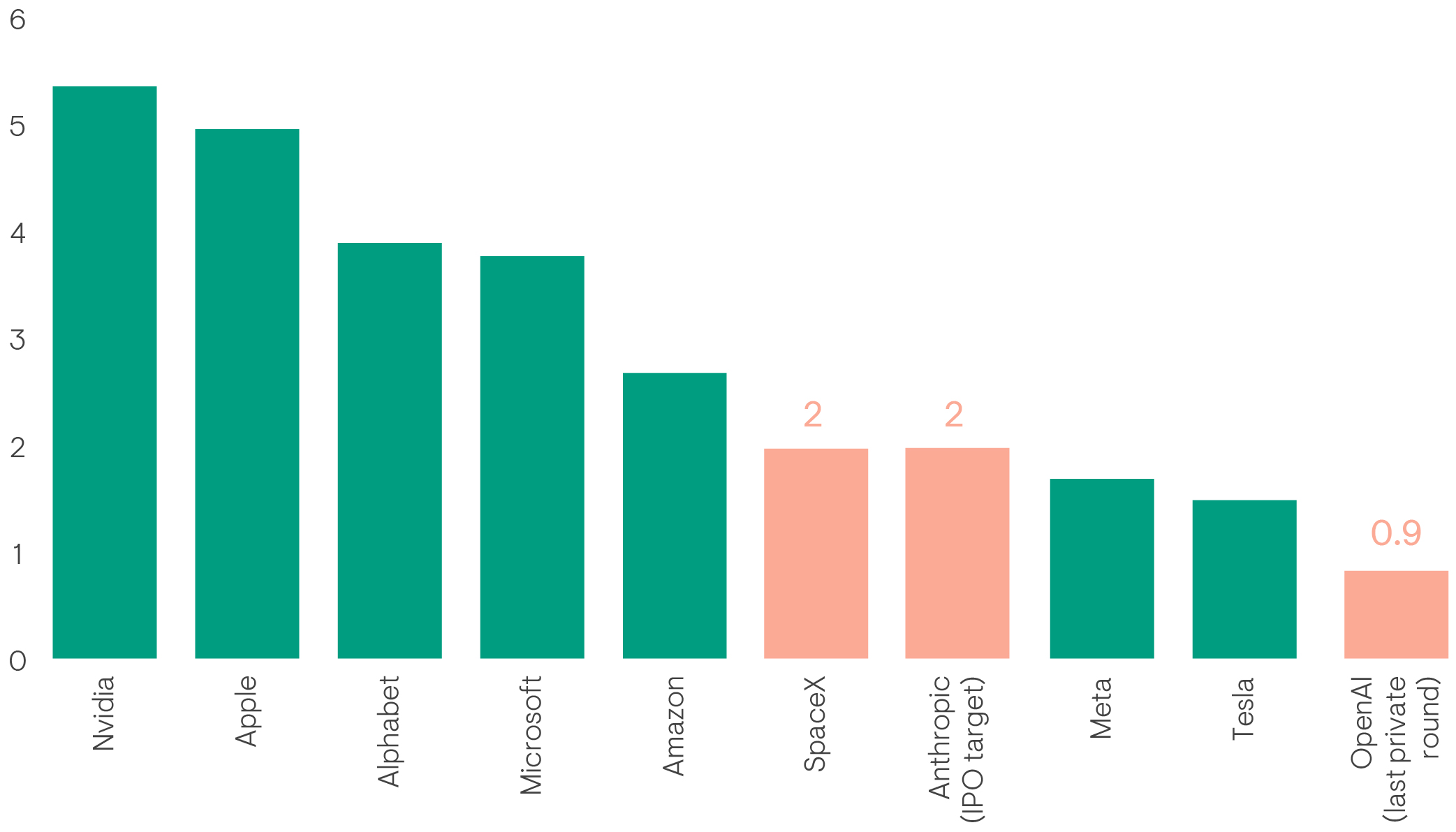
We are in the midst of an IPO cycle unlike anything markets have seen before. SpaceX currently trades at a valuation of around US$2 trillion following its successful IPO in June.
Anthropic is targeting a similar valuation, while OpenAI has confidentially filed documents with the US Securities and Exchange Commission ahead of a potential IPO.
The Magnificent 7 could therefore soon become the Magnificent 10. What this means for investors will depend not only on which companies ultimately succeed, but also on the price investors pay to gain exposure to them.
Figure 1: Mag 10 – Market capitalisation (US$tr)
Source: Bloomberg as at 29 September, 2026.
On 12 June, SpaceX listed at a valuation of US$1.77 trillion, immediately becoming one of the world’s largest listed companies and completing the largest IPO on record.
It may not hold that record for long: Anthropic has disclosed in its recently published IPO prospectus that it is targeting an indicative valuation of US$2 trillion.
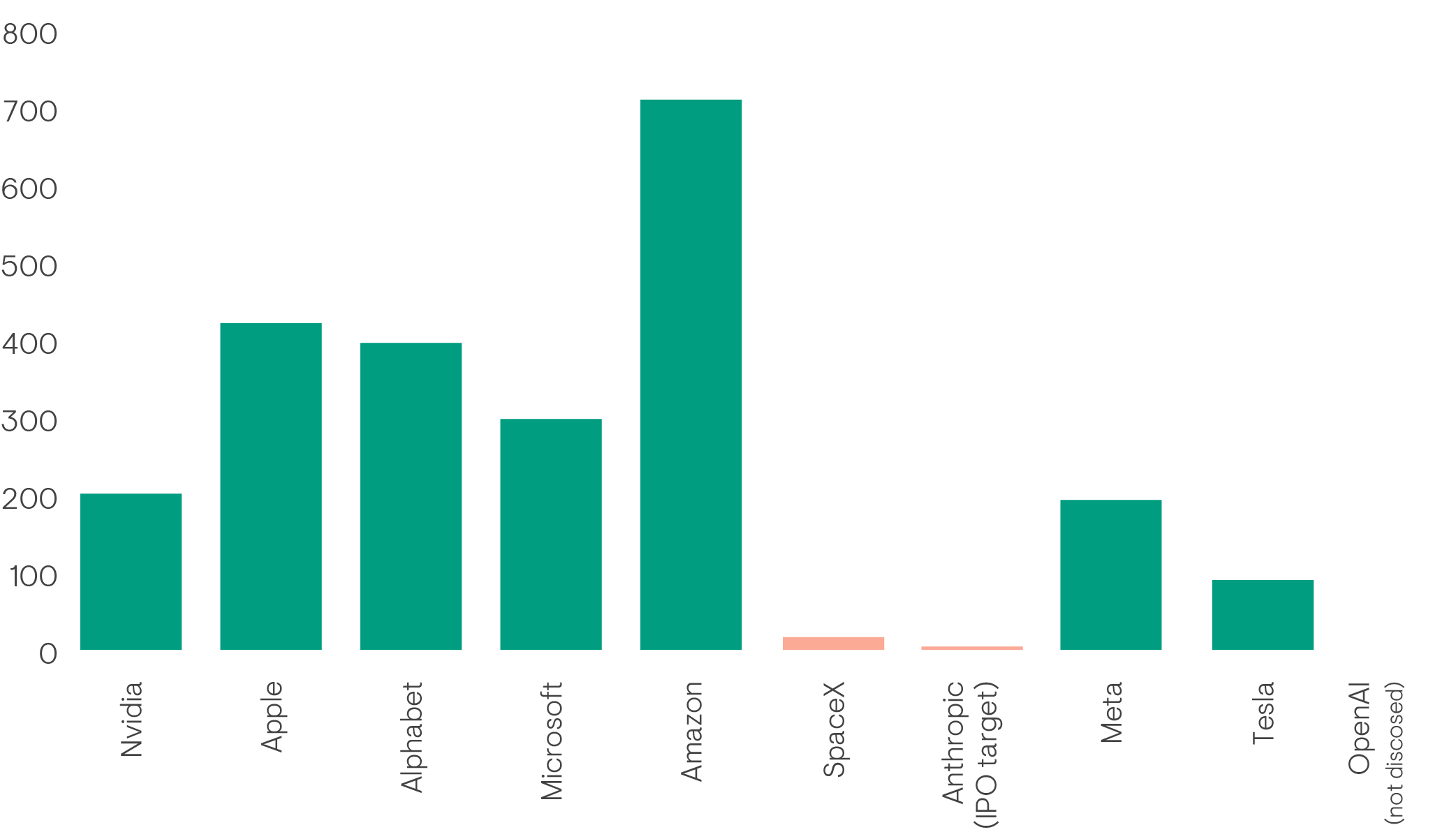
These company valuations are even more striking when compared with the companies’ expected revenues next year. Investors are therefore being asked to take a long-term view of their growth and profit potential.
Figure 2: Mag 10 – CY25 Revenues (US$m)
Source: Bloomberg as at 29 September, 2026.
The curious case of index inclusion
The size of these IPOs is only part of the story. Nasdaq, Russell and MSCI have shortened the period between listing and potential index inclusion. In some cases, newly listed mega-caps can enter major benchmarks within days.
This can leave less time for the market to determine an appropriate price before funds tracking those indices need to buy the shares. Active investors, by contrast, retain the discretion to decide whether the valuation is justified and when to participate.
However, strong IPO debuts do not guarantee strong long-term returns. Jay Ritter, a professor of finance at the University of Florida, has studied IPO performance for four decades.
His research shows that while IPOs delivered an average first-day “pop” of 18.9%, investors buying at the end of Day 1 subsequently trailed the broad US equity market by 20.5% over approximately three years*.
Figure 3: The IPO pop can be a poor guide to long-term returns
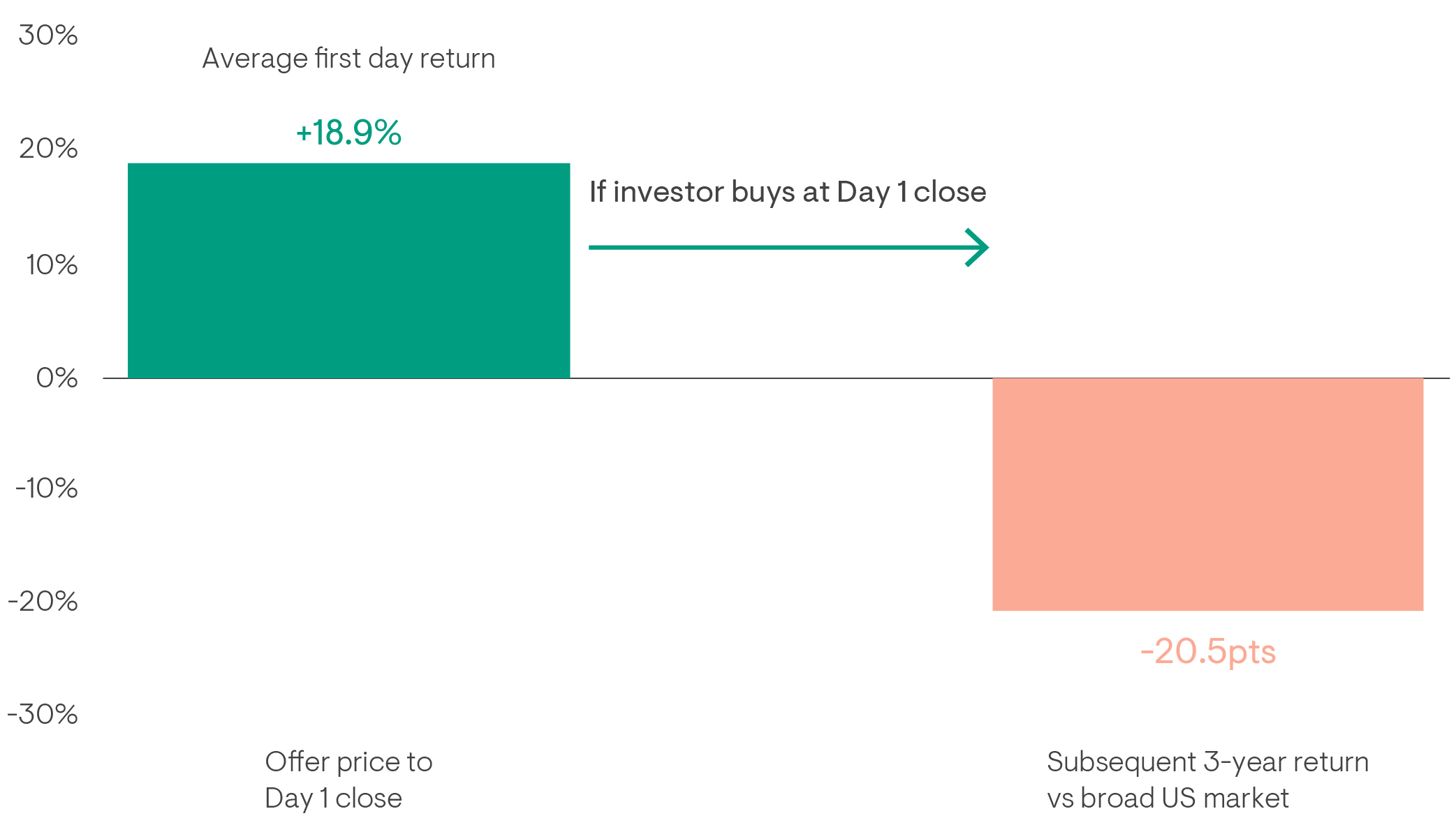
Average first-day return vs median 3-year buy-and-hold return from first close, 9,195 IPOs, 1975–2021. Source: Jay Ritter, University of Florida, 2026.
IPOs can attract strong initial demand and excitement. Over time, however, returns depend on whether the company delivers the revenue growth, profits and cash flow implied by its initial valuation.
The lesson is not that investors should avoid IPOs. It is that they should be selective about which companies they buy, when they invest and how much they pay.
Faster index inclusion means that index-tracking funds may need to buy shares before meaningful price discovery has occurred, irrespective of valuation.
Active investors do not have to follow automatically. They can assess each company’s quality, growth prospects, ability to generate cash and valuation to back likely winners while avoiding businesses whose prospects are overvalued based on the share price.
As the Magnificent 7 becomes the Magnificent 10, that discretion could become more valuable than ever.


















 Loading ...