

3 scenarios for this week’s election – including the worst case for investors in South Africa



South Africa’s nationwide municipal elections on Wednesday hold few fears for investors, if market indicators are anything to go by.
But shifts in broad support for the major political parties could provide a read on the future of the governing coalition that has steered the country’s fiscal and economic reforms.
One-week implied volatility for the rand versus the dollar has declined since the start of October and is well below the one-year average level, suggesting little extra demand to hedge against price swings.
Government bond yields have fallen, and the cost of insuring the country’s debt against default is close to a 16-year low.
While the African National Congress—the country’s biggest political party—controls most municipalities, its support has declined nationally since 2016, when it attracted more than 50% of the vote.
In 2024, it got just 40% in parliamentary elections.
Polls across the board show the ANC losing even more support this time round, and perhaps ceding control of key metros to the main opposition Democratic Alliance.
For markets, however, what matters is where those votes land.
“The key question for investors is not so much the outcome of individual municipal elections, but what the results signal about the future of the Government of National Unity and the direction of national economic policy,” said Rajeev De Mello, a global macro portfolio manager at Gama Asset Management SA.
Investors should prepare for one of three potential scenarios, according to Metodi Tzanov, chief economist at Emergingmarketwatch:
No fear: ANC loses support, but GNU is intact

In this scenario, the ANC loses support nationally, but gains are dispersed among various smaller parties, without any opposition group achieving a major improvement.
That would leave the balance of power in the coalition government intact and the fiscal and reform agenda in place, according to Tzanov.
Investors have little to fear from this scenario, with the rand and government bonds likely to remain supported by positive sentiment about the economy.
“A further weakening of the ANC without a clear beneficiary would probably have a limited impact on the rand and government bonds,” de Mello said.
“More fragmented municipal governments could undermine local service delivery and investment, but unless the results threaten the stability of the national government, the market reaction should be relatively muted.”
Best case: ANC loses support, DA gains the upper hand

If the DA has a strong showing at the expense of the ANC, that would further cement the coalition government, though the balance of power in policymaking could shift toward the opposition parties.
Control of major metros like Cape Town and Johannesburg would also strengthen DA’s hand.
The government’s economic agenda would remain intact or even accelerate, while improving governance of important cities would be positive for investment and the economy.
That would support financial-market assets and the rand, according to Mark Bohlund, a senior credit research analyst at REDD Intelligence.
“This scenario would offer some upside to the equity and bond market and the rand with investors likely less concerned about developments in KwaZulu-Natal and the Eastern Cape,” provinces where populist parties have made inroads, he said.
With investors increasingly focused on institutional reform, fiscal discipline and governance, the DA gaining ground in major metros would be seen as a validation of the “GNU experiment” and evidence that reform-based politics can gain support, said Thierry Larose, an emerging-market debt portfolio manager at Vontobel Asset Management AG.
“A strong DA performance could reduce perceived political risk premiums,” Larose said. “The rand could appreciate” and government bonds “could outperform other EM local markets,” with the sovereign spread also narrowing as credit-rating upgrades become more likely, he said.
Worst case: ANC loses support, throws in with EFF and MK
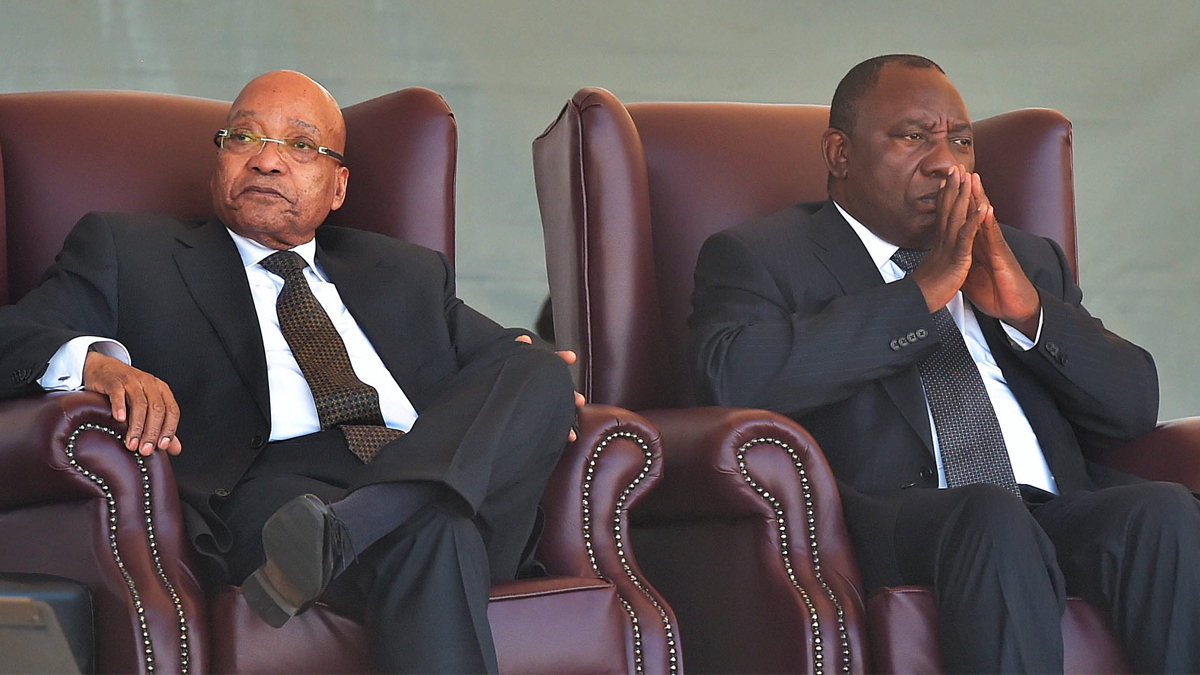
The worst-case scenario for investors is if the ANC’s losses come against gains for the Economic Freedom Fighters and uMkhonto weSizwe Party, both of which oppose the coalition government and free markets, while the DA fails to strengthen its position.
The GNU would become vulnerable to factions within the ANC that disagree with its fiscal policies.
That would be negative for the currency as it would raise doubts about the durability of the coalition government, according to Lee Hardman, a senior forex strategist at MUFG Bank Ltd.
It would also likely weigh on bonds as the prudent fiscal policies that have driven gains over the past two years erode.
President Cyril Ramaphosa will stand down as leader of the ANC in late 2027, with behind-the-scenes jockeying to take over his position already in full flow.
If the ANC loses ground with voters in this week’s elections, and especially if it loses control of metros such as Johannesburg and Tshwane, the capital, it may weaken his ability to steer the selection of his successor toward someone who will continue reforms.
That’s a tail risk investors should be prepared for, according to Adriaan du Toit, the London-based head of emerging-market sovereign research at AllianceBernstein Ltd.
“South Africa’s election risk looks underpriced. Pragmatic outcomes are possible, but there are a few scenarios that would weigh on local assets,” he said.
“The election also starts the clock on a more volatile political backdrop before the ANC’s December 2027 conference.”


















 Loading ...