

R1,900 a month reality check for anyone employing domestic workers in South Africa



The cost of employing a domestic worker in South Africa has increased in 2026, with the national minimum wage (NMW) now standing at R30.23 an hour.
However, the reality is that even workers earning the legal minimum wage are struggling to afford basic necessities.
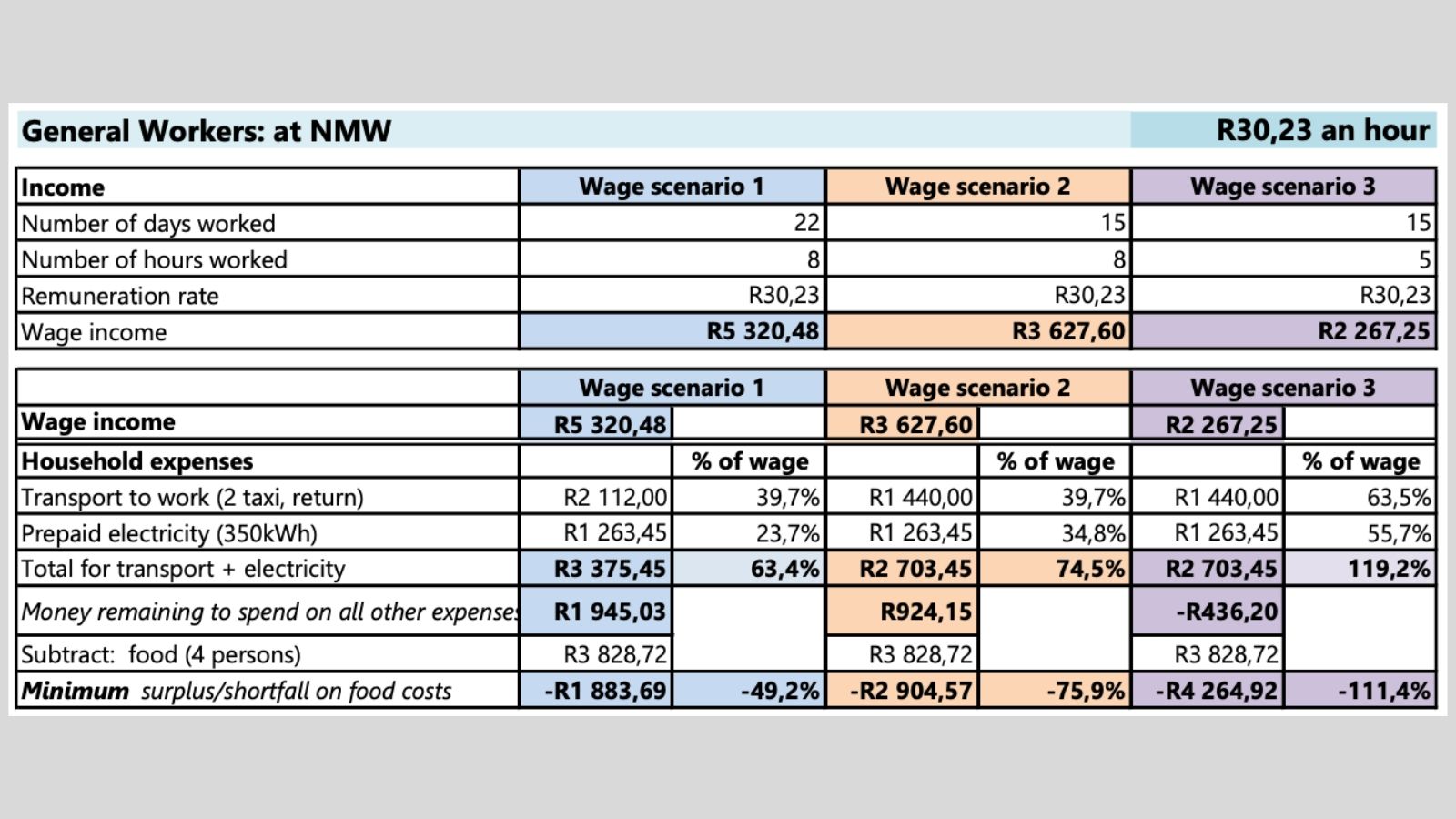
According to the Pietermaritzburg Economic Justice and Dignity (PMBEJD) Household Affordability Index, a worker earning the NMW in October 2026 would still face a monthly food shortfall of almost R1,900 after paying for transport and electricity.
The National Minimum Wage increased by 5% on 1 March 2026, rising from R28.79 to R30.23 an hour. This translates to R241.84 for an eight-hour workday and R5,078.64 for an average 21-day working month.
However, the PMBEJD’s October calculations set the maximum monthly earnings at R5,320.48, based on the maximum number of working days and hours in its scenario.
The organisation assessed whether workers earning the minimum wage could afford essential expenses, which include transport to and from work, prepaid electricity, and a basic nutritional food basket for a family of four.
Using Pietermaritzburg transport and electricity costs, it calculated that a worker would spend R3,375.45 a month on these first two expenses, leaving R1,945.03 for food.
The average cost of a basic nutritional food basket for a family of four across Johannesburg, Durban, Cape Town, Springbok and Pietermaritzburg was R3,828.72 in October.
This leaves a monthly food shortfall of R1,883.69, or 49.2%. Even if the entire remaining salary went towards food, each family member would have just R486.26 a month to eat.
That is 44% below the national food poverty line of R868 per person per month, the minimum amount considered necessary to meet basic daily energy requirements.
The PMBEJD added that the NMW remained inadequate because workers could not afford even basic food costs.
This excludes other expenses such as school fees, debt repayments, education, burial insurance, and household hygiene products.
Domestic workers under severe pressure
The pressure is especially severe for domestic workers, who earn around or below the statutory minimum wage and work part-time across several households.
Data from SweepSouth’s domestic worker surveys show that approximately 39% of domestic workers earn below the legal minimum wage, despite legislation requiring their pay to align with the national minimum wage.
The median monthly income for domestic workers is around R3,635, while basic household essentials can cost more than R4,500. This leaves a monthly deficit of nearly R900.
More than 85% of domestic workers reportedly work part-time, meaning that earning the minimum hourly rate does not necessarily translate into a sufficient monthly income.
SweepSouth CEO Lourandi Kriel said domestic workers were particularly vulnerable because they often feared challenging employers over their pay.
“The domestic worker feels vulnerable. They don’t push for minimum wage because they just want a job. These are the most marginalised women in society,” she said.
“They are not used to standing up for themselves. Often they will just work to put bread on the table.” Employers also tend to reduce domestic work hours when household budgets come under pressure.
“Domestic work is very price-elastic. When there are challenges in an economy like ours, consumers either cut domestic work as a whole or they try to pay less,” SweepSouth’s industry report found.
SweepSouth data also showed that 72% of domestic workers cannot save money, while only 13% have retirement savings. Around one-third are in debt, with a median debt of R3,725.
The PMBEJD said the minimum wage should be judged by whether it allows workers to afford the basic goods and services required for a dignified life, and this is a reality employers should consider.

















 Loading ...