

South Africa is close to having 4 provinces where more people are unemployed than working


South Africa is close to having four provinces where more people are unemployed than working, as the official unemployment rate rises in the country.
According to Statistics South Africa’s (Stats SA) latest Quarterly Labour Force Survey for the third quarter of 2026, two provinces already have more people unemployed than working, with another two provinces toeing the line.
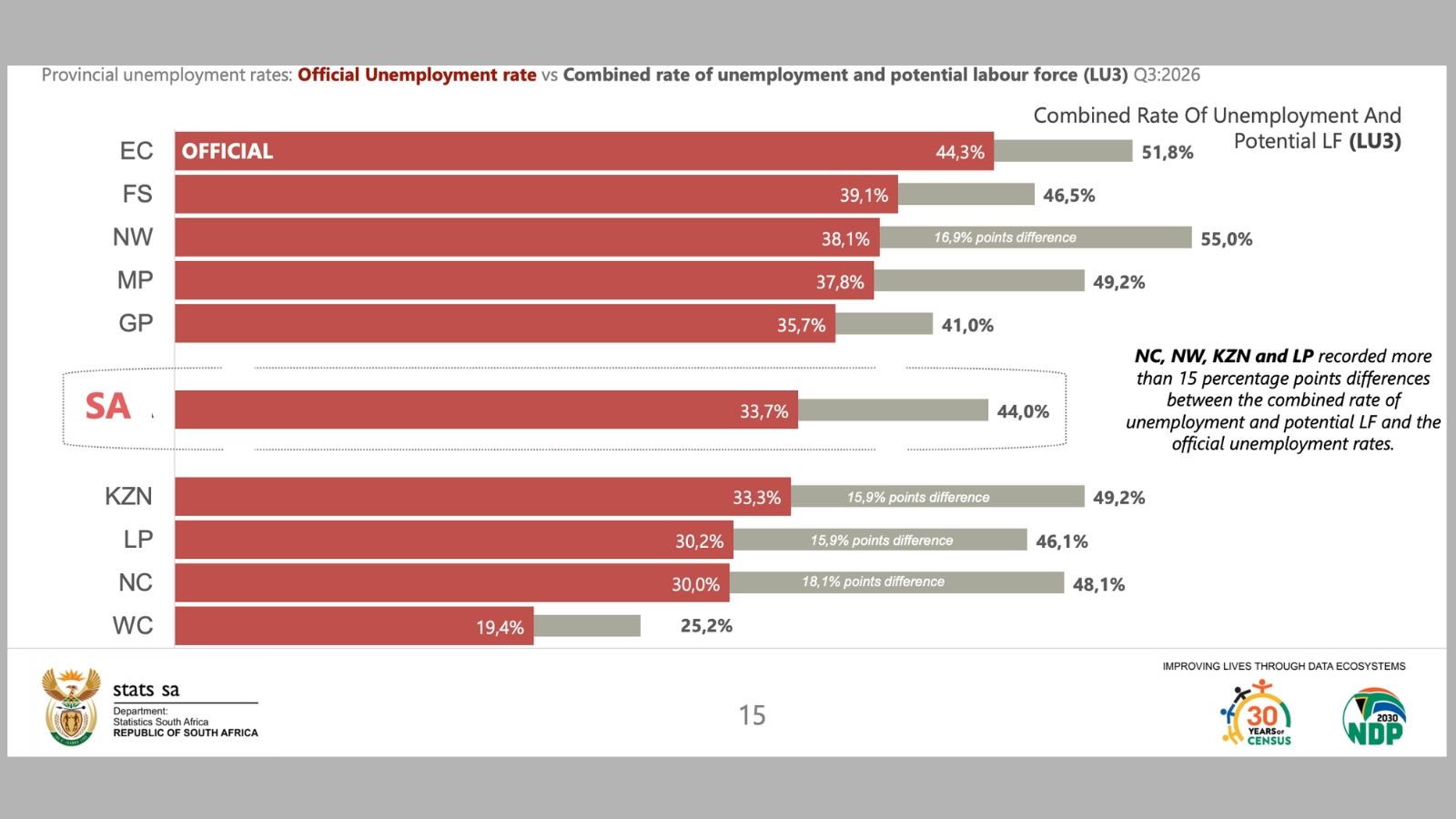
The provinces are North West and the Eastern Cape, where the combined rate of unemployment and potential labour force has climbed above 50%. KwaZulu-Natal and Mpumalanga are both just 0.8 percentage points away from joining them.
South Africa’s official unemployment rate increased slightly from 33.6% in the second quarter to 33.7% in the third quarter. This is 1.8 percentage points higher than the 31.9% recorded during the same period last year.
The number of unemployed people increased by 97,000 over the quarter to 8.6 million, while employment grew by 101,000 to 16.8 million.
However, the country’s labour force expanded by 198,000 to 25.4 million. This means the number of people entering or participating in the labour market outpaced the number of jobs created.
The number of people outside the labour force also decreased by 82,000 to 17 million, which pushed the labour force participation rate up by 0.3 percentage points to 59.9%.
The formal sector added 268,000 jobs, with finance contributing 111,000, manufacturing 33,000 and mining 31,000.
However, these gains were offset by job losses in the informal sector, which shed 98,000 positions. Private households lost another 68,000 jobs, while agriculture recorded a decline of 34,000.
The provincial figures show just how unevenly employment opportunities are distributed across the country.
The Western Cape recorded the highest labour absorption rate, at 55.4%, followed by Gauteng at 44%.
The national rate was 39.7%, meaning these were the only two provinces where employment accounted for a larger share of the working-age population than the national average.
The provinces in trouble
The Eastern Cape recorded the lowest labour absorption rate, at just 29.6%. This means fewer than three in every 10 residents in the province were employed.
North West was also below the national average, with an absorption rate of 32.1%, followed by KwaZulu-Natal at 34.8%.
Stats SA also reports a combined rate of unemployment and potential labour force, known as LU3. This measure includes officially unemployed people and those outside the labour force who could potentially enter it.
The measure replaced the previously reported expanded unemployment rate following changes to international labour statistics standards in the third quarter of 2025.
Nationally, LU3 reached 44% in the third quarter of 2026, representing 13.2 million people. This includes 8.6 million officially unemployed people and another 4.6 million in the potential labour force.
North West recorded the highest combined rate, at 55%, followed by the Eastern Cape at 51.8%. KwaZulu-Natal and Mpumalanga both recorded 49.2%, while the Northern Cape was at 48.1%.
A combined rate above 50% means that the number of unemployed people and those in the potential labour force is higher than the number of employed people.
This means that if KwaZulu-Natal and Mpumalanga experience even relatively small increases in their combined rates, South Africa could have four of its nine provinces where more people are unemployed than working.


















 Loading ...