

2026 election final results vs the polls – and the one thing no one saw coming


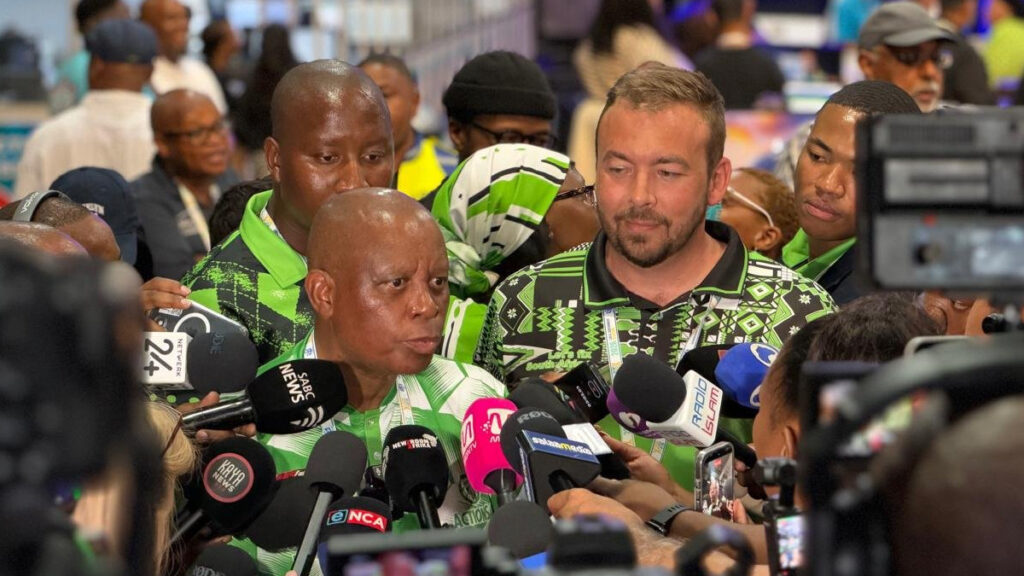
Three prominent and reputable polls leading up to the 2026 Local Government Elections captured sentiment ahead of the vote but completely missed the rise of ActionSA.
Polls in South Africa have become increasingly prominent as the country moves away from one-party dominance toward a much more fragmented political system.
However, they have also faced their fair share of controversy, with many politicians claiming that they are being paid for and used by political opponents to push specific “narratives” ahead of votes.
One of the political parties that has been very outspoken against the current state of polling is ActionSA, which has even gone so far as to propose laws to clamp down on polling.
Through the “Election Integrity Bill”, the party sought to establish a polling ombudsman and prohibit the publication of any political opinion polls related to an election within 7 days prior to voting day.
When it introduced the bill in 2025, the party alleged that polls have increasingly been used by “unscrupulous political actors and potential foreign interests” as tools of manipulation.
While the party doesn’t want polling scrapped, it does want them to be regulated and for laws to be established to govern the conduct, publication, and dissemination of political opinion polling during or before election periods.
With the 2026 election results now finalised, ActionSA’s position isn’t surprising.
In polls run by three reputable research companies ahead of the 2026 vote, none predicted ActionSA would be as popular as it ended up being.
These firms include global research group Ipsos, the Social Research Foundation (SRF)/The Common Sense and MarkData/ENCA.
None of the polls counted ActionSA among the top 5 nationally, and in the most hotly contested metros—Johannesburg and Tshwane—the deviations were through the roof.
Pollsters and researchers stress that polls are not predictions and only capture voter sentiment at any given point in time.
Nevertheless, they are frequently used by political parties in their messaging to the electorate.
In assessing how accurately the polls gauged this sentiment ahead of the elections, BusinessTech compared the final poll results with the election outcome and tracked percentage-point deviations.
A deviation of 0 would represent a spot-on call. The larger the deviation, the further away the poll was from the final result.
South Africa
| Party | Election Result | SRF Poll | Deviation | Ipsos Poll | Deviation |
|---|---|---|---|---|---|
| ANC | 30.8% | 32.0% | 1.2 | 30.0% | 0.8 |
| DA | 24.6% | 28.0% | 1.4 | 28.0% | 3.4 |
| MK Party | 9.8% | 12.0% | 2.2 | 12.0% | 2.2 |
| EFF | 6.2% | 8.0% | 1.8 | 10.0% | 3.8 |
| Total Deviation | vs 0.0 | SRF | 6.6 | Ipsos | 10.2 |
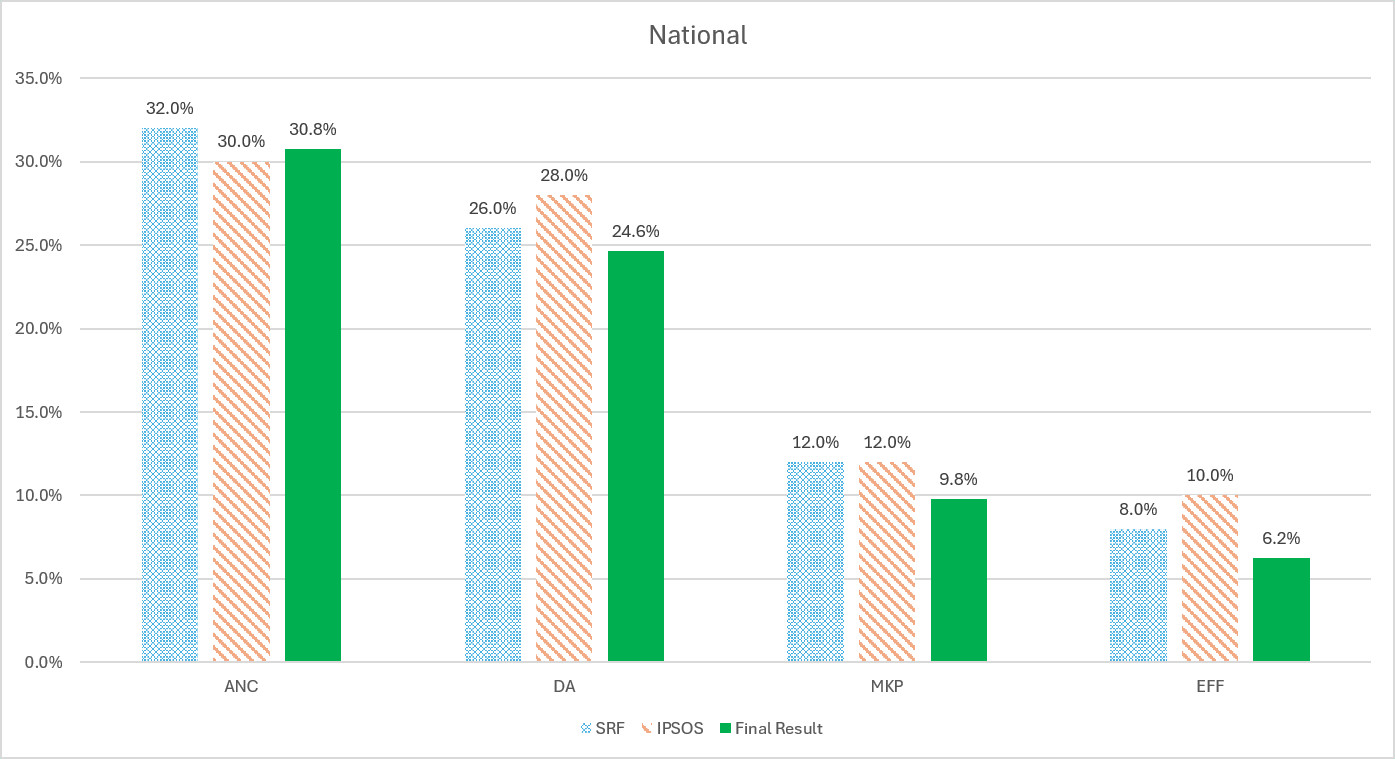
The national picture presented by the two polls that ran a national survey was quite close to the outcome, reflecting the same degree of accuracy that was present in the 2024 National Election.
The SRF was again closest to the outcome, with an overall deviation of 6.6 points, and matching the final results by around 2 percentage points.
Its closest result was for the ANC, where it polled the party at 32%, versus the 30.8% outcome—a 1.2-point deviation.
However, it overestimated the MK Party’s influence, polling at 12% nationally, versus the 9.8% outcome.
The Ipsos poll was also fairly close, with a 10.2-point deviation, nearly matching the ANC’s result (polling at 30%).
However, the poll did not capture the EFF’s decline, polling the party at 10% when it ultimately received only 6.2% of the vote.
Johannesburg
| Party | Election Result | SRF Poll | Deviation | Ipsos Poll | Deviation | MarkData Poll | Deviation |
|---|---|---|---|---|---|---|---|
| DA | 34.8% | 36.0% | 1.2 | 30.0% | 4.8 | 35.0% | 0.2 |
| ANC | 20.3% | 22.0% | 1.7 | 27.0% | 6.7 | 21.8% | 1.5 |
| ActionSA | 16.3% | 9.0% | 7.3 | 11.0% | 5.3 | 10.3% | 6.0 |
| EFF | 6.5% | 6.0% | 0.5 | 12.0% | 5.5 | 11.9% | 5.4 |
| MKP | 5.6% | 11.0% | 5.4 | 5.0% | 0.6 | 12.5% | 6.9 |
| VF+ | 1.8% | 3.0% | 1.2 | 3.0% | 1.2 | 0.9% | 0.9 |
| PA | 2.0% | 2.0% | 0.0 | 1.0% | 1.0 | 3.7% | 1.7 |
| Total Deviation | vs 0.0 | SRF | 17.3 | Ipsos | 25.1 | MarkData | 22.6 |
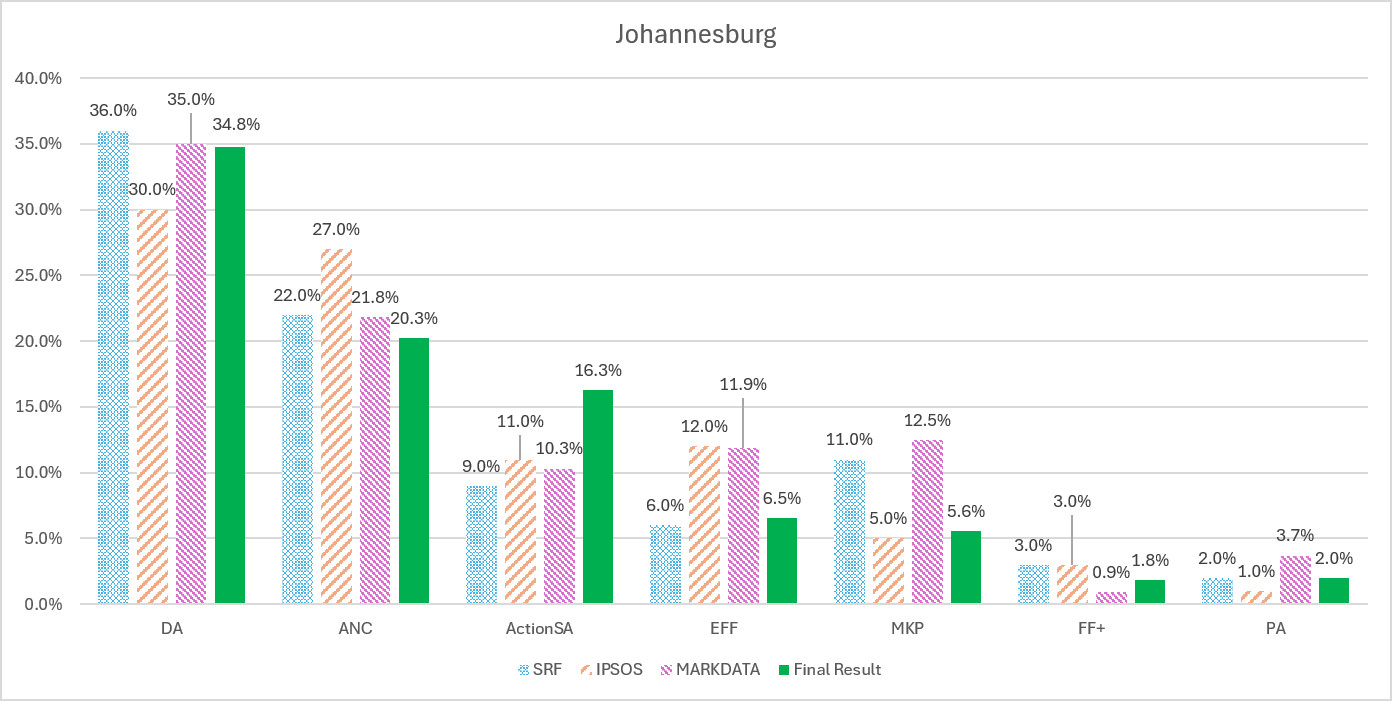
The City of Joburg was an incredibly tough call, with none of the polls really capturing the shifts happening in the metro.
The SRF was closest, with a 17.3-point deviation. It came close to polling the ANC, DA, EFF and FF+, and hit the PA’s result spot-on.
However, a significant underestimation of the ActionSA—a 7.3-point deviation—skewed the results. This was coupled with a sizeable overestimation of the MK Party.
Neither Ipsos nor MarkData fared any better, with ActionSA being underestimated in each.
Tshwane
| Party | Election Result | SRF Poll | Deviation | Ipsos Poll | Deviation | MarkData Poll | Deviation |
|---|---|---|---|---|---|---|---|
| DA | 34.4% | 32.0% | 2.4 | 34.0% | 0.4 | 33.9% | 0.5 |
| ANC | 20.2% | 26.0% | 5.8 | 31.0% | 10.8 | 24.9% | 4.7 |
| ActionSA | 22.1% | 12.0% | 10.1 | 8.0% | 14.1 | 10.7% | 11.4 |
| EFF | 5.8% | 8.0% | 2.2 | 8.0% | 2.2 | 12.3% | 6.5 |
| VF+ | 7.6% | 7.0% | 0.6 | 5.0% | 2.6 | 7.9% | 0.3 |
| MKP | 2.0% | 4.0% | 2.0 | 2.0% | 0.0 | 5.2% | 3.2 |
| Total Deviation | vs 0.0 | SRF | 23.1 | Ipsos | 30.1 | MarkData | 26.6 |
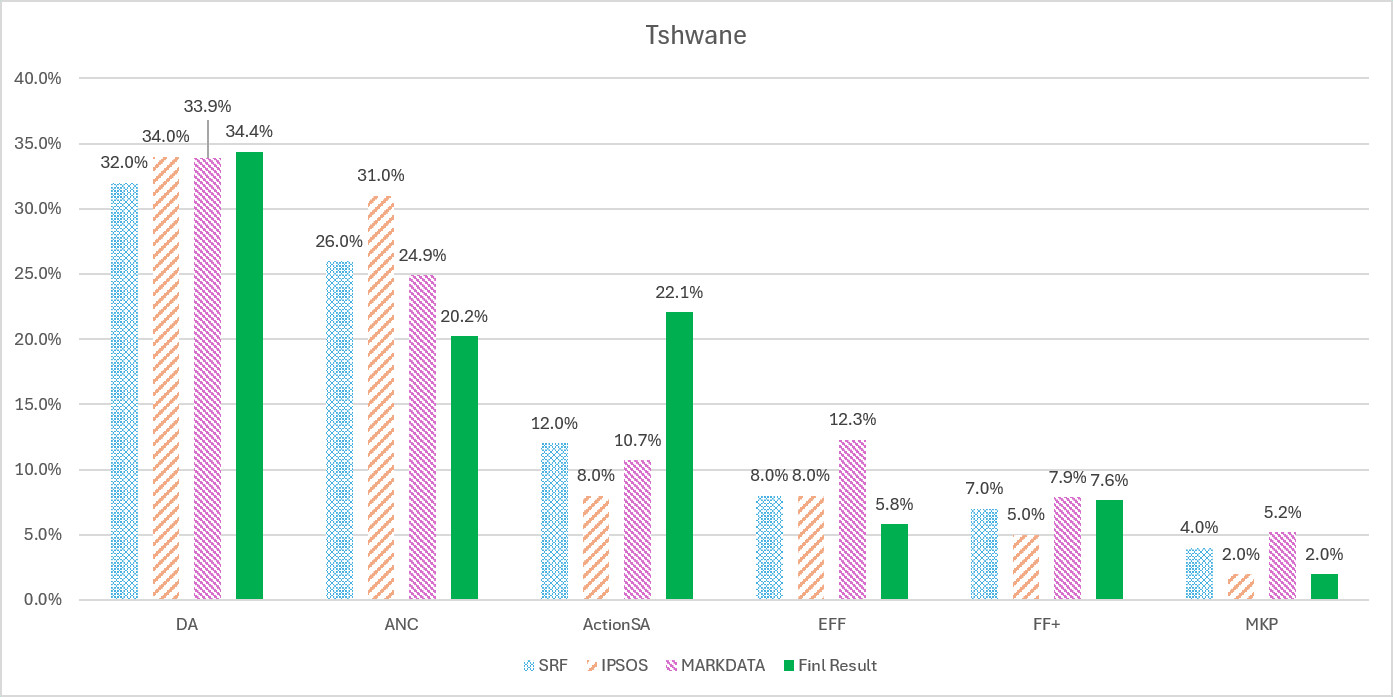
The City of Tshwane was another example of ActionSA being underestimated.
While the SRF poll was again the most accurate, a 23.1-point deviation shows just how far off the sentiment check was.
None of the polls saw ActionSA’s rise in the city, with the lowest deviation being the SRF’s 10.1, where the survey polled ActionSA at 12%, versus the 22.1% result it achieved.
Ipsos counted ActionSA at 8% and MarkData at 10.7%. Because of these big misses, poll results for the ANC and EFF were also out.
Notably, the calls for the DA were fairly close, indicating a broader shift away from the ANC and EFF toward ActionSA, rather than the party eating into the DA’s support.
eThekwini
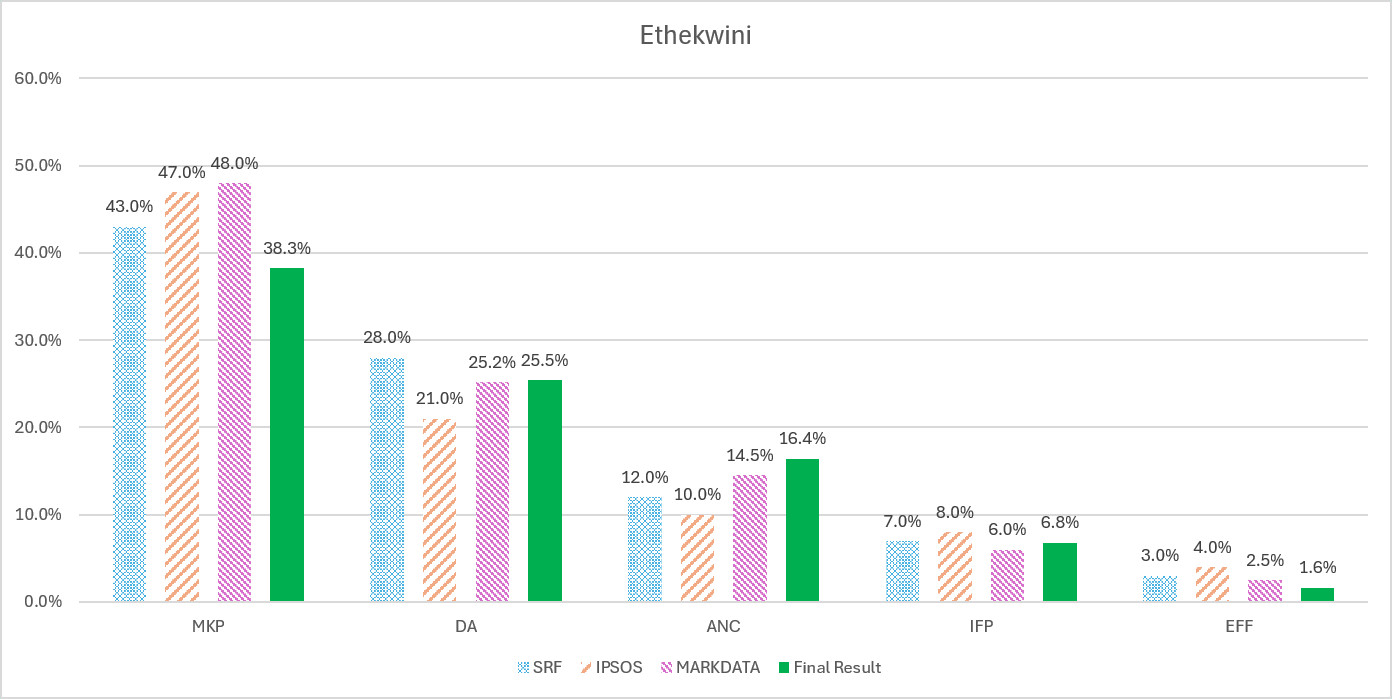
| Party | Election Result | SRF Poll | Deviation | Ipsos Poll | Deviation | MarkData Poll | Deviation |
|---|---|---|---|---|---|---|---|
| MKP | 38.3% | 43.0% | 4.7 | 47.0% | 8.7 | 48.0% | 9.7 |
| DA | 25.5% | 28.0% | 2.5 | 21.0% | 4.5 | 25.2% | 0.3 |
| ANC | 16.4% | 12.0% | 4.4 | 10.0% | 6.4 | 14.5% | 1.9 |
| IFP | 6.8% | 7.0% | 0.2 | 8.0% | 1.2 | 6.0% | 0.8 |
| EFF | 1.6% | 3.0% | 1.4 | 4.0% | 2.4 | 2.5% | 0.9 |
| Total Deviation | vs 0.0 | SRF | 13.2 | Ipsos | 23.2 | MarkData | 13.6 |
The non-Gauteng city that everyone had eyes on was eThekwini, with the rise of the MK Party predicted.
Contrary to the situation with ActionSA, however, the high deviations in the city were due to overestimation of MK’s influence.
While the party still trounced the ANC with a 38.2% result, this was far from the 43%-48% it was polled at.
Ultimately, the SRF poll was again the closest, with a 13.2-point deviation overall vs the polls, but the MarkData survey was close behind with a 13.6-point gap.
Who ran the polls
| Poller | Who | Sample | 2024 National Election accuracy |
|---|---|---|---|
| Ipsos | Ipsos is one of the largest market research and polling companies globally and has been conducting various polls since 1975. It is a publicly traded multinational market research company. | Interviews with 3,600 randomly selected South African adults, conducted between 12 September and 13 October 2026. Registered voters. Those who indicated they would not vote were excluded. | 12.0 point deviation |
| SRF/Common Sense | The SRF is a South African think tank established in 2021 to promote democracy and sound public policy, chaired and led by political and economic analyst Dr Frans Cronje. Cronje is editor and co-director of The Common Sense, a media company. It is privately funded. | Market surveys conducted by SRF/TCS, carried out by Victory Research. The survey was conducted from 18 September to 12 October 2026 among 3,100 respondents. The sample was weighted to reflect the demographic characteristics of the registered voter population. | 7.0 point deviation |
| MarkData/ENCA | MarkData is an independent marketing, insights and consulting firm. It originated as the survey and opinion research centre of the Human Sciences Research Council in 1981 and was re-established as a private company in 1996. ENCA is a 24-hour broadcaster owned by eMedia Holdings. | A MarkData survey of 6,113 voters across six major metros—approximately 1,000 people per metro. Interviews were conducted from 10 August to 14 September 2026. | 10.6 point deviation |













 Loading ...