

People earning over R420,000 a year are in trouble in South Africa



New data shows that people taking home more than R35,000 and R50,000 a month spend almost all their income on debt repayments.
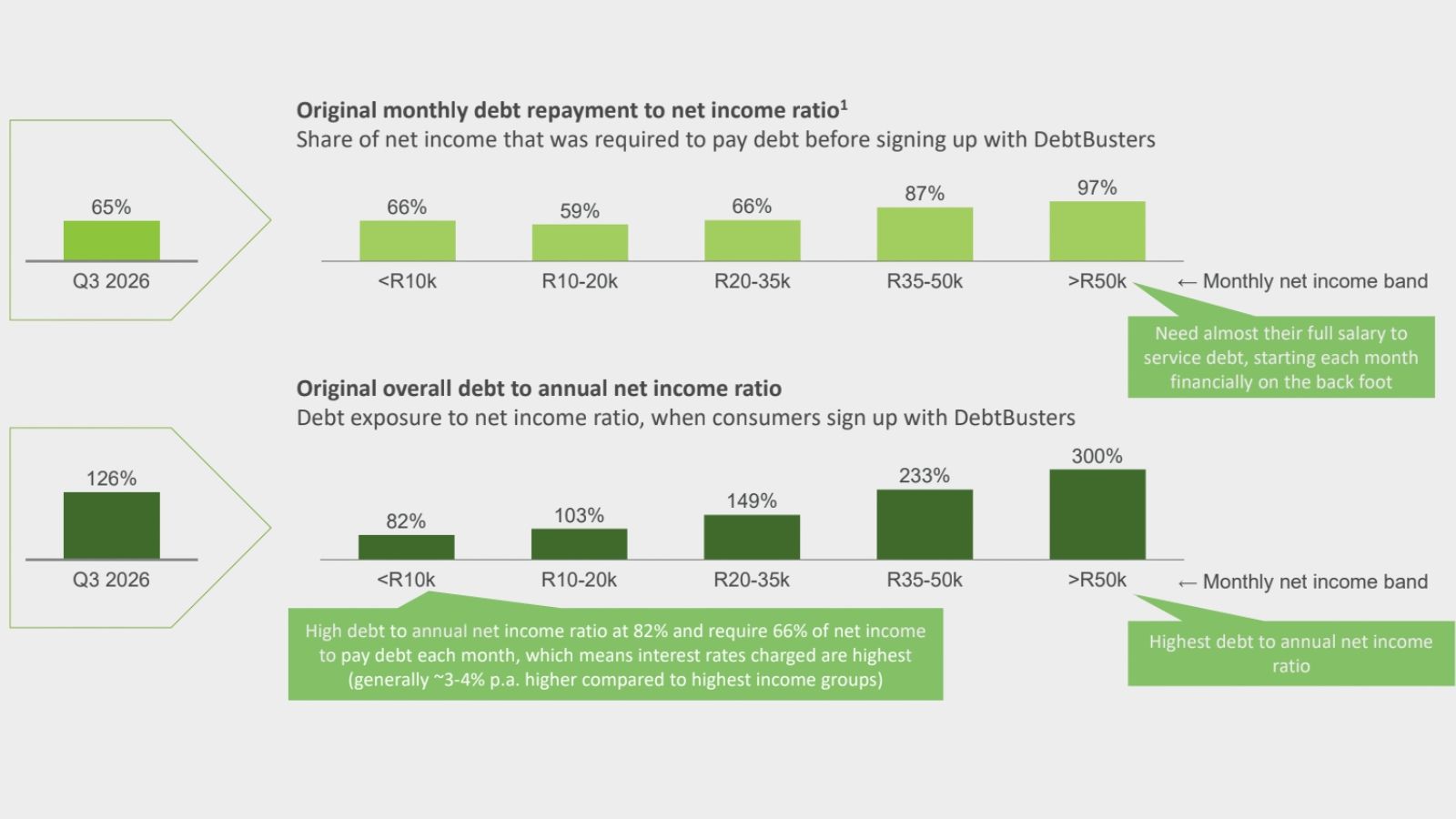
According to DebtBusters’ Q3 2026 Debt Index, consumers in this income bracket need 97% of their take-home pay to service debt, while their total debt is equivalent to three times their annual net income.
The findings highlight the extent of financial pressure faced by South Africans across income groups, including those earning more than R420,000 a year.
The Debt Index, which has tracked consumer borrowing behaviour for more than a decade, is based on information supplied by people applying for debt counselling.
In the third quarter of 2026, consumers seeking debt counselling needed an average of 65% of their take-home pay to service their debt.
Although this is an improvement over the 73% peak recorded in the first quarter of 2021, it remains a significant financial burden.
For those earning more than R50,000 a month, the situation is considerably worse. Their debt-to-income ratio is 300%, the highest among any income group, despite having fallen from a peak of 340% in the third quarter of 2024.
According to Benay Sager, executive head of DebtBusters, the data points to growing financial pressure among consumers who might otherwise be considered relatively comfortable earners.
The pressure is also reflected in the type of credit South Africans are using. Banks accounted for 65% of the debt held by new debt counselling applicants in the third quarter, the lowest proportion recorded by DebtBusters.
This is down from a peak of 75% in the third quarter of 2023. However, non-bank lenders, including retailers, microlenders, unsecured lenders, and online lending platforms, accounted for 15% of applicants’ debt.
This is almost double the 8% recorded in the third quarter of 2024 and the highest proportion since the Debt Index began.
Groceries, electricity, and petrol price increases are hitting hard
Sager said the shift suggested that consumers are increasingly turning to alternative lenders when they cannot access traditional bank credit or need money quickly.
A record 64% of new debt counselling applicants had a one-month payday loan, compared with 57% a year earlier. Furthermore, 96% had a personal loan.
The average number of credit agreements per applicant has also reached 8.8, its highest level since the index began.
“At 8.8, the average number of credit agreements per applicant is at its highest since the Debt Index began. This indicates the extent of financial pressure consumers are experiencing,” Sager said.
The middle-income brackets, particularly those earning between R10,000 and R50,000 a month, have experienced almost no growth in take-home pay.
At the same time, several essential expenses have increased at a rate significantly faster than inflation. Petrol prices have risen by 46% since 2021, while electricity tariffs have increased by 101%.
For people taking home between R10,000 and R20,000 a month, groceries account for 38% of their disposable income. Among those earning less than R10,000, this rises to 50%.
The situation has also been affected by rising borrowing costs. Following interest rate cuts in 2024 and 2025, the South African Reserve Bank’s repo rate has since risen to 7.25%.
DebtBusters said the average annual interest rate on unsecured debt among incoming applicants has reached 19.85%, compared with 14.1% for vehicle finance and 10.6% for home loans.
Financial pressure is also becoming more widespread across age groups. Under-25s now account for 9% of new debt counselling applicants, three times their proportion in 2024. People aged 45 and older account for 29%, compared with 22% in 2016.


















 Loading ...