

House prices vs inflation in South Africa right now


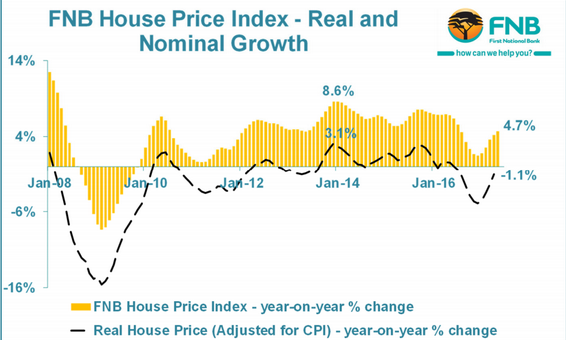
Data by FNB in its latest House Price Index shows that South Africa’s property market remains mediocre at 4.7% year-on-year, while adjusting for CPI inflation implies a negative growth rate in real terms.
On a month-on-month basis, the index recorded a return to slowing growth in April and May, after a strengthening period in the first quarter, suggesting another possible housing market and economic “soft” patch emerging, the bank said.
In real terms, when adjusting for CPI (Consumer Price Index) inflation, the rate of house price growth was negative to the tune of -1.1% year-on-year in April, after a revised -2.4% in March.
FNB said that the average price of homes transacted in May was R1,112,466.
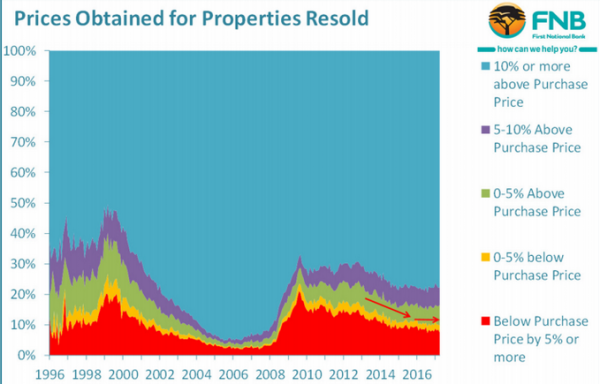
FNB said that in recent times, the incidence of re-sales price deflation has been moderate by historic standards, and has shown no meaningful sign of an increase.
Over the last decade-and-a-half, August 2009 was the month where the highest estimated percentage of total properties were being resold at below their previous purchase price since a previous high early in1999, i.e. 23.4% of all property sales registered in that month.
“The country had just lived through a recession, and interest rates had peaked in mid-2008, and this was the lagged impact of those economic events on the housing market. It was a period of widespread financial stress amongst households, and many had previously bought homes at astronomical highs around 2006/7 at the back end of the property bubble,” said household and property sector strategist at FNB, John Loos.
By comparison, in April 2017 this percentage was a far lower 9.8% of total home sales being below previous purchase price. 7.5% of re-sales were more than 5% below, while 2.2% of sales were 0 to 5% below previous purchase price.
These most recent estimates represent no noticeable increase from lowly levels of 2016, with only the August 2016 estimate of 9.4% being lower than the April 2017 estimate in the past 8-and-a-half years, the analyst said.
The FNB forecast is for real economic growth to be only marginally better at 0.7% in 2017, compared to 0.3% in 2016.
“We don’t expect this to have a material positive impact on the housing market despite apparent mild first quarter improvement. And the recent slowing in month-on-month house price growth accompanied by a PMI dip convinces us to maintain our lowly 3% average house price growth forecast for 2017 as a whole,” Loos said.
Read: Massive increase in the number of Joburgers moving to Cape Town


















 Loading ...