

Why South Africa’s troubles lie beyond the ANC’s December conference


While South Africa’s economy will feel the knock-on effects of the imminent ANC elective conference, even more rests on the back of February’s Budget Speech, where the country’s financial future will be laid bare.
The ANC is due to pick a successor to president Jacob Zuma in its conference that begins on Saturday and finishes on December 20.
According to the latest analysis by the Institute of International Finance (IIF), in the short-term, who the ANC elects as its leader – either deputy president Cyril Ramaphosa, or Nkosazana Dlamini-Zuma – will play a big role in setting up the scene for 2018, but ultimately, either leader will have to face the same challenges.
In fact, the group said, despite media portrayals that Ramaphosa is the ‘market friendly’ option, and Dlamini-Zuma is more rooted in populism, the political reality is that neither candidate can be so narrowly defined, and both would still be bound by ANC policies.
“There is unlikely to be such a stark contrast between the two candidates – talk of land seizures and bank nationalization is political rhetoric, not ANC policy,” the group said.
Regardless of who emerges victorious in December, there will be some sort of sense of stability returning to the market, as the political uncertainty begins to fade. However, the country will continue to be hampered by high unemployment; low growth; the threat of further downgrades, troubled SOEs; rising government spending – all of which cannot be wished away by whoever is left standing.
“The actions taken to address the economic malaise, boost growth and tackle fiscal fragilities and governance issues will be more important for medium-term prospects,” the IIF said.
And looking at the medium-term, things remain hazy for the country, it said.
“(Since the Mid-term Budget Policy Statement), South Africa’s fiscal consolidation challenge has increased as the Treasury must now contend with a call from the Presidency for free tertiary education, estimated to cost around R50 billion per year, equivalent to just over 1% of GDP.
“Even if a watered-down version is implemented, savings will have to be found elsewhere and taxes will likely have to be raised if the government is to present a budget in February that stabilizes the debt-to-GDP ratio over the medium term.
“Furthermore, there can be no slippage on the wage bill and the introduction of universal health coverage may well have to be postponed. These challenges suggest that uncertainty will persist beyond the upcoming ANC leadership election, with the major risk event in 2018 likely to be the reaction to next year’s budget,” the IIF said.
The IIF published several graphs showing South Africa’s current state of affairs, with a number of projections for 2018 and beyond.
Economic Growth
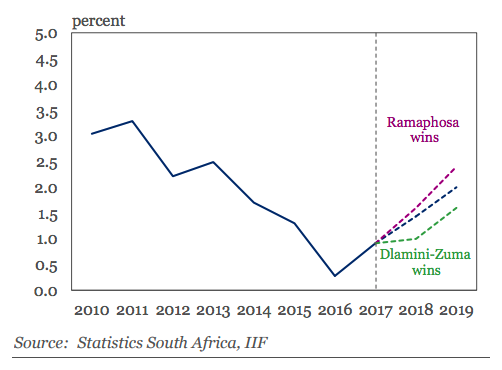
After the ANC conference, the overall growth picture looks more positive. With Ramaphosa at the helm, growth could hit 1.6% in 2018, at a steeper upward trend, while under Dlamini-Zuma, the recovery is expected to be slower at 1.0% in 2018, but also up over time.
A Reuters poll found on Monday that the local economy needs political support to maintain upward momentum into next year. Medians in the poll of 26 economists, surveyed by Reuters last week, suggested the economy will grow 1.2% next year after expanding 0.9% in 2017.
Only one economist forecast 2% growth next year, the most bullish expectation, while the most bearish was 0.9%.
Real GDP Growth
Inflation
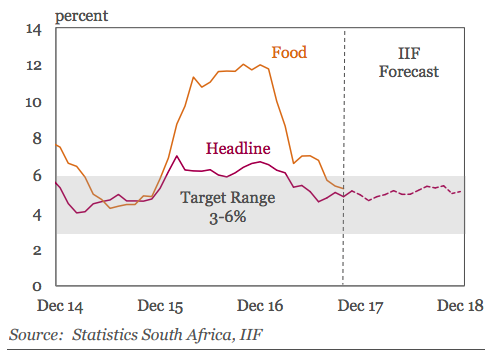
Following the recovery of the agricultural sector, the inflation rate is expected to stay well within range (3%-6%) in the coming year.
Inflation
Repo Rate
The IIF expects the SARB to remain hawkish regarding rates, with the possibility of hikes if Moody’s downgrades the country to full junk status. Considering the fundamentals, the risk of a downgrade in the next three months remains high, the group said. If South Africa avoids a downgrade, it could well leave room for more cuts.
Repo Rate

Government Debt
With the MTBPS highlighting the country’s financial woes – and offering no plan to curb spending – government debt is just expected to climb in the coming years.
Government Debt


















 Loading ...