

Shopping malls in South Africa have a big problem


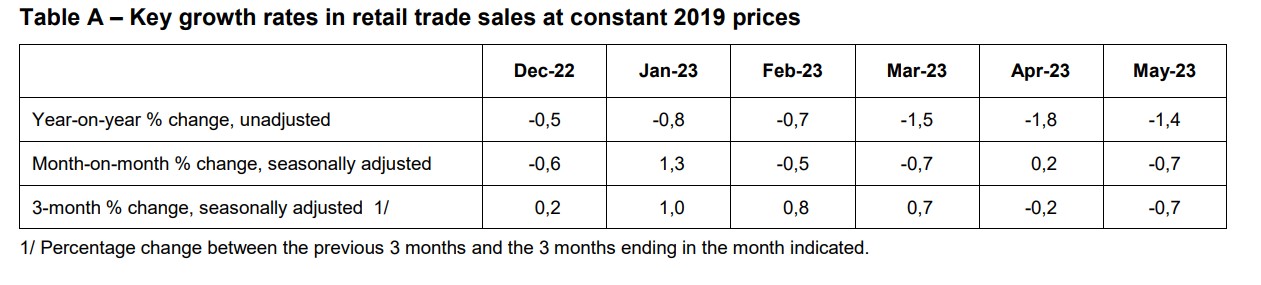
South Africa’s retail sector faces significant headwinds, with Stats SA’s retail trade sales for May showing a sixth consecutive month of year-on-year decline.
In May, retail trade sales dropped by 1.4% year-on-year, following a 1.8% year-on-year decline in April.
Retail trade sales also saw a 0.7% month-on-month decline from April to May.
Seasonally adjusted retail trade sales also declined by 0.7% in the three months that ended May 2023 compared to the prior three months.
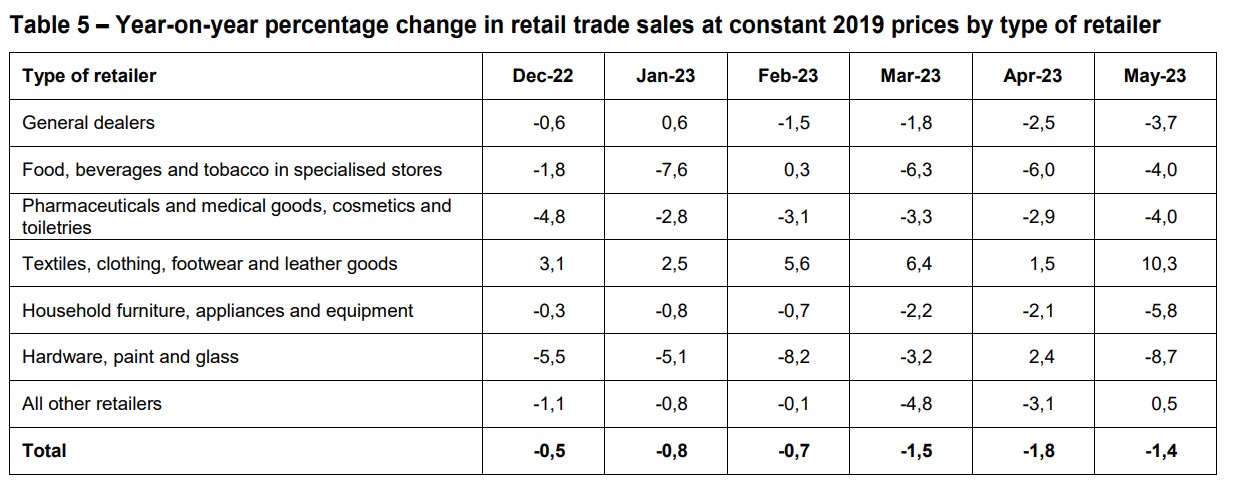
The pressure on sales was seen across most of the major retail categories, except for ‘Clothing and Footwear Retail’, which saw 10.3% growth year-on-year.
John Loos, the property strategist at FNB Commerical Property, noted that even the less cyclical ‘General Dealers’ category saw a decline of 3.7%, which he attributed to rising interest rates, food price inflation and a weakening economy putting pressure on consumer disposable income.
“But it is in Home-related retail where the pressure is perhaps seen more, ‘Household furniture, appliances and equipment’ retail declining by a more severe 5.8%, and ‘Hardware, paint and glass’ retail sales by an even larger 8.7% (decline) year-on-year,” Loos said.
“More significant drops in these two latter categories makes sense, given that many home-related purchases and maintenance items are postponeable in tough financial times, such as the current time.”
Tenant and landlord pain
Loos said that this keeps the pressure on retail shopping centres and will likely sustain the recent slowdown in the retail centre trading densities seen in the MSCI Q1 numbers.
All five main shopping centre categories (Super Regional, Regional, Small Regional, Community and Neighbourhood) showed slowing trading density growth in the first quarter of 2023, following a post-lockdown recovery in 2021/22.
Three of the five centre categories also saw real (inflation-adjusted) year-on-year declines in trading densities in Q1.
“The recent perception of the brokers is thus not way out of line with various data covering last year and early 2023, and more recently in the 2nd quarter of 2023, the brokers continued to perceive declining vacancy rates, albeit with diminishing conviction,” Loos previously said.
TPN tenant data, correct as of Q1 2023, did not show any recent degeneration in retail tenant rental payment performance, with the percentage of tenants in good standing at 73.34%.
However, Loos said that a further decline in real retail sales in Q2 – as the full impact of interest rate hikes and the economic slowdown is felt – will likely lead to tenant payment performance languishing in the second half of 2023.
He said that this will likely keep the pressure up on base rental growth in the retail property sector, with landlord ‘pricing power’ weakening as tenants continue to struggle.
The retail sector is also battling above-inflation municipal rates and tariff hikes, and many are having to seek expensive electricity alternatives as power supply reliability worsens.
“First quarter MSCI data has shown recent slowing in year-on-year growth in base rental/square metre in all five main centre size categories (Super Regional, Regional, Small Regional, Community and Neighbourhood), and when we adjust it to real terms, all five of the categories were already in year-on-year decline in the first quarter,” Loos said.
“In short, the declining May 2023 real retail sales numbers point to a likely continuation of the recent weakening in the retail property market on a national aggregated basis.”
Read: Big new shopping malls coming to Joburg, Pretoria and Cape Town


















 Loading ...