

140 more businesses in South Africa shut their doors


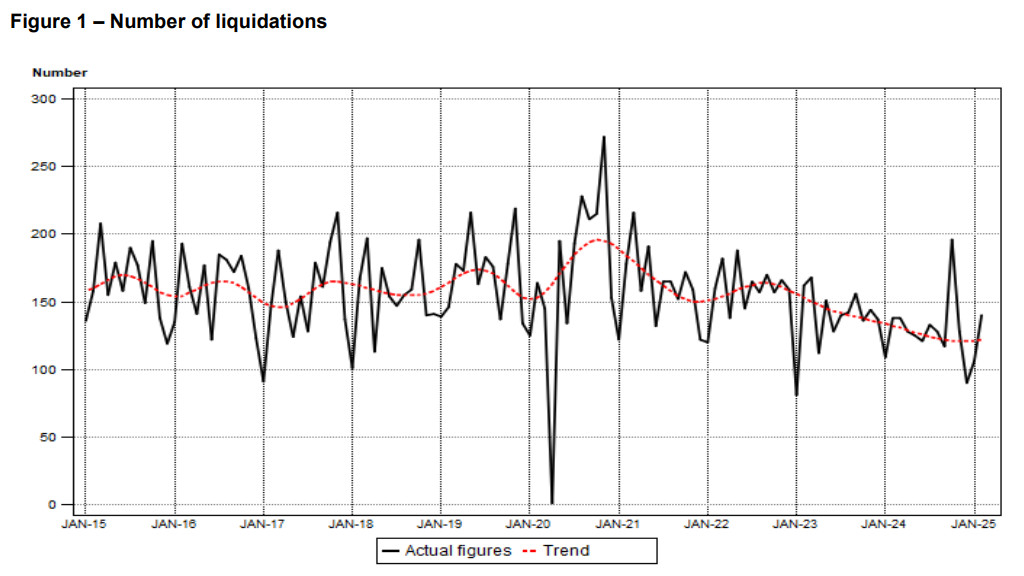
South Africa saw 140 more liquidations in February 2025, taking the total for the year up to 246 so far.
While the number of liquidations was up slightly compared to February 2024, the first two months of 2025 have been marginally better than the year before.
Stats SA’s tracking of liquidations in the country shows that year-to-date liquidations are down 0.4% from 2024.
When looking at the three-month period covering December 2024 to February 2025, things look even better, with the number of liquidations down 12.5% compared to the same period last year.
That said, February 2025 itself saw 1.4% more liquidations than February 2024.
Following the longer-term trend line, the decline in liquidations seen since January 2023 appears to be slowing down and flattening out.
In 2024, 1,551 businesses were liquidated—the lowest number in almost a decade. However, the year experienced many ups and downs, including a sharp spike in closures around October.
According to Craig Blumenthal, director of business rescue, dispute resolution, and insolvency at Fluxmans’s Attorneys, this was due to issues in the Master’s Office in the middle of the year that delayed processing liquidations.
Delays at the courts, which are overburdened, can also lead to data coming in much later.
What the liquidation data means
Speaking to BusinessTech, Blumenthal previously noted that liquidation data can tell very different stories about the economy.
While high levels of liquidation could cause trouble for businesses in South Africa, the distinction between voluntary and compulsory liquidation is important.
This is because voluntary liquidations could reflect regular business activity, where certain companies or special-purpose vehicles are liquidated for transactions.
Put another way, liquidations could indicate business or investment activity rather than businesses simply shutting down due to insolvency.
Compulsory liquidations, however, are usually court-ordered or forced due to insolvency.
Blumenthal noted that even in the case of compulsory liquidations, the numbers aren’t straightforward.
For instance, a low number of compulsory liquidations could indicate an improved business environment (fewer forced shutdowns)—or it could mean there are fewer businesses left to shut down.
For 2025, the vast majority of liquidations have been voluntary, with only 33 compulsory liquidations. Worryingly, compulsory liquidations are up 32% from the first two months of 2024.
Outside of the hard numbers, other metrics, such as GDP and the Business Confidence Index (BCI), can help contextualise companies’ moods in South Africa.
South Africa’s GDP is barely growing. The country recorded just 0.7% growth in 2024, following a meagre 0.6% growth in 2023.
The environment is not conducive for business expansion—and hasn’t been for several years now. Poor economic policies, a severely constrained power grid and crumbling infrastructure, are huge impediments.
While things are very slowly starting to improve due to urgent—but far too late—interventions, businesses are still struggling.
The latest BCI, published in early March, showed that most businesses are still generally pessimistic about operating conditions in South Africa.
The index was recorded at 45 in the first quarter of the year, five points below the ‘neutral’ mark at 50.
While this is higher than the same time last year and just above the long-term trend for South Africa, the Bureau for Economic Research (BER) said it was a worrying sign.
Four of the five sectors tracked saw confidence slip relative to the fourth quarter of 2024, and a slight majority of respondents across sectors are pessimistic about current business conditions in South Africa.
This means that, while the overall number of liquidations is lower compared to previous years, it is likely due to fewer businesses being in operation.


















 Loading ...