

Two Springbok legends partner to launch next-gen Cash-in-Transit vehicles



Springbok legends Ox Nché and Fidelity CEO Wahl Bartmann have partnered to launch Fidelity’s next generation of Cash-in-Transit (CIT) vehicles in South Africa.
The new vehicles are aimed at improving security for crews transporting money across South Africa.
The launch by Fidelity Services Group comes as the country continues to battle organised CIT crime, although recent figures suggest attacks are beginning to decline.
According to the Cash-in-Transit Association of South Africa (CITASA), 180 CIT robberies were recorded nationally in 2025, representing a 13% year-on-year decrease.
Fidelity said its own operations recorded a 23% decline in successful vehicle attacks and a 12.5% drop in cross-pavement robberies over the same period.
As of May 2026, the company added that none of its newly deployed vehicles has been successfully attacked.
The launch also marks a partnership between Fidelity and Ox Nché, who has earned 47 Test caps for the Springboks since making his debut against Wales in 2018.
Nché played a key role in South Africa’s Rugby World Cup and Rugby Championship successes and currently represents the Sharks.
Bartmann, Fidelity’s chief executive, also has a strong rugby background. He played eight Tests for the Springboks and represented Natal and the Lions during his playing career.
He also captained Natal 45 times and helped the side win the Currie Cup in 1990 and 1992. Bartmann said the new vehicles reflect Fidelity’s broader responsibility to the South African economy.
“Ox Nché is a figure widely respected not only for his rugby achievements but also for his consistency, discipline, and composure under pressure,” said Fidelity.
“The partnership reflects qualities central to Fidelity’s operational philosophy: resilience, reliability, discipline, and performance when it matters most. In the CIT environment, those qualities are not symbolic — they are essential.”
Fidelity processes around R246 billion in cash every year and completes approximately 29,000 pickups daily across more than 31,000 service points in South Africa and Eswatini.
Its fleet of 1,162 armoured vehicles travels over 65 million kilometres annually while servicing 942 routes every day.
New CIT vehicle specifications
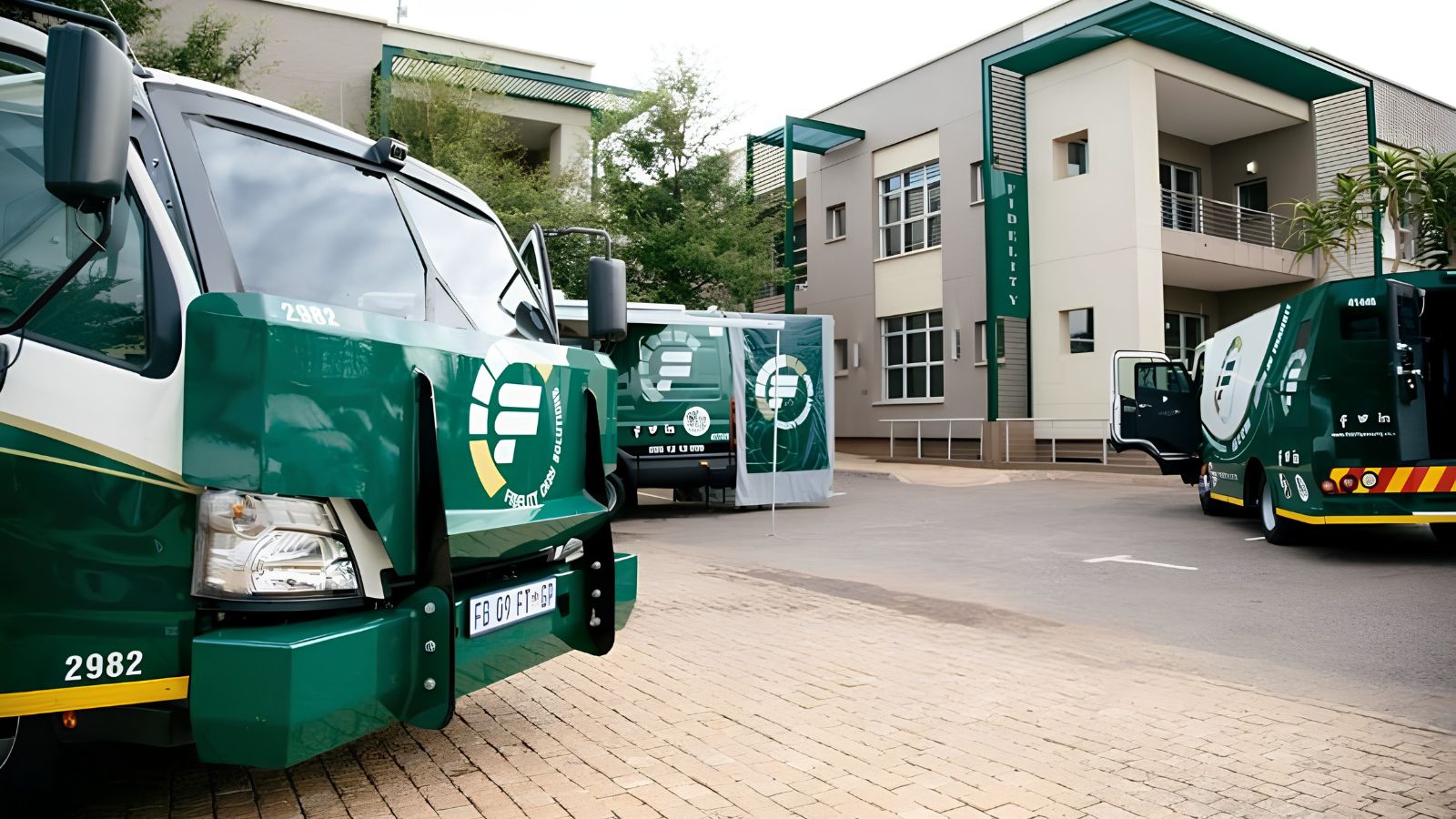
The company said the scale of these operations means disruptions can have major consequences for banks, retailers, informal traders, and communities that still rely heavily on cash transactions.
The newly developed CIT vehicle has been built around a reinforced monocoque hull, which integrates the drivetrain and operational systems into a single welded steel structure.
Fidelity said this reduces body roll and improves protection against side-impact ramming attacks.
The vehicle floor also features a shallow V-shaped design made from high-tensile armoured steel to improve protection in the event of explosions beneath the vehicle.
Its ballistic protection and glazing comply with B6+ STANAG standards, which are designed to withstand high-powered firearms.
The trucks also include run-flat tyres that allow drivers to continue moving after sustaining tyre damage during an attack.
Inside the vehicle, the onboard safe system contains multiple independently secured compartments with reinforced anti-cut linings.
Fidelity said the safes underwent controlled blasting tests overseen by the Council for Scientific and Industrial Research.
The locking systems are also geo-fencing compatible, meaning access is only possible within authorised geographic zones.
Additional safety features include self-extinguishing fire-retardant insulation in personnel areas, surveillance cameras, remote interlocking systems, integrated vehicle tracking, and configurations supporting crews of between two and four members.
Fidelity said it has deployed 125 of the next-generation vehicles since November 2023, including 23 Superbulk units. Another 48 newly built vehicles and 38 refurbished units have since joined the fleet.
Collectively, the vehicles have travelled more than five million kilometres without a security incident.
“In South Africa, cash remains a vital enabler of daily life. It powers businesses, supports communities, and drives economic participation across both the formal and informal sectors,” Bartmann said.
“At Fidelity, we are entrusted with the responsibility of moving South Africa’s money safely and reliably every day.”
Fidelity has operated in South Africa’s CIT sector since 1957 and estimates that it currently holds between 70% and 75% of the retail CIT market.
















 Loading ...