

Petrol price heartbreak for South Africa in May


Data from the Central Energy Fund for the end of the third full week of April shows that motorists are still in store for a big price hike at the pumps in May—despite the early-month shock receding significantly.
According to the CEF’s latest snapshot, under-recoveries for petrol and diesel have trended lower over April, reducing looming price hikes by as much as 73%.
The current review period (27 March to 30 April 2026) began with an under-recovery of R7.88 per litre for petrol 95 and R17.57 per litre for diesel (0.005% sulphur).
However, as the final week of the month approaches, the CEF is now showing much smaller under-recoveries.
Petrol is showing an under-recovery of between R1.82 and R2.14 per litre, down 73% from the start of the month.
Meanwhile, diesel has pulled back to an under-recovery of around R5.93 per litre, down more than 66% over the same period.
These are the projected levels at the end of week 3:
- Petrol 93: increase of R1.82 per litre
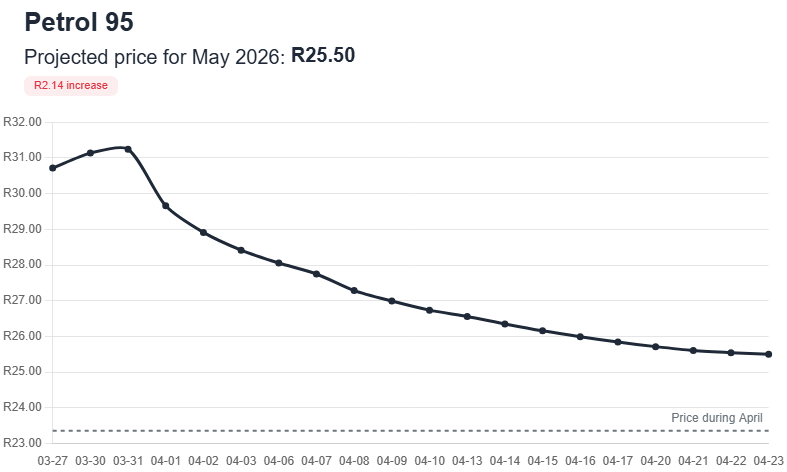
- Petrol 95: increase of R2.14 per litre
- Diesel 0.05% (wholesale): increase of R5.92 per litre
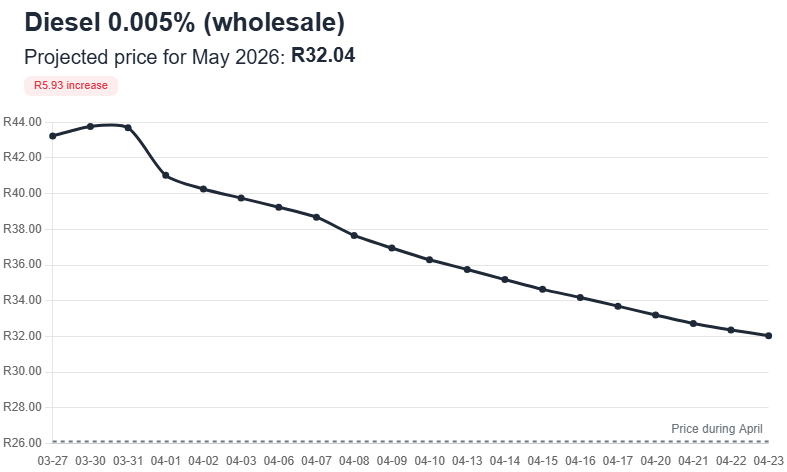
- Diesel 0.005% (wholesale): increase of R5.93 per litre
- Illuminating paraffin: increase of R4.99 per litre
The CEF does not provide daily snapshot data for LP Gas, so it is not currently possible to provide an expected price for the coming month.
Petrol 95 daily projections (for May 2026)
Diesel (0.005%) wholesale daily projections (for May 2026)
While the data shows a significant swing from the start of the month, market volatility around the war in the Middle East remains a major determining factor.
The CEF data shows that the price of international petroleum products (driven by oil prices) is the biggest contributor to the under-recovery, accounting for basically the entirety (99.5%) of the shortfall.
While the rand has weakened amid the risk sell-off turmoil in the Middle East, it has remained remarkably resilient in relative terms.
After trading below R16/$ in the first months of the year, it buckled to over R17/$ at the onset of the war, but has remained in a relatively stable trading range around R16.50/$.
On Friday (24 April), the rand weathered the latest wave of news that peace negotiations between the US and Iran had stalled, again dampening hopes for an immediate easing of Middle East tensions.
It is currently trading at R16.64/$, just 0.4% weaker.
However, the global oil price has moved back over $100 a barrel on the same news, keeping the pressure on local fuel recoveries.
South Africa is a net importer of energy and is highly exposed to fluctuations in global energy prices.
Oil rose on Friday on concerns of a renewed military escalation in the Middle East after Iran released footage of commandos boarding a cargo ship in the Strait of Hormuz.
There has been a distinct lack of progress in reopening the key waterway. Navigation through the strait, which before the war carried about a fifth of global oil output, remains effectively blocked.
Various analyses and scenario forecasting for global energy prices are tied to the length of the conflict. The longer it continues, the worse things get for fuel prices.
The R3 per litre axe over motorists’ heads

While fuel under-recoveries have reduced significantly, South African motorists and energy users are still sitting with a sizeable R3.00 per litre question unanswered.
The National Treasury cut fuel levies in South Africa by R3.00 per litre in April to shield users from the sudden price shock. However, this is set to expire on 6 May.
Finance Minister Enoch Godongwana has noted that the government is considering extending the relief, but has warned that it cannot be sustained for a long time.
Godongwana previously stated that the relief would come at a cost of R6 billion to the fiscus, with economists indicating that extending the relief would push this to between R10 billion and R12 billion.
The rub for taxpayers is that whatever relief is provided, and for however long it is provided for, has to be budget-neutral, which means that the cost must be collected through other measures in the current financial year.
When similar relief was provided in 2022, the National Treasury implemented a staggered recovery, adding the fuel levy back to prices over a period of two months.
Because of this, what should have been a R1.80 per litre increase to petrol in July 2022 became a R2.60 increase instead.
What should have been a R2 per litre cut to petrol prices in August 2022—the termination of the relief that year—ended up being a cut of R1.30 per litre.
Adding the current relief back in full would push May’s projected hike from R2 a litre to R5 a litre for petrol and from R6 a litre to R9 a litre for diesel.
With fuel prices expected to remain under strain for the foreseeable future, there may simply not be a good time to add it back.
Whatever approach is taken this time around, the result will be the same: fuel users will pay.

















 Loading ...