

National shutdown warning next week in South Africa


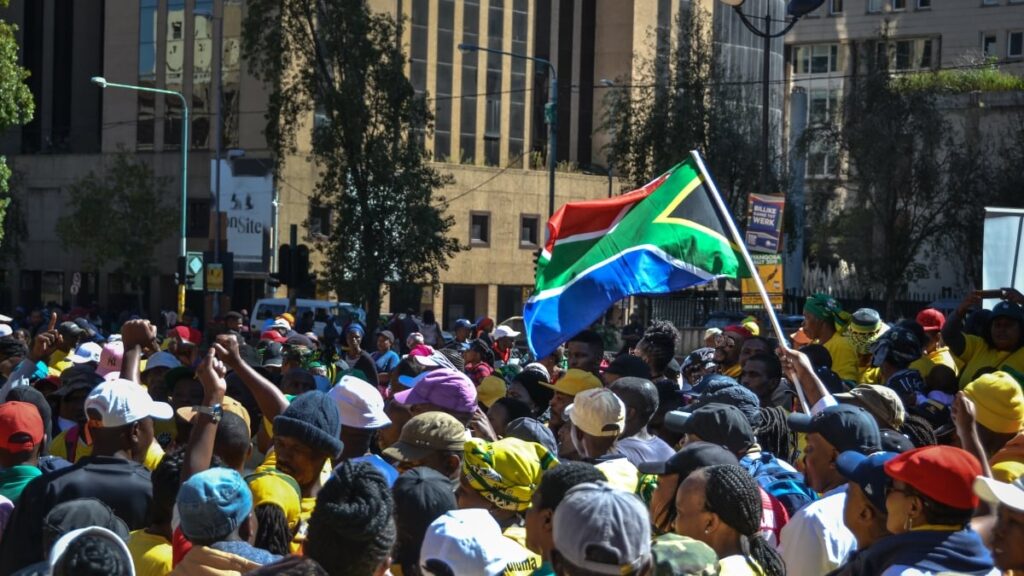
Concerned Citizens of South Africa have called for a national shutdown across South Africa to force the government to cut the General Fuel Levy (GFL) and lower petrol prices.
South Africa’s fuel prices have risen sharply in recent months, with petrol reaching R30.25 per litre in October.
The high prices have put pressure on households and prompted calls for the government to intervene by suspending certain levies.
This tactic was used earlier in 2026, when the GFL was lowered by R3 per litre to protect the country from a sharp hike in fuel prices.
The GFL was suspended in April and May 2026, then phased back in over two parts, with R1.50 added to fuel prices in June and July.
With the recent increase in fuel prices, a group called Concerned Citizens of South Africa has called for a national shutdown to protest against the petrol costs.
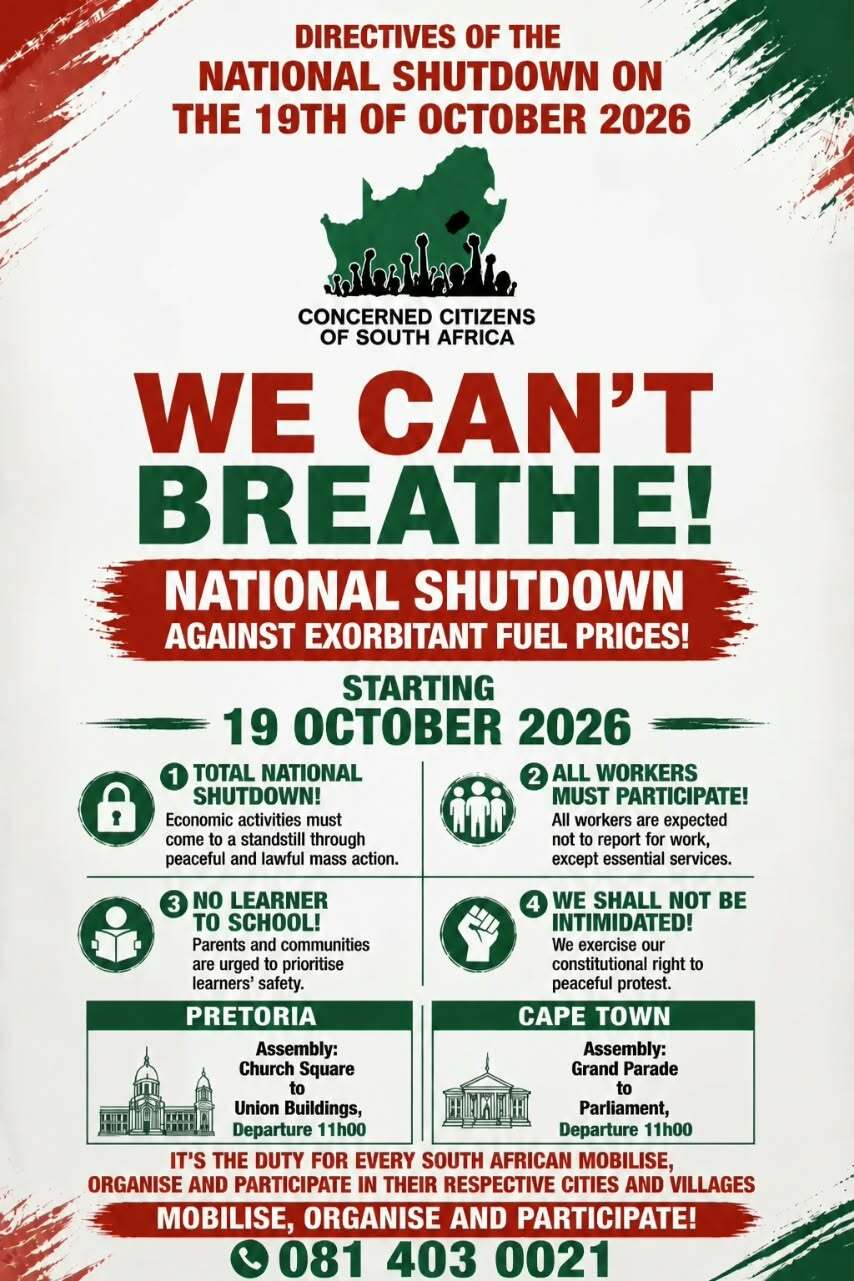
Recently, a poster with the group’s name has circulated on social media, advocating for a “total national shutdown” on 19 October 2026.
The image said that workers should not report to work, and learners should not attend school on the day of the planned demonstrations.
A representative from the organisation, Ntokozo Mkhize, spoke to Cape Talk about the proposed demonstrations and confirmed that the viral image was from their group.
“The poster that the people of South Africa saw going viral on different social media platforms is coming from Concerned Citizens of South Africa,” he said.
“We are taking full ownership of that poster; it is from us.”
He described the organisation as “purely a people’s movement” and said it has no affiliation with any political party in South Africa.
“It is not a political campaign for any political party,” he said. “This is a genuine concern of the South African people. South African people are saying enough is enough.”
Calls for tax cuts
Mkhize said that South Africa’s government should reduce the levies on fuel purchases to lower the overall price.
“It must come from cutting these levies and taxes that are included in the petrol price,” he said. “We have the RAF, we have the General Levy, we have all sorts of levies that we are paying.”
The two levies placed on South Africa’s retail fuel purchases are the GFL and the Road Accident Fund (RAF) levy.
These levies are used to pay for infrastructure upgrades and maintenance in South Africa, along with assisting victims of vehicle crashes and their dependents.
Currently, the GFL adds R4.10 per litre to fuel prices, while the RAF levy adds an additional R2.25, making the combined levy R6.35.
The Concerned Citizens of South Africa is not the only group calling for the removal of these levies, with the Automobile Association of South Africa also voicing concerns about the high prices.
The group said that the GFL should be reduced by R3 per litre, while the RAF levy should be scrapped entirely.
The group conceded that reducing the GFL significantly cut the government’s tax revenue earlier in the year, but said that long-term solutions still need to be implemented.
“The AA acknowledges the short-term General Fuel Levy relief that, on a sliding scale, was implemented earlier in the year when National Treasury cut fuel levies by R3 a litre in April, at a cost of approximately R17 billion,” it said.
“We warned at the time, though, that this strategy needed to have a longer-term consumer vision; today, we are digesting the lack of Treasury’s foresight for the longer-term relief position the AA called for.”
“We maintain that government can afford to cut the general fuel levy by R3 a litre, which would materially reduce the inflationary impact of fuel price changes.”











 Loading ...