

Gold is the biggest winner of 2016 so far


While global markets struggle to find stability, gold has emerged as the biggest winner in 2016 so far, rising as much as 17% in value since January.
Gold is currently trading at R19,100 per ounce (over R610,000 a kilogram) – after recently reaching record highs for South Africa (R19,763).
In US currency however, gold reached its highest point in August 2011, when the commodity traded at around $1,900 an ounce. At the time, however, exchange rates put the price at R12,648 in local currency.
Gold has since slumped to around $1,230 an ounce – but with the South African rand at some of its highest points against the dollar, the value of gold is at a record high.

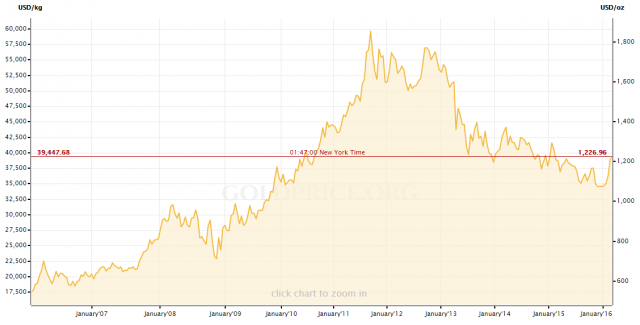
The recent surge in gold price has commodity fans excited, with the metal gaining as much as 17% in 2016.
Its strength is reflective of ailing global economic conditions – where China is slowing down, the price of oil is dropping, and Britain is threatening to exit Europe.
All these conditions – much like the turbulence faced by global markets in 2008 – are pushing people to invest in the metal, which is seen as a safe bet amid economic uncertainty.
However, economists and analysts, both globally and locally are divided – with many warning that gold’s return to glory may be temporary, and even detrimental in the long-run.
Goldman Sachs revised its 12 month target price of gold to $1,000 an ounce, saying that fear was driving the price hike, and it would not last.
Other economists estimate that the price could go as high as $1,400 an ounce if global markets do not stabilise – higher if another global recession had to hit.
Head of Randgold Resources, Mark Bristow, painted a gloomier picture, saying that, if the gold price stays on the lower end of the price spectrum ($1,000) producers would be forced to cut production, as it would become unprofitable to extract the ore.
About 5 million ounces needed to be cut from global production to keep prices higher than $1,400 in the long-term, he said.













 Loading ...