

South Africa’s middle class is cracking


South Africa’s Consumer Confidence Index (CCI) recorded another decline for the third quarter of the year, driven by tanking sentiment among the country’s middle class.
The CCI, compiled by the Bureau for Economic Research (BER) and FNB, was recorded at -13 for the third quarter, down further from -10 in Q2, though still above -20 at the start of the year.
The index is tracking well below the -1 average recorded since 1994.
According to the BER, consumer confidence in the first quarter of the year was driven by a confluence of negative impacts.
This included the initial proposal to hike VAT by two percentage points, the fallout between the ANC and the DA about the budget, and a deterioration in diplomatic relations between South Africa and the United States.
Absent most of these impacts in the third quarter, the reading of -13 is relatively bleak for the country, reflecting economic pressure on consumers.
Across the three sub-indices tracked by the BER, consumer confidence in the country’s economic outlook is most negative, currently sitting at -22.
This is lower than the -18 in Q2, but higher than the -32 recorded at the start of the year.
While South Africa’s economy has remained surprisingly resilient this year in the face of many external headwinds—including a 30% tariff on exports to the USA—growth remains anaemic.
The second quarter GDP figure came in at 0.8% growth quarter-on-quarter, reigniting hopes for a full-year growth figure above 1%.
However, with population growth exceeding this by some margin, South Africa continues to get poorer, and the country is struggling to get out of the sub-1% growth rate rut it has been in for over a decade.
This reflects wider in the durable goods sub-index, which is also sitting -20. This reflects a lack of confidence among consumers in making big, long-term purchases.
This has only been marginally supported by lower interest rates—improving from -21 in Q2—reflecting the continued strain consumers face by the Reserve Bank’s reluctance to cut rates.
The only sub-index that is positive is the household financial outlook, which, at +3, reflects some degree of confidence that finances will improve in the coming months.
However, this also comes with a caveat that the sub-index is lower than the +9 recorded in Q2 and only marginally higher than the -1 in Q1.
More broadly, the index points to a slowdown in real household consumption expenditure growth during 2025Q3.
Why South Africa’s middle class is feeling bleak
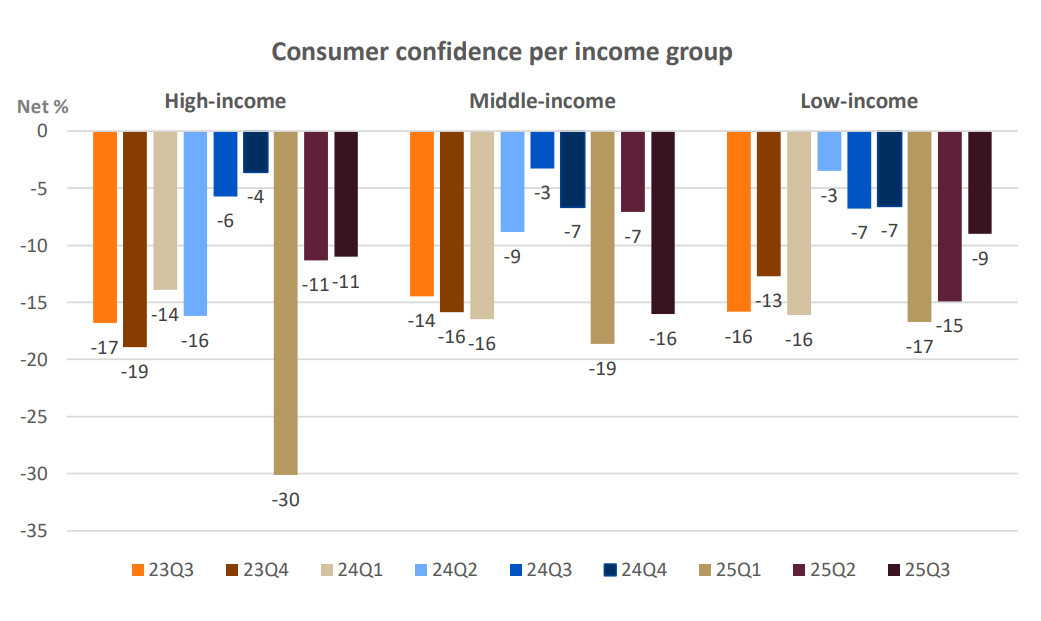
The drop in confidence is particularly true for the middle class segment (those earning between R5,000 and R20,000 a month), where confidence has tanked from -7 to -16 on the index.
This was the only economic segment to see a decline, with the high-income and low-income groups improving (though remaining in the negatives).
According to the researchers, this is because the middle class feel the shocks of economic strain more acutely, without the social support of the low-income groups or resources of high-income groups to soften the blow.
FNB Chief Economist Mamello Matikinca-Ngwenya said the uptick in low-income confidence was somewhat surprising, given the sharp increase in food inflation in recent months.
However, the above-inflation increases in social grants likely helped low-income households (earning less than R5,000 per month) to make ends meet.
Furthermore, the improved third quarter reading for low-income confidence also compares to a particularly weak second quarter, when more than a hundred people lost their lives in the Eastern Cape floods.
Looking at high-income earners (earning over R20,000 per month), Matikinca-Ngwenya noted that this segment is riding out the negatives with a larger pool of resources to tap into.
While two-pot pension fund withdrawals likely faded during the third quarter and higher personal income taxes started to bite, another 25-basis-point interest rate cut would have brought welcome debt service cost relief to more affluent consumers.
“The strong performance of share prices on the JSE and the appreciation in the exchange rate of the rand may also have underpinned the confidence levels of high-income households,” Matikinca-Ngwenya said.
By contrast, weak job creation, rising inflation and dwindling two-pot funds likely started to weigh on the confidence levels of the middle class.
“Increasing inflation, shrinking two-pot retirement payouts and waning consumer confidence will likely translate into a more pronounced slowdown in real household expenditure growth towards the final quarter of the year,” the BER said.
“In the absence of further interest rate cuts and a bounce-back in job creation, higher food inflation will erode the purchasing power of middle-income consumers in particular.”


















 Loading ...