

Bad news about interest rates in South Africa


Any hope for interest rate cuts in South Africa continues to be dampened by the conflict in the Middle East, with optimism over a quick end to the conflict slowly disappearing.
While the South African Reserve Bank (SARB) was expected to cut interest rates at the start of the year, the US and Israel’s attacks on Iran and the retaliation dashed that expectation.
The SARB was widely expected to cut interest rates by 50 basis points in 2026, adding to the cumulative 150 basis points worth of cuts in 2024 and 2025.
The conflict led to a massive increase in fuel prices, with petrol rising by R3 in April and diesel by R7, despite the government dropping the fuel levy by R3.
Recent mid-month statistics from the Central Energy Fund (CEF) showed under-recoveries of around R3 for petrol and R10 for diesel, pointing to further pain ahead.
While the US and Iran agreed to a ceasefire last week, peace talks ended without a result. The US has now followed in Iran’s footsteps by also imposing a blockade of the Strait of Hormuz.
The CEF’s latest under-recoveries do not account for the US’s announcement of its blockade, which sent oil prices soaring and pointed to even higher fuel prices in the future.
Oil is currently at over $100 per barrel, while the rand slid from around R16.60 to R16.90 against the US Dollar.
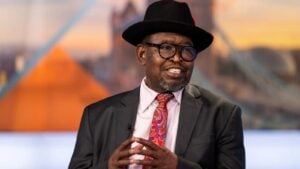
Aluma Capital Chief Economist Frederick Mitchell said that the likely increase in petrol prices means that the R3 breather from National Treasury will likely be swallowed up by international price spikes in May.
South African Reserve Bank’s balancing act

Mitchell said that the fuel price volatility is the wildcard in the SARB’s deck after its Monetary Policy Committee (MPC) left the Repo Rate unchanged at 6.75% in its March meeting.
While inflation in February hit the SARB’s ambitious new target of 3.0%, the path of the further fuel trajectory threatens to unanchor inflation expectations.
Mitchell said that Governor Lesetja Kganyago and the MPC are essentially in a “wait and see” mode, as the under-recovery could lead to a sustained secondary inflationary push.
Higher transportation costs will drive up food prices, which are a core component of inflation calculations.
If these second-order effects materialise, Mitchell said the SARB could be forced to abandon its hopes of a rate-cutting cycle later this year.
“For now, the unchanged stance serves as a stabiliser, signalling that while the bank is satisfied with current inflation levels, it remains wary of the energy shocks bleeding into the broader economy,” he said.
He noted that the US and Israel’s conflict with Iran has made the world a harder place to do business.
However, there is solace for South Africa after securing R415 billion in private investment pledges at the latest South African Investment Conference.
“For South Africa, the challenge is clear: survive the short-term inflationary squeeze of R25+ per litre petrol while accelerating the implementation of the R415 billion investment pipeline,” said Mitchell.
He said that if the ceasefire holds and the R3.00 levy cushion buys enough time for global prices to cool, South Africa could not only survive the storm but also become a preferred destination for global capital.











 Loading ...