

South Africans under siege by criminals, with police seen as too useless or unwilling to help


Stats SA has published its Governance, Public Safety and Justice Survey for 2025/26, revealing a high degree of mistrust and lack of faith in the country’s police services.
The report is a countrywide, household-based survey that seeks to bridge the gap between official crime data reported by the SAPS and households’ experiences of crime in the country.
While the SAPS crime data shows the number of crimes processed by the police across all precincts in the country, it is limited to the actual crimes that are reported or discovered through investigation.
The Victim of Crime survey, on the other hand, offers a different perspective, focusing on statistics on crimes experienced by households.
Crucially, the survey includes data on the number of crimes that are not reported to the police—and thus not captured in SAPS crime data—as well as the reasons households and individuals don’t report.
The survey revealed significant gaps in crime reporting from households, where often more than half of incidents are not reported.
The degree of non-reporting is often tied to the severity of the crime.
In cases of theft of personal property, for example, almost two-thirds of these crimes go unreported. When it comes to violent crimes like murder, almost all crimes are reported.
But even in cases where South Africans’ lives are put in danger—such as being mugged on the street—more than half the crimes are not reported to the police.
Across the survey, the reasoning for this lack of reporting is fairly consistent: respondents believe that the police would simply not do anything about it.
The second-most common response was that the police simply couldn’t do anything about it, usually due to a lack of proof of the crime.
The table below outlines these crimes, the number of incidents, and the number that were not reported to the police.
Included is the top reason given, where asked, as to why the crime was not reported to the police.
Household crime
| Crime | Incidents 2025/26 | Not reported | Top reason for not reporting |
|---|---|---|---|
| Damage to Dwelling | 122,000 | 59.2% | Solved it myself |
| Theft of Livestock | 275,000 | 58.9% | Police won’t do anything about it |
| Housebreaking | 1,549,000 | 51.8% | Police won’t do anything about it |
| Home robbery | 223,000 | 48.4% | – |
| Assault | 160,000 | 43.1% | – |
| Theft of Motor Vehicle | 87,000 | 30.6% | – |
| Sexual Offences | 14,000 | 21.9% | – |
| Murder | 19,000 | 6.0% | – |
Individual crime
| Crime | Incidents 2025/26 | Not reported | Top reason for not reporting |
|---|---|---|---|
| Psychological violence | 264,000 | 69.3% | Solved it myself |
| Theft of personal property | 1,423,000 | 62.7% | Police won’t do anything about it |
| Consumer fraud | 558,000 | 61.2% | – |
| Street robbery | 515,000 | 58.3% | Police won’t do anything about it |
| Assault | 560,000 | 45.3% | – |
| Sexual Offence | 22,000 | 33.0% | – |
| Hijacking of Motor Vehicle | 122,000 | 22.7% | – |
According to Stats SA, the survey data shows that households experience break-ins the most in the country, although the incidence has dropped since 2024/25.
For individuals, theft of personal property is the most common crime experienced, and this has also dropped, though only very slightly, from last year.
The pervasiveness of criminality and crime has led to a constant feeling of insecurity, particularly in the most populated, urbanised provinces, and especially at night.
About 81% of those aged 16 years and older felt safe walking alone in their neighbourhood during the day in South Africa.
This drops to just 38% when walking alone in their neighbourhood at night.
In the previous reporting period (2024/25), a higher proportion of females (44.9%) than males (39.6%) felt very unsafe walking alone in their areas at night.
In 2025/26, the proportion of those who felt very unsafe decreased among males (38.8%) but increased among females (45.1%).
Limpopo (98.0%) recorded the highest proportion of individuals who felt safe walking alone during the day, followed by the Northern Cape (88.2%) and Mpumalanga (88.0%).
By contrast, the Western Cape (30.1%) recorded the highest proportion of individuals who felt unsafe walking alone during the day, followed by Gauteng (25.8%) and KwaZulu-Natal (18.9%).
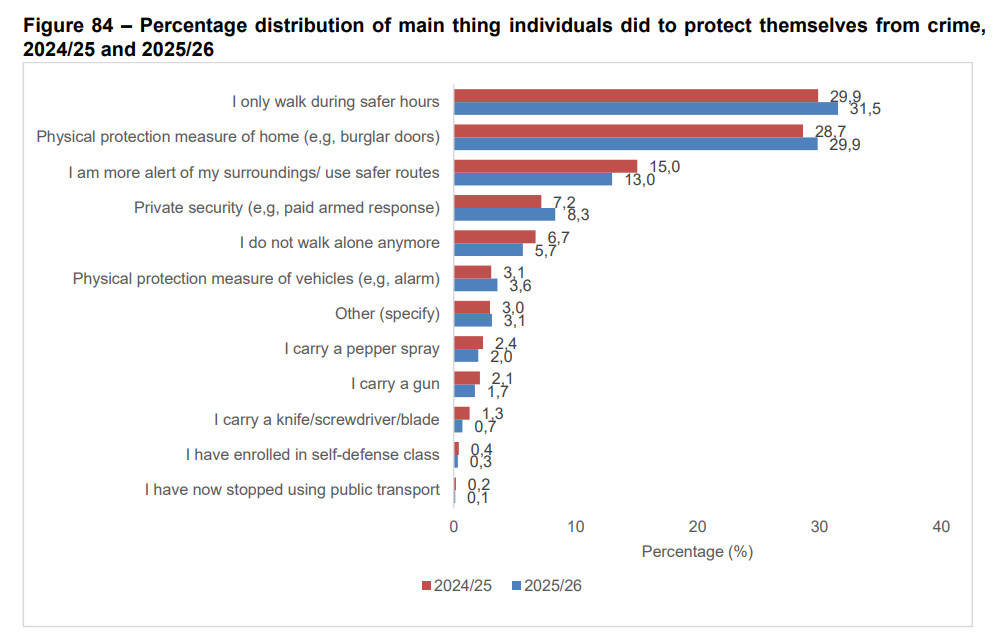
The proportion of individuals who have done something to protect themselves against crime increased from 43.3% in 2024/25 to 46.6% in 2025/26.
The main measure taken is simply to walk in during safer hours, while households have boosted security by adding deterrents such as burglar-proofing.
Another growing measure is hiring private security and armed response.
















 Loading ...