

Plan to kick the DA out of Joburg, Tshwane and Ekurhuleni as coalition lines are drawn


South African political parties intensified coalition negotiations following the announcement of municipal election results that produced no outright winner in seven of the eight biggest cities and saw a further weakening of support for the African National Congress.
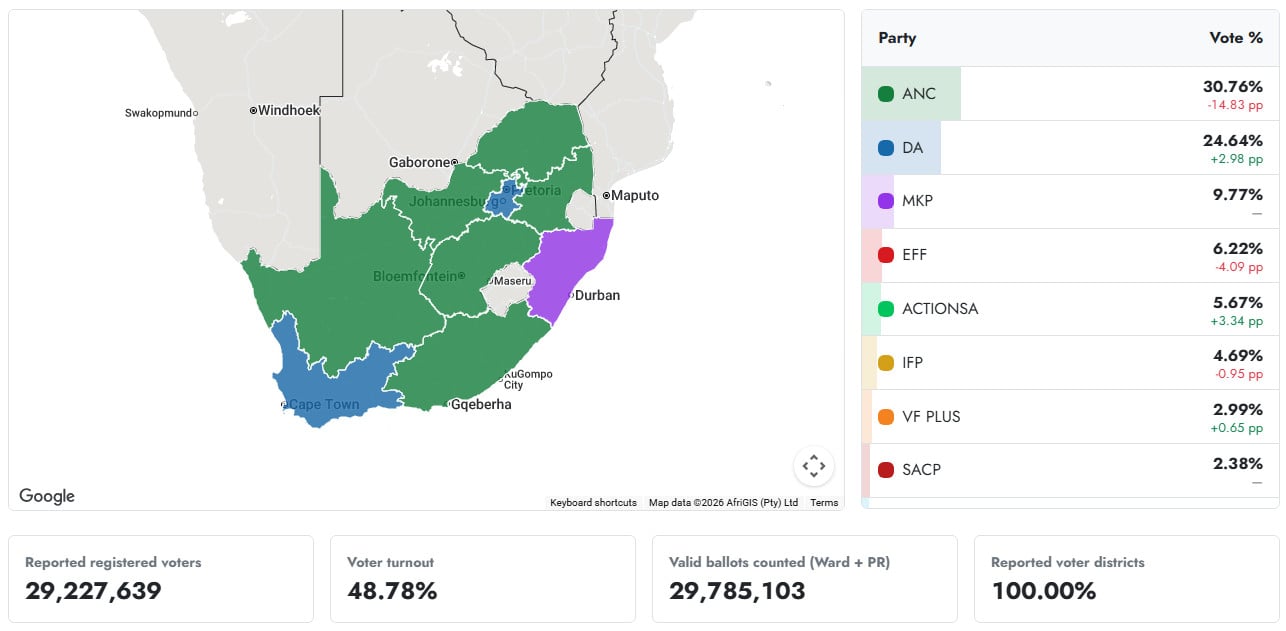
Final tallies released by the Electoral Commission of South Africa on Sunday showed the ANC remained the largest party with 30.8% support, down from 46% in the last local government vote in 2021 and its worst showing since it took power after apartheid ended in 1994.
Its biggest rival, the Democratic Alliance, narrowed the gap by increasing its share to 24.6% from 22%.
The 257 municipalities are responsible for distributing water and electricity, collecting refuse and overseeing some roads, and the mismanagement of many of them has angered residents, pushed up businesses’ operating costs and deterred investment.
Some councils are unable to collect the money they are owed for services and are themselves in debt to state utilities to the tune of billions of rand, with business lobby groups warning that they pose a threat to the nation’s finances.
Cape Town was the only metropolitan municipality in which a party—the DA—secured an outright majority of council seats, meaning the rest will be run by coalitions.
In Johannesburg, the DA won the largest share of the vote with 35%, short of a council majority that would have secured former Cape Town Mayor Helen Zille the top post in the country’s biggest city and financial hub.
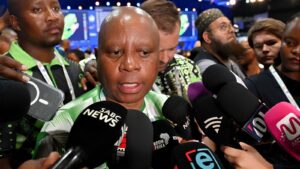
ActionSA, led by former mayor Herman Mashaba, emerged as a potential kingmaker after increasing its support.
Informal coalition negotiations kicked off on Friday.
South Africa 2026 election results
| Party | 2021 Result | 2026 Result | Change (%pt) |
|---|---|---|---|
| ANC | 45.59% | 30.76% | -14.83 |
| DA | 21.66% | 24.64% | +2.98 |
| MK | – | 9.77% | +9.77 |
| EFF | 10.31% | 6.22% | -4.09 |
| ActionSA | 2.33% | 5.67% | +3.34 |
Gauteng in focus
Several parties in Johannesburg are considering forming an alliance that could elect Mashaba as mayor and shut out Zille, according to people familiar with the situation, speaking to Bloomberg, who asked not to be identified, as they discussed private information.
The bloc would reportedly include the ANC, Action SA, uMkhonto weSizwe Party and the Economic Freedom Fighters.
The cooperation agreement may extend to Tshwane and Ekurhuleni, the two other metros in the central Gauteng province, they said.
Under this arrangement, the bloc would sweep all three metros.
ANC, ActionSA, EFF and MK coalition in Gauteng
| Party | Johannesburg | Ekurhuleni | Tshwane |
|---|---|---|---|
| ANC | 63 | 59 | 44 |
| ActionSA | 43 | 40 | 48 |
| MKP | 15 | 15 | 4 |
| EFF | 17 | 14 | 13 |
| Total | 138 | 128 | 109 |
| Needed for majority | 136 | 113 | 108 |
The ANC could alternatively decide to work with the DA, with the two rivals already part of a 10-party national governing coalition.
This would give the team a solid majority in the metros and arguably the most stable coalition with the fewest parties involved.
DA-ANC coalition in Gauteng
| Party | Johannesburg | Ekurhuleni | Tshwane |
|---|---|---|---|
| DA | 91 | 66 | 74 |
| ANC | 63 | 59 | 44 |
| Total | 154 | 125 | 118 |
| Needed for majority | 136 | 113 | 108 |
Another configuration could include a tie-up between the DA and ActionSA that would enable the latter party’s Nasiphi Moya to remain as mayor of Tshwane, which includes the capital, Pretoria.
While this arrangement should allow Zille to become mayor of Johannesburg, ActionSA has nixed this
ActionSA’s Mashaba has explicitly stated that he would not even begin to negotiate with the DA if Zille is part of the picture.
Complicating the fraught relationship between the two, the parties would only command majority influence together in Tshwane.
They would fall short of a majority in Johannesburg and Ekurhuleni, which would require a third party to join the coalition, opening the door for other conflicting interests.
DA-ActionSA coalition in Gauteng
| Party | Johannesburg | Ekurhuleni | Tshwane |
|---|---|---|---|
| DA | 91 | 66 | 74 |
| ActionSA | 43 | 40 | 48 |
| Total | 134 | 106 | 122 |
| Needed for majority | 136 | 113 | 108 |
ActionSA’s Chairman Michael Beaumont met the ANC’s secretary-general, Fikile Mbalula, on Sunday. Mashaba quit the DA in 2019 after a fallout with Zille.
He told Johannesburg’s Business Day newspaper that he had no interest in repairing the relationship and that Zille could only become mayor if the ANC decided to support her.
Talks need to be concluded within the next 14 days, after which the new councils must hold their first meetings, placing pressure on parties to reach agreements quickly.
Zuma’s party benefited from the decline in support for the ANC, consolidating its base in eastern KwaZulu-Natal.
The party, which first contested the polls in 2024, won outright majorities in three municipalities and the most votes in 20 this year, and aims to lead a coalition in eThekwini, which encompasses the port city of Durban.
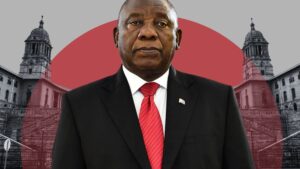
The ANC’s losses are likely to intensify scrutiny of President Cyril Ramaphosa’s leadership ahead of the party’s 2027 conference to elect his successor.
Regional and provincial structures within the party are pressing for its leadership to account for the further decline in support, according to people familiar with the discussions.
The party’s national executive committee, its top decision-making body, is expected to assess its performance at a meeting set for Thursday.
The ANC’s performance was “concerning,” Ramaphosa told reporters before the announcement of the final results in Pretoria on Sunday.
“We accept that this is how the people of South Africa in our towns, cities, and metros have spoken, and this is their verdict. We accept it with humility.”
With Bloomberg









 Loading ...