

DA leader Geordin Hill-Lewis on the DA staying in the GNU after being shut out of local government


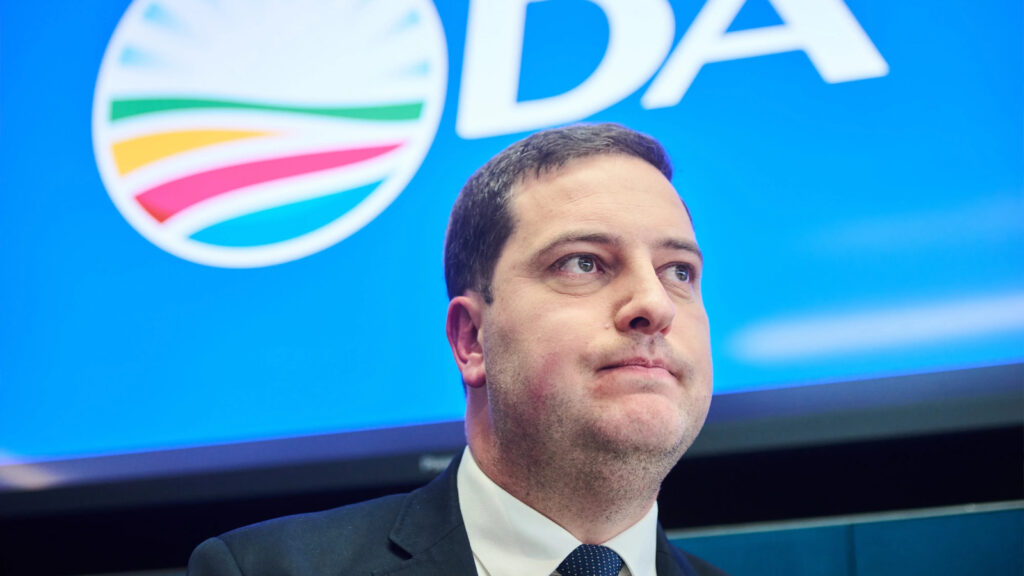
South Africa’s second-biggest party isn’t currently considering quitting the national coalition government, its leader said, even as it looks likely to be excluded from administrations in several of the country’s main cities.
Municipal elections held on 4 November failed to produce outright winners in Johannesburg and six other metropolises, meaning they will be run by coalitions.
The African National Congress, the biggest party, is in ongoing talks about tie-ups with ActionSA and other rivals that would shut out the Democratic Alliance—arrangements that have raised concerns about the stability of the so-called government of national unity (GNU) that has run the country since mid-2024.
“We are still in active negotiation talks, so the matter of the stability of the GNU is not presently the focus of discussion,” DA leader Geordin Hill-Lewis said in an interview on Wednesday, while adding that the issue could be reviewed at a later stage depending on how the political situation develops.
“There definitely are scenarios which might play out in the coming weeks in which it becomes a point of discussion within my party. At that point, the DA will carefully consider our options,” he said.
“Leaving the GNU, it isn’t ever off the table. We aren’t there to remain at all costs. We’re there to deliver change, drive reform, and get South Africa working.”
The rand reversed a decline after Hill-Lewis’ remarks to trade 0.5% stronger against the dollar by 13h00 in Johannesburg.
The benchmark government 10-year bond yield fell about 11 basis points from a session high to 8.89%.
Investors see the DA as an important advocate for economic reforms within the 10-party GNU, and the risk of it leaving has been evident in the financial markets.
The rand had fallen as much as 2.6% against the dollar since the election results were announced, the most of the 24 African currencies monitored by Bloomberg.
It reached its lowest level in almost a year on Thursday, with a stronger dollar and a slump in precious-metal prices adding to the pressures arising from the domestic political uncertainty.
Despite the tensions, the DA is unlikely to withdraw from the GNU, with its internal polling indicating that the party’s supporters favour its national partnership with the ANC.
That’s according to people familiar with the party’s internal discussions, who asked not to be identified because the deliberations are private.
Disagreements over policy could intensify, but those disputes won’t necessarily lead to the DA’s immediate exit, they said.
The ANC dismissed reports that the coalition talks were impacting the rand.
“Financial markets have no right to dictate those negotiations or to pressure the ANC into a coalition with the DA,” the party said in a statement, adding that it would continue engagements with the aim of forming stable, accountable municipal governments.
People familiar with the ANC’s thinking said that while there is growing dissatisfaction within its ranks about the DA’s conduct, it would prefer its coalition partner to leave voluntarily rather than it being expelled.
Representatives from the ANC, ActionSA, the Economic Freedom Fighters and uMkhonto weSizwe Party met in Johannesburg on Wednesday for their first multilateral discussions since the elections, following a series of bilateral engagements.
The talks focused on governing arrangements in Johannesburg, Ekurhuleni and Tshwane, three of the largest cities where the DA polled the most votes.
“We are closer to an agreement with the ANC than the DA, because the ANC and EFF and MK are availing themselves for talks,” Michael Beaumont, ActionSA’s national chairperson, said in an interview on the sidelines of the meeting.
“They’re the only party in the entire political spectrum that we have not had a negotiating team-level meeting with.”
While ActionSA said it remains willing to engage with the DA, it had been waiting a week for the party to arrange a meeting, he added.
Municipal councils have until 27 November to elect new leaders, leaving parties little time to conclude coalition agreements.

















 Loading ...