

Scrums.com review – A hands-on look at the platform redefining software outsourcing



The software development outsourcing model has undergone a radical shift, and Scrums.com offers businesses a solution.
For years, companies outsourced software development in a relatively simple way – they hired developers, gave them a project, and waited for the solution to be delivered.
But delivering software has become significantly more complex than it was a few years ago.
It’s no longer just software development. Businesses are looking for multiple solutions to solve different problems across cloud infrastructure, DevOps pipelines, development tools, integrations, and increasingly AI-powered engineering assistants.
Engineering teams are no longer just groups of developers, either – they now have to coordinate people, tools, infrastructure, and AI.
They therefore require a platform approach that allows them to orchestrate their software engineering operations from a single system – and Scrums.com was built to address this shift.
“I’ve had the privilege of working with multiple enterprise businesses solving complex engineering challenges,” said Scrums.com Chief Revenue Officer, Chase le Roux.
“What we’ve built with Scrums.com is a direct response to that, bringing people, tools, infrastructure, and AI into one system. We’re seeing real step-change improvements in performance, and most importantly, consistently happier clients.”
Watch our review of the Scrums.com platform below.
What Scrums.com is
Scrums.com combines every element of your software development needs into a single environment, from outsourced talent to ongoing workflows and project timelines.
Instead of juggling separate tools for project tracking, communication, and reporting, everything is accessible in one place.
When you sign up, you are assigned an account executive who will help you get up and running and ensure you get the most out of your Scrums.com experience.
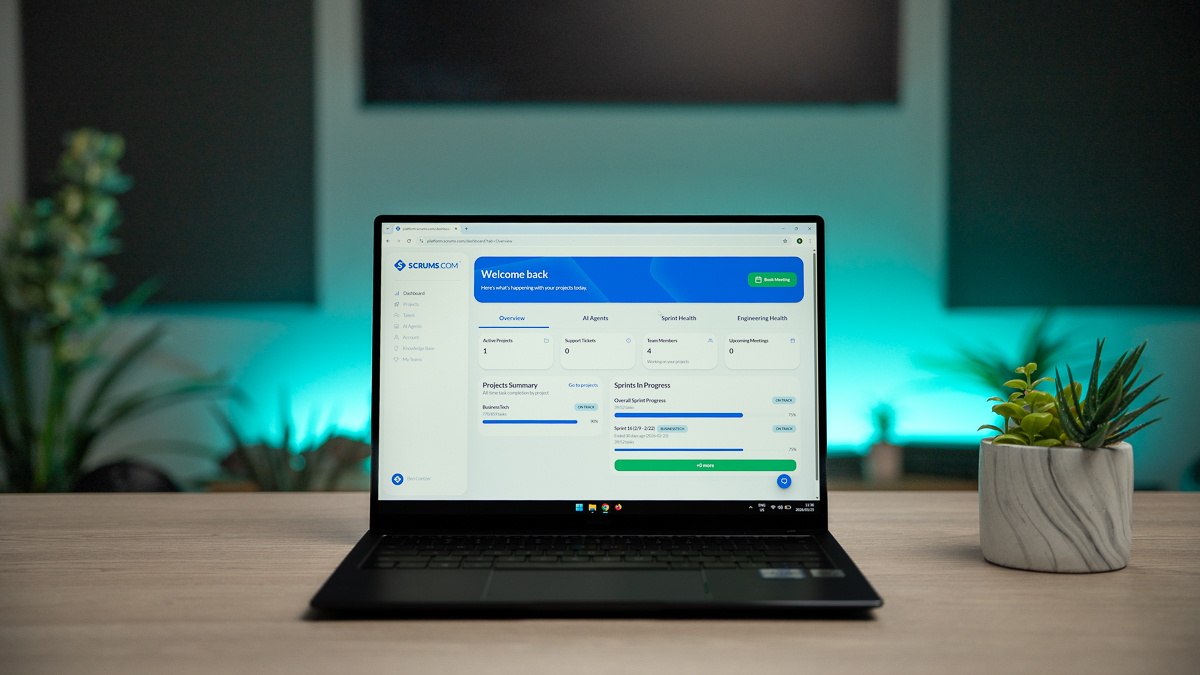
Once you’re set up, you have access to a dashboard that acts as the central hub for all activity inside Scrums.com, providing an immediate overview of your projects, teams, and ongoing tasks.
Everything from planning to delivery is handled within the same system, removing the need to rely on multiple external tools.
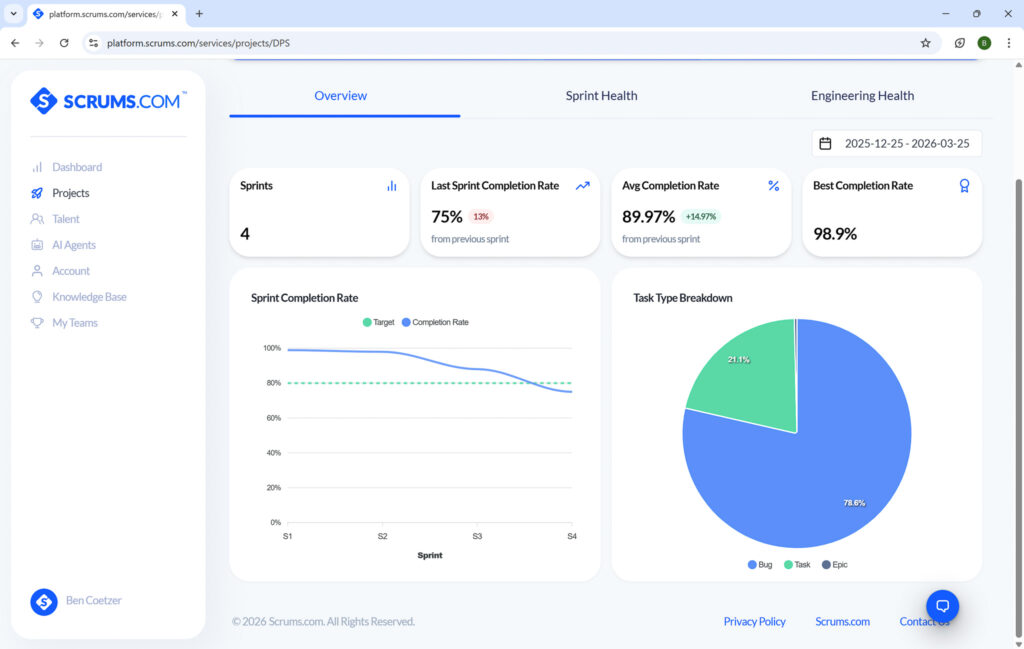
The projects tab gives you deeper visibility into each individual project, helping you explore timelines, track progress, and review specific deliverables, known as sprints.
It also provides analytics such as sprint completion rate and deployment frequency to ensure you can drive momentum when needed.
Other sections of the Scrums.com platform provide access to team performance metrics, an inventory of top talent from which to choose, and access to various AI Agents.
Managing engineering teams in real time
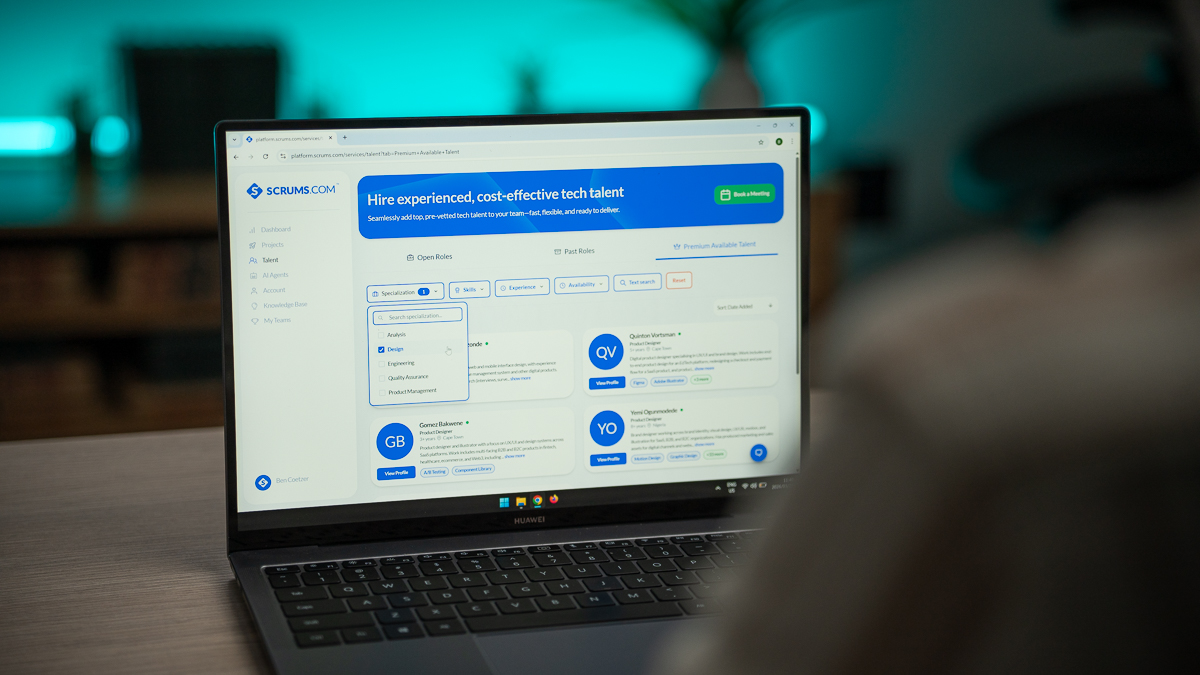
Scrums.com gives you access to a wide range of top talent, allowing you to choose various developers based on their skillsets and how they match your project goals.
One of the biggest advantages here is access to specialised skills without the delays of traditional hiring.
Through the Talent feature, you can tap into a pool of developers, specialists, and project managers with experience across multiple technologies.
You simply filter talent based on your exact project requirements.
This allows you to bring in the right expertise for your project, and scale up or down at any time as your needs shift, whether you need support with a specific feature or an entirely new phase of development.
You can even arrange online meetings with candidates you are interested in.
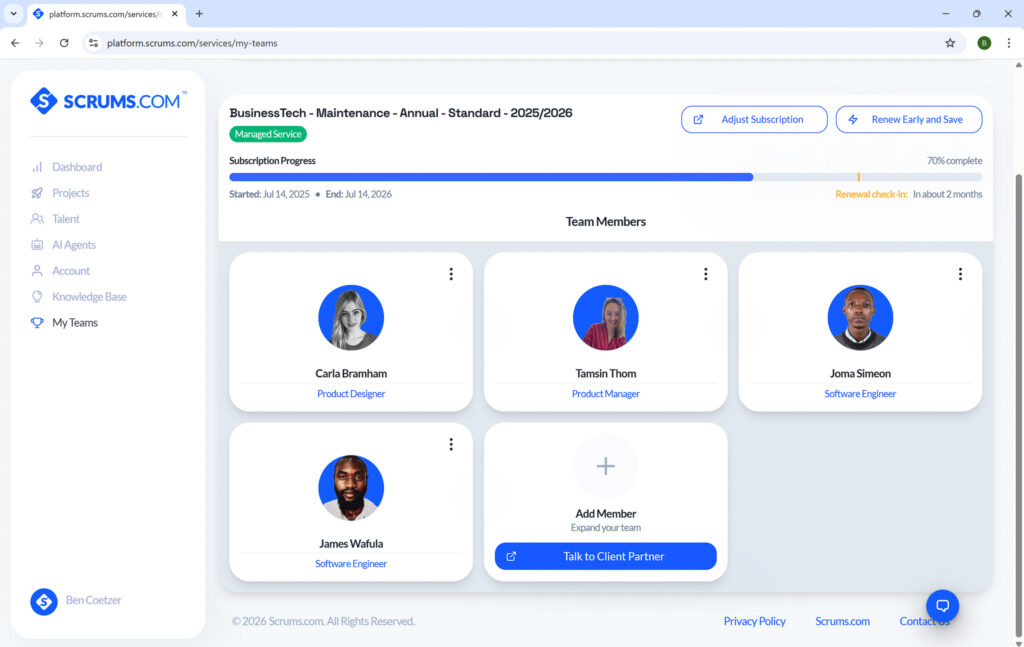
Once you’ve built your ideal team and assigned them to your project, you can track their progress and workloads.
This visibility makes Scrums.com’s outsourcing feel far more controlled than traditional models, as you have a live view of how work on your project or projects is progressing, rather than waiting for updates and delayed feedback.
This level of integration is what makes the outsourcing model feel seamless in practice. Your teams essentially operate as an extension of your business rather than as a separate external unit.
In day-to-day use, this translates into a more agile and efficient development process that lets you retain control while benefiting from the speed, skills, and scalability that outsourcing provides.
AI-powered workflows and automation
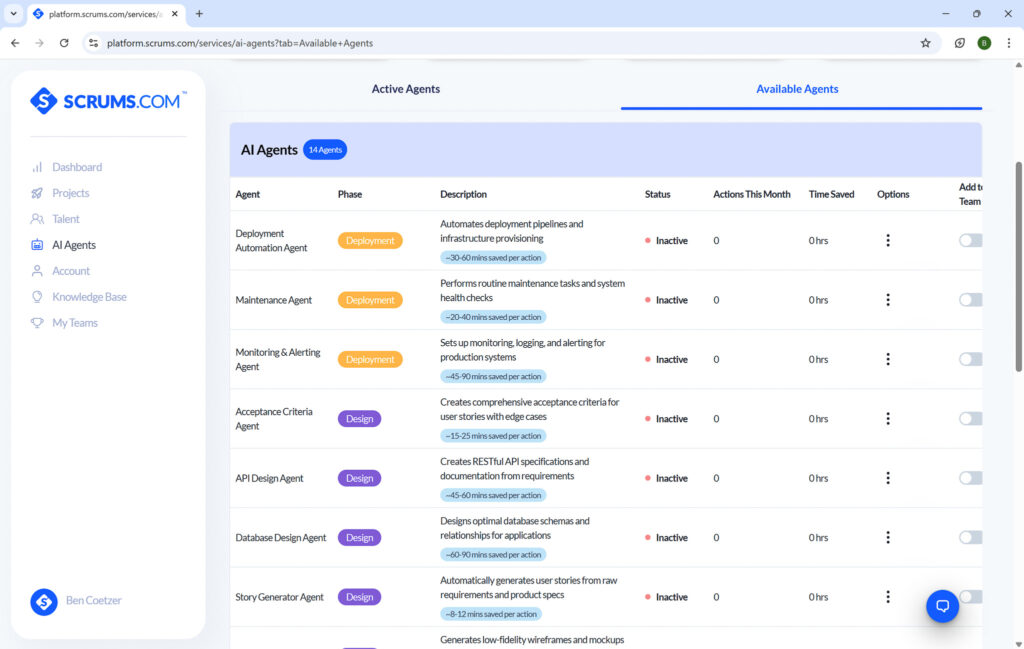
Scrums.com integrates AI directly into its engineering workflows through its AI Gateway, which lets you deploy a wide range of AI Agents across various stages of your project development cycle, such as QA, analytics, and delivery.
The AI Agents tab lets you add these tools at any point, view the total number of running agents, and see how much time and money you are saving by deploying these agents. For example, “60-90 minutes per action”, or “4 minutes per line of code”.
These AI features are built into the workflow rather than added separately, making them easy to use as part of everyday development activities.
The result is a more efficient process, as routine tasks are handled automatically, allowing teams to focus on building and improving software.
A streamlined approach to modern engineering
Using Scrums.com provides a clear view of how modern software development can be managed more effectively.
It brings together people, tools, and processes into a single system, and keeps your projects organised and teams aligned.
It allows businesses to handle complexity while maintaining control over their engineering operations.
Visit Scrums.com to explore its engineering operations platform and dedicated development teams.


















 Loading ...