

The SAP ECC deadline is not an IT deadline – it is an operational deadline



For African manufacturers and mining companies, 31 December 2027 is a strategic deadline with implications for operational continuity, cost, risk and competitiveness.
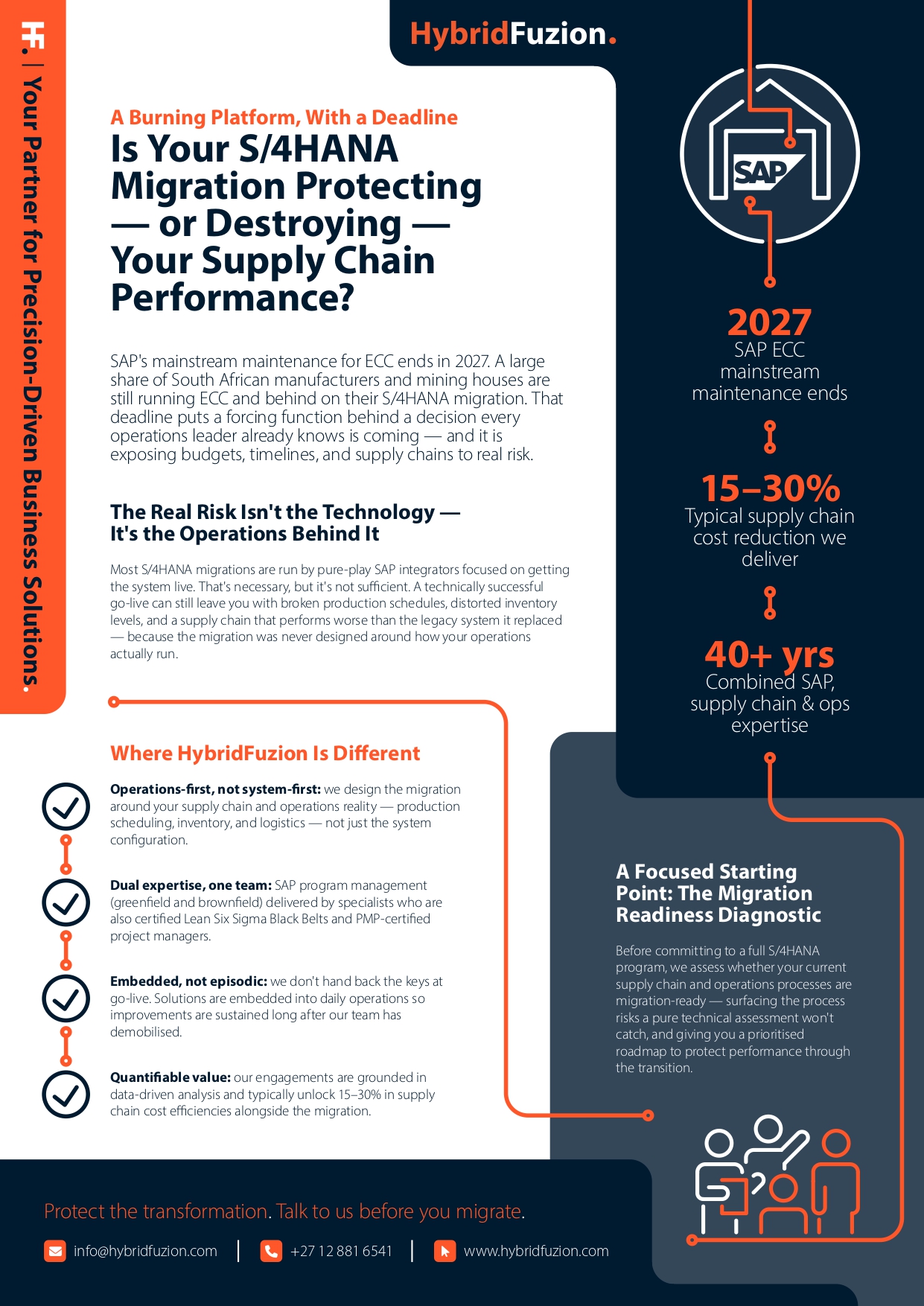
SAP has confirmed that mainstream maintenance for its Business Suite 7 core applications, including SAP ERP 6.0, will end at the close of 2027.
Optional extended maintenance will be available from 2028 until the end of 2030 at a premium of two percentage points.
Organisations that do not select extended maintenance, or reach its end, will move to customer-specific maintenance.
The migration is here
The 2025 SAPinsider SAP S/4HANA Migration Benchmark Report found that the end of maintenance and support was the leading migration driver, cited by 57% of respondents.
Only 32% had already transitioned to S/4HANA, while 27% were still implementing it.
African operations also face distinct realities, and the African SAP User Group material cautions organisations against assuming that a solution designed for a South African or core entity will automatically work elsewhere in Africa.
For African manufacturers and miners, migration complexity is intensified by:
- Multiple mines, plants, warehouses and distribution points.
- Ageing operational and infrastructure assets.
- Years of accumulated SAP customisation.
- Interfaces with planning, warehouse, fleet, maintenance and production systems.
- Dependence on contractors, transport providers and external suppliers.
- Significant working capital invested in inventory and spares.
- The requirement to maintain production throughout the transformation.
- Limited availability of experienced internal business resources.
Migration is not the same as transformation
An S/4HANA implementation can be technically successful and still damage the business.
SAP experts warn that even a technical or brownfield migration should not be treated as a simple lift and shift.
S/4HANA introduces different functionality, technologies and architecture, creating new considerations for security, controls and governance.
The operational priority is equally clear.
Operational performance guardrails should be established before design begins.
These should cover the outcomes that matter most to the organisation:
- Production schedule adherence.
- Plant and asset availability.
- Inventory availability and accuracy.
- Critical-spares service levels.
- Procurement cycle time.
- Supplier delivery performance.
- Forecast accuracy and planning stability.
- Working capital.
- Logistics reliability.
- Order fulfilment.
- User productivity.
The purpose is not to promise that every measure will improve immediately at go-live.
It is to prevent the program from making design decisions without understanding their operational consequences.
Every major process decision should answer four questions:
- What operational problem are we solving?
- Which performance measure should this decision influence?
- What could go wrong at the mine, plant, warehouse or distribution centre?
- How will we verify the process under realistic operating conditions?
The technology must work when the operation is under pressure, not only when the test script follows the expected path.
Do not migrate complexity simply because it exists
Years of ECC operation often leave organisations with accumulated custom code, local workarounds, duplicated reports and site-specific variations.
The migration creates a rare opportunity to decide what should be retained, redesigned, standardised or eliminated.
That decision cannot be made through technical usage statistics alone.
The objective should be a fit-for-purpose operational core: standard where standardisation creates value, differentiated where the business genuinely requires it, and free from complexity that no longer contributes to performance.
The differentiator is operational understanding
SAP implementation expertise remains essential.
Organisations need specialists who understand architecture, configuration, data conversion, security, integration, controls and cutover.
But technology expertise alone is not enough.
Mining and manufacturing businesses also need people who understand how planning affects production, how procurement affects maintenance execution, how material-master quality affects inventory and how a small workflow change can influence the reliability of an entire site.
This is where HybridFuzion’s operational perspective becomes the differentiator.
HybridFuzion does not replace the SAP systems integrator.
HybridFuzion connects program design to operational reality – helping leaders determine whether the migration:
- Protects operational continuity.
- Resolves or transfers existing weaknesses.
- Improves supply chain decision-making.
- Reduces unnecessary complexity.
- Leverages more of the SAP functionality already being paid for.
- Creates measurable operational value.
- Leaves the organisation more adaptable after go-live.
The ECC deadline provides an unavoidable reason to act. But urgency should not become an excuse for a technology-led migration that protects the deadline while putting operational performance at risk.
The ECC deadline creates the reason to act. Operational value must determine how you act.
Click here to learn more about how HybridFuzion will help your business migrate to SAP S/4 Hana.


















 Loading ...