

Domestic workers in South Africa are in serious trouble


The latest employment statistics published by Stats SA show that domestic worker jobs in the country continue to decline as workers face increasing financial stress.
While the quarter-on-quarter growth for the sector was up, the year-on-year tracking was down from Q2 2024.
Not only are domestic worker jobs shrinking year-on-year, but other finance reports point to this key demographic — women earning less than R5,000 a month — being under severe financial stress.
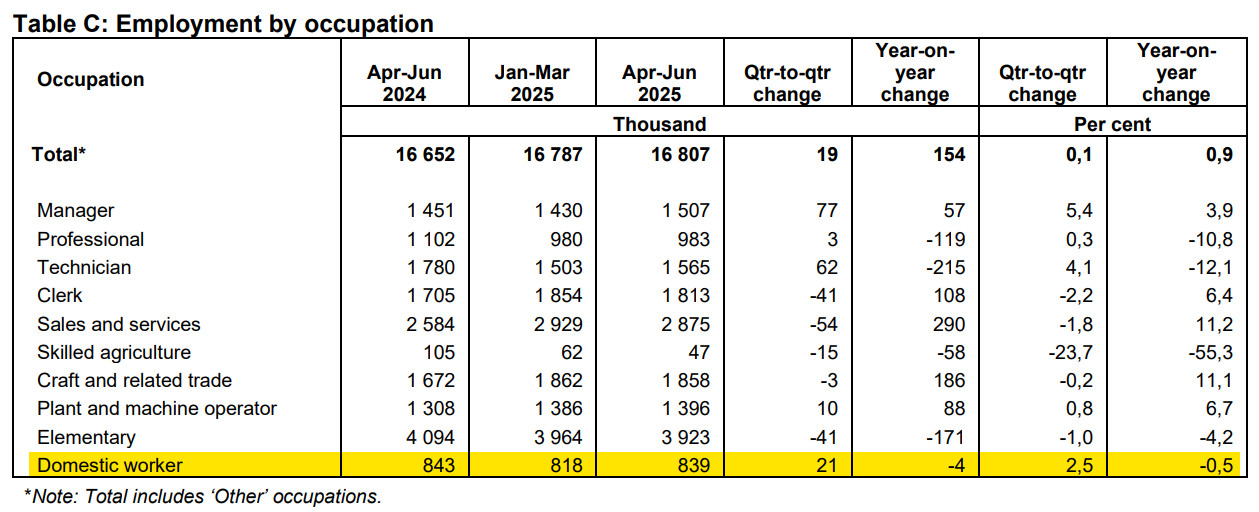
According to the latest Quarterly Labour Force Survey (QLFS) for the year’s second quarter, domestic worker jobs increased by 21,000 positions between April and June 2025.
While this is a 2.5% climb on the previous quarter to 839,000 positions, this is still down 0.5% (or 4,000 positions) from the same time in 2024.
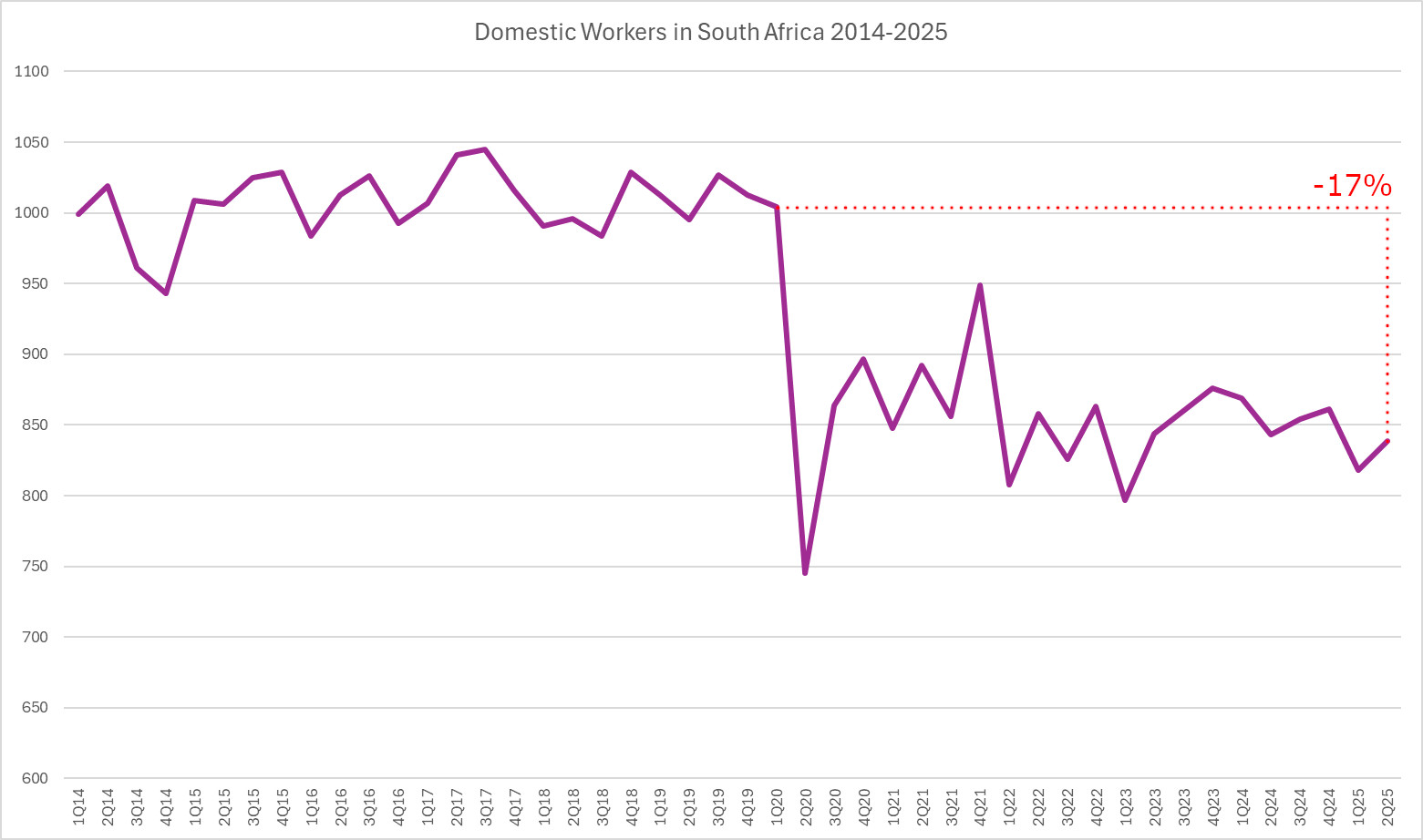
The longer-term trend shows that South Africa has permanently lost around 160,000 domestic worker jobs since the Covid-19 pandemic — a loss of 17% of all domestic worker jobs.
However, CEO of SweepSouth, Lourandi Kriel, said the long-term loss of domestic workers is even more pronounced, with the platform’s data pointing to about 1.2 million domestic workers pre-Covid.
“Before Covid-19, there were 1.2 million domestic work opportunities in South Africa. That dropped to 850,000 after Covid, and we’re now hovering between 800,000 and 850,000, and trending downward,” she said.
“This means 21% of domestic workers have lost all employment, and 36% have lost some form of employment.”
Kriel said that domestic workers are in a “serious and worsening” situation in South Africa, with fewer jobs available, declining earnings for many, and growing mental health challenges.
Many of these mental health challenges are directly tied to a deteriorating financial position, which adds multiple layers of stress.
In many cases, domestic workers are the primary breadwinners in a household, and with an average of four dependents, the pressure to earn enough to sustain the household is immense.
Financial stresses mounting
According to two recent studies by DebtBusters, tracking money stress and debt levels, it is evident that domestic workers are buckling under the pressure of a strained financial situation.
In the group’s Money Tracker for July 2025, it identified females earning under R5,000 a month as being the most stressed about their finances.
This particular demographic is most likely to turn to multiple sources to try and alleviate their money stress—such as selling personal items, cutting back spending, taking out loans, etc—and also reports the highest incidence of feeling “stuck” and unable to do anything to turn things around.
In DebtBusters’ latest Debt Index for the second quarter, the financial pressure is more stark, with those earning less than R5,000 a month also sitting with extremely high debt-to-income ratios.
Featuring mostly unsecured loans, this demographic has a rario of 94%, requiring 77% of net income to pay off loans each month.
This position has deteriorated over the years, moving up from a debt-to-income ratio of just 61% in 2020.
According to Debtbusters, the woes don’t end there. While inflation has increased 51% between 2016 and 2025, the average income has only grown 2%.
While net incomes for lowest tier earners have increased 11% between 2016 and 2025, this is still far below inflation of 51% over the same period. Worse still, debt levels for this income group have climbed 18%.
Domestic worker pay is also a significant issue in South Africa.
The National Minimum Wage sets pay for domestic workers at R28.79 per hour, which works out to an absolute minimum of R115 per day and up to R5,600 a month for a full-time employee.
However, SweepSouth’s 2024 domestic worker survey showed that these employees earn, on average, much less at R3,349 per month.
Median earnings data from Stats SA shows that domestic workers have the lowest median salaries in the country, coming in at around R2,350 a month.
This is less than half the national median of R5,417 a month.
“When you’re stressed about finding work and worried about putting food on the table, the anxiety and depression can be overwhelming,” Kriel said.


















 Loading ...