

Big turn for domestic workers in South Africa


While domestic workers remain one of the most vulnerable consumer classes in South Africa, the segment has seen a remarkable turnaround over the past five years when it comes to being in default.
According to the latest Eighty20/XDS Credit Stress Report for the third quarter of 2025, South African consumers in general showed improved diligence when it comes to handling their debts.
While the total loan balance in South Africa increased by 0.8% quarter-on-quarter, reaching R2.6 trillion, overdue balances dropped by R3 billion or 1.4% quarter-on-quarter, down to R212 billion.
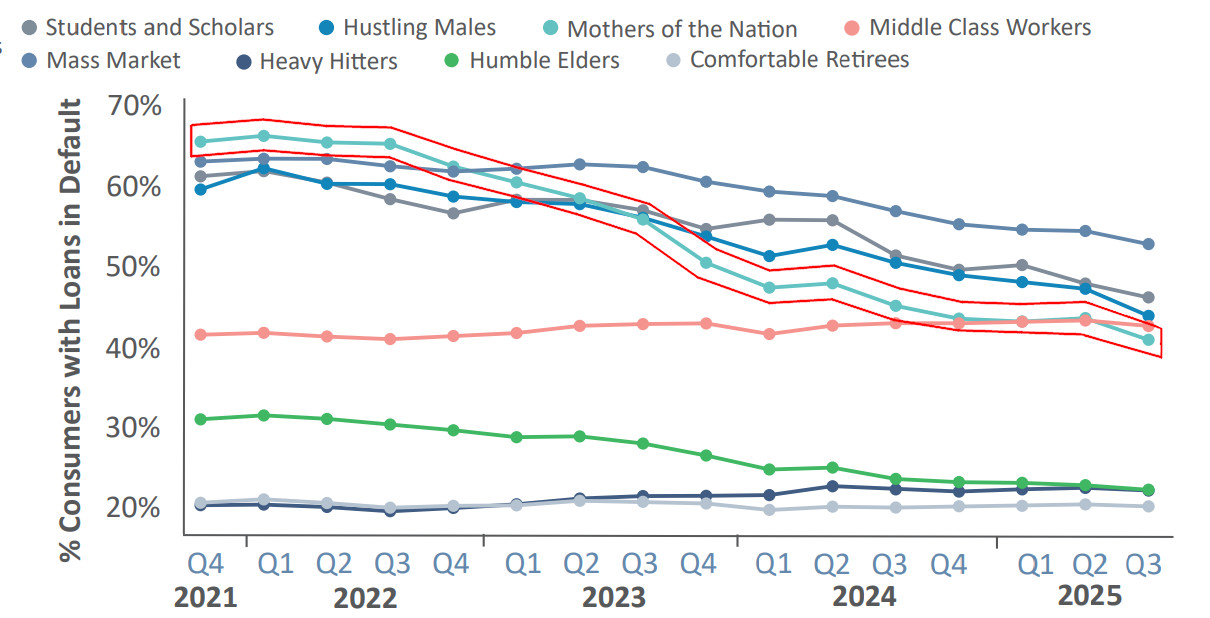
When looking at the market segmentation, there’s one class that really stands out as having turned things around: The Mothers of the Nation.
According to Eighty20’s segmental breakdown, the Mothers of the Nation are low-income, female grant recipients, mainly unemployed or underemployed.
The segment is represented largely by the 850,000 or so domestic workers and clerks of the country and represents one of the most vulnerable groups of consumers.
Like most South Africans, this segment has been under immense pressure over the past five years, struggling alongside everyone amid high inflation and interest rates in a stagnating economy.
However, unlike most segments, domestic workers in particular have been under severe stress due to being employed largely by private households.
Thus, their stresses were two-fold: their livelihoods under pressure from their employers suffering under the economic strain, and having to deal with that economic strain themselves.
As was the trend at the time, these workers turned to credit and loans to make ends meet, a significant number of whom ended up in default.
According to Eighty20’s data, by Q4 2021, the Mothers of the Nation segment had the highest levels of default out of all groups, around 75%.
This reflects credit-active individuals with at least one loan in default (or three-plus months in arrears).
However, the group’s latest report shows that default levels among this segment have decreased significantly, reaching just over 40% in Q3 2025 – lower than the middle class.
Default levels remain lowest for Heavy Hitters, Humble Elders and Comfortable Retirees, while the Mass Market continues to show the highest default prevalence.
Domestic workers still face immense pressure
While the Mothers of the Nation have staged a significant turnaround in their credit matters, the fact remains that the climate for domestic workers in South Africa remains bleak.
Domestic worker jobs are still largely informal and open to abuse.
SweepSouth’s domestic worker survey shows that these employees are still not getting paid in line with the National Minimum Wage, and administrative processes and protections like signing up to the Unemployment Insurance Fund (UIF) are not being done.
At the same time, the government and new unions are continually working to formalise the sector, which has the double-edged sword effect of making it less appealing for private households to take them on.
The sector has also been hit by other factors over the years, with semigration and emigration also impacting jobs, as employers move away.
According to the latest employment data from Stats SA, employment in private households—the primary employer of domestic workers—increased by 5,000 or so jobs over the quarter, a rise of 0.5% from Q2.
However, year-on-year, the total number of jobs declined by 1.5%, resulting in a 17,000 position decrease.
Looking at domestic worker jobs specifically, the number of domestic workers increased by 9,000 since the second quarter, but the annual data still shows a decline of 0.7%.
Tracking the jobs data over a longer period, domestic worker positions haven’t moved higher than the 880,000 mark in almost four years.
This reflects a permanent loss of around 150,000 domestic worker jobs in the country since the COVID-19 pandemic.
Pre-pandemic (Q4 2019), figures fluctuated around 1 million domestic workers. When factoring in the seasonal variations and potential base, groups like SweepSouth put the figure closer to 1.2 million.
However, since lockdowns ended and the pandemic was declared over, the sector simply never recovered.
















 Loading ...