

Major petrol price and food price win for South Africa comes with a big catch


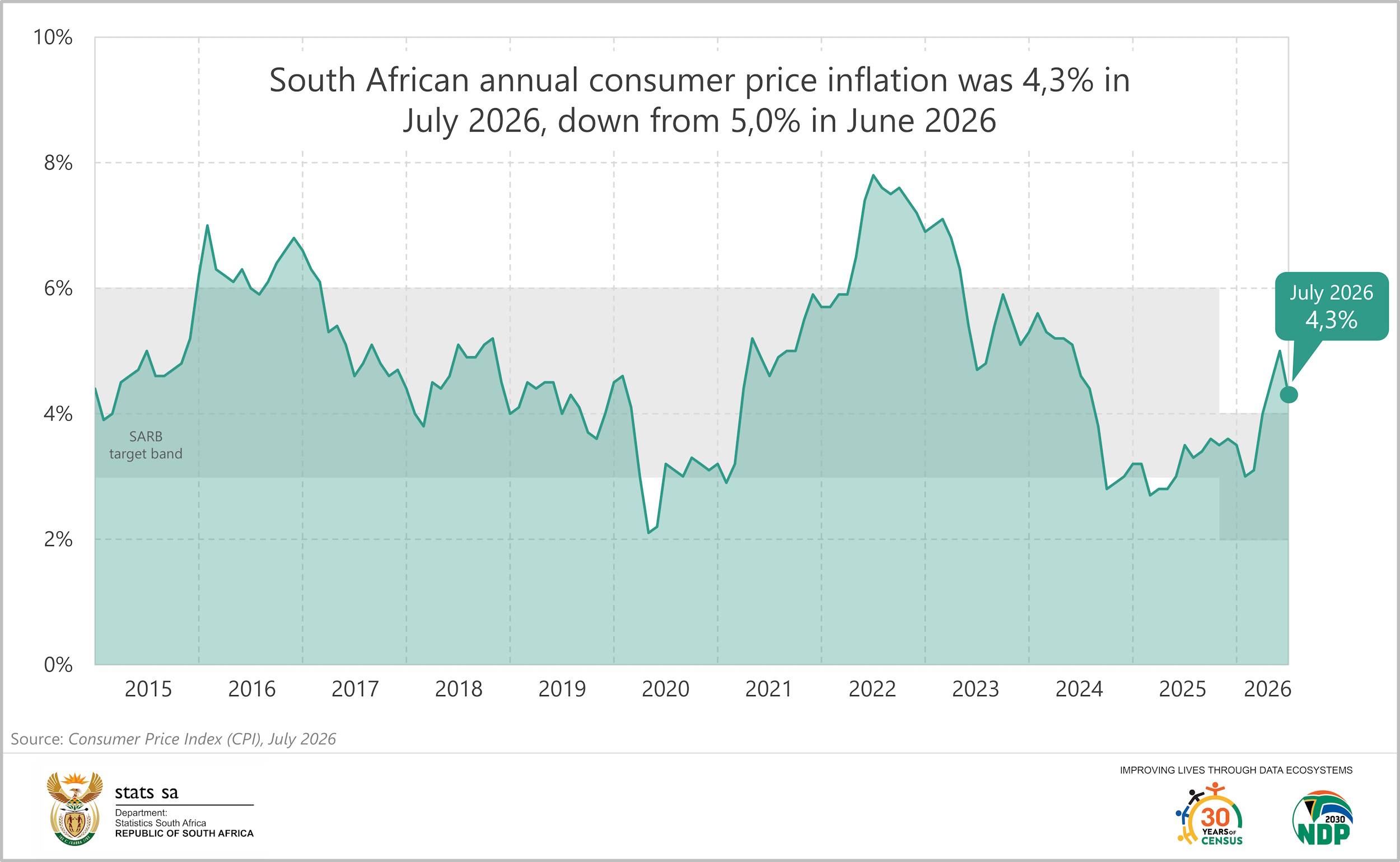
The headline inflation rate cooled for the first time in five months, declining to 4.3% in July from 5.0% in June.
The monthly increase in the consumer price index (CPI) was 0.2%, down from 0.7% in June.
The lower inflation rate was in line with market expectations, given the lower petrol and diesel prices that month—but the same reasoning has raised warning flags for inflation in August and likely September.
According to Stats SA, the slowdown can be attributed to softer food inflation, lower municipal tariff increases compared to last year, and a monthly decline in fuel prices.
The petrol price cut in July was a major factor. Petrol prices were cut by R1.96 per litre that month, and diesel prices were cut by R3.59 per litre.
Petrol prices decreased by 7.1% and diesel by 11.7% between June and July, pulling the annual rate for fuel down to 20.6% from 34.3% in June.
This led to annual transport inflation cooling to 8.9% in July from 12.7% in June.
However, despite the monthly decline, petrol is 19.3% and diesel 28.8% more expensive than a year ago.
Adding to the red flags, diesel prices also rose in August and are currently on track for petrol and diesel price hikes in September.
This means that inflation readings for August and September may once again spike higher, making the July dip a temporary grace.
According to Investec Chief Economist, Annabel Bishop, the bump in August and expected R2.50-plus hike in diesel prices in September will likely push inflation back up to 5.0% y/y.
Helping alongside lower fuel prices in the month were softer municipal tariff increases.
Municipalities implement their tariff increases in July each year. Most CPI tariff categories saw lower increases in 2026 than in 2025.
However, this is in the context of all tariffs being higher than the Reserve Bank’s 3% inflation target.
Electricity tariffs rose by 8.1% in 2026, down from a rise of 10.4% in 2025. A similar pattern was recorded for water tariffs (10.2% compared with 12.1%) and refuse removal (4.7% compared with 6.6%).
One exception was sewerage tariffs, which increased by 7.8% in 2026, higher than the 6.5% rise recorded in 2025.
Property assessment rates increased by 4.9% in both 2025 and 2026.
Great news for food prices in South Africa
Something that is not a temporary dip, however, is food prices.
According to Stats SA, food inflation has hit its lowest point in 16 years, with the annual rate for food & non-alcoholic beverages (NAB) declining to 0.9% in July.
The last time food NAB inflation hit these levels was June 2010 when it was 0.7%. Incidentally, that was the month when South Africa hosted the FIFA World Cup, the stats body noted.
Investec’s Annabel Bishop said that food price deflation has helped South Africa’s CPI greatly.
“CPI inflation would be at 5.8% y/y instead of 5.0% y/y, if food and non-alcoholic beverages prices were excluded,” she said.
However, she warned that this, too, will wane over the rest of 2026 and into 2027. This is likely to happen alongside lower oil and fuel pricing, which should balance it out.
The lower rate for food & NAB in July 2026 was mainly due to cereal products and meat. Cereal products recorded an annual change of -2.0%, down from -1.5% in June.
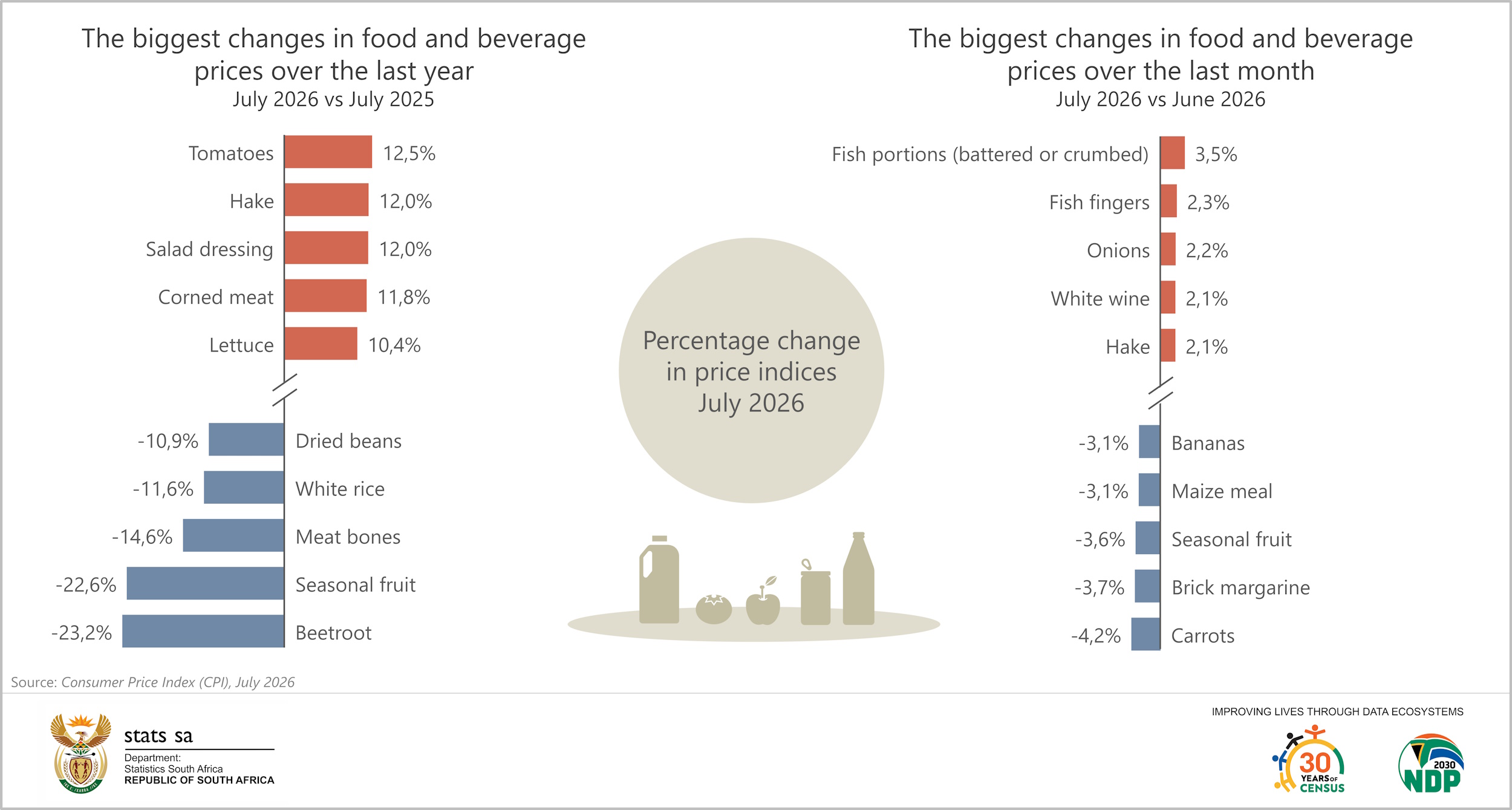
Several products recorded softer monthly rates, most notably maize meal (-3.1%), macaroni (-0.7%) and white bread (-0.6%).
Annual meat inflation slowed to 1.5% from 5.1% in June.
Unprocessed beef products reflected negative annual price changes, with stewing beef at -7.9%, beef steak at -6.1% and beef mince at -5.8%.
However, several processed meat products recorded an increase, including corned meat (+11.8%), meat patties (+7.8%), russians (+7,7%) and sausages (+6.2%).
Food & NAB categories that registered higher annual inflation rates in July include fruits & nuts; fish & other seafood; vegetables; oils & fats; cold beverages; and milk, other dairy products & eggs.
Oils & fats, for example, saw their rate rise from 2.3% in June to 2.8%.
Several fish products recorded sharp monthly increases, including battered or crumbed fish portions (+3.5%); fish fingers (+2.3%); hake (+2.1%); and canned fish (excluding tuna) (+2.0%).















 Loading ...