

These cars are the least-safe to drive in South Africa


The Automobile Association (AA) has published its second annual Entry-Level Vehicle Safety Report that assess the safety features on entry-level vehicles in South Africa – those cars that come with fewer safety features.
The report considered the safety features of 25 vehicles available in South Africa currently priced under R160,000. This is R10,000 (6.7%) more than the vehicles the AA considered previously, to account for an increase in inflation.
According to figures from the Road Traffic Management Corporation (RTMC) 14,071 people died on South African roads in 2016.
While efforts to reduce this number are ongoing, it comes against the backdrop of data from the National Traffic Information System (eNaTIS) that shows the total vehicle population in the country remains high at just under 11 million (10 967 958) vehicles.
Of these just over 7 million (7,140,959) are classified as motor cars or station wagons.
These two figures – the high fatality rate, and the high vehicle population – again highlight the need for safer driving for everybody, the association said. This includes increased road safety awareness initiatives, better policing and enforcement of road regulations, and a wholesale improvement in driver attitudes.
It also emphasises the need for improved safety features in the vehicles people drive.
The purpose of the research, the AA said, is to highlight the importance of safety features in new cars, understand how these features can save lives, and encourage new car buyers to consider safety in their decisions, and not only price.
“Price is, unfortunately, a main driving factor in people’s decisions to buy vehicles. What we would like to see more of is people considering other elements of the vehicles they intend buying such as safety features, which can mean the difference between life and death,” the AA said.
“In our first report last year we highlighted the disconnect between price and safety on entry-level vehicles; cheaper models seemed to have limited safety features. It is disappointing that vehicles listed in last year’s report, most of which are still on sale, carry similar, if not the same, limited safety equipment as standard,” it said.
The AA developed a safety point-based system with relevant weights allocated to the existence of certain safety features.
Active safety features such as ABS and ESC were given the most significant weights (30points each), as the importance of their core function of avoiding collisions is recognised.
In relation to passive safety features, focus is placed on the presence of the number of airbags available, with each of the airbags scoring 10 points.
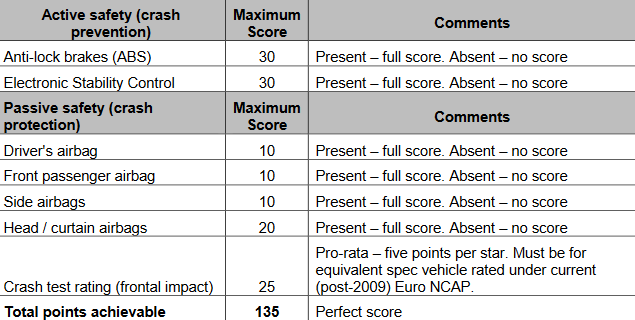
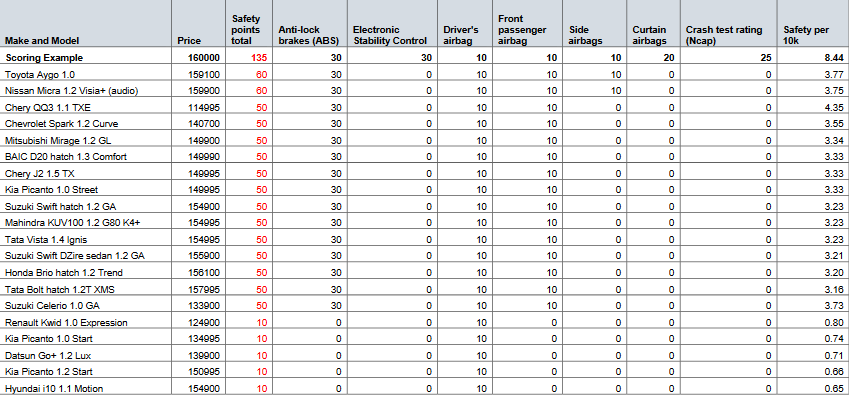
The 25 vehicles surveyed for the second instalment of the report were evaluated against the number of active safety features they have (anti-lock braking systems, electronic stability control), and passive safety features (airbags).

Vehicles with an NCAP rating (New Car Assessment Programme) from Europe were awarded points according to the safety rating they achieved. The scoring for the NCAP rating is only applied if the model of the vehicle on sale in South Africa is confirmed to be identical to the model which received the NCAP rating initially.
The report did not consider the structural integrity of the driver/passenger compartment, the association pointed out.
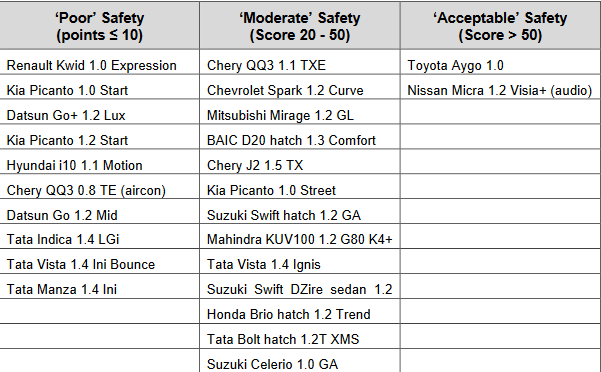
Of the 25 vehicles assessed, only two are categorised as having acceptable safety. Thirteen of the vehicles are categorised as having moderate safety, and ten are classified as having poor safety.

“Safety features on vehicles are critical elements which can provide much-needed protection in the event of a crash. What we’d like to see is that all car manufacturers include more safety features in their vehicles, and to make more use of international safety ratings such as NCAP from the region of manufacture or importation.
“In this way, we believe, customers will be better placed to know what they are getting in terms of safety,” the association said.
The AA’s Entry-Level Vehicle Safety Report is available here


















 Loading ...