

Sustainability in practice: How innovation is reshaping sustainable finance


Sustainable finance is often reduced to a narrow set of tools—green bonds, renewable energy projects, or net‑zero commitments. But in practice, it is evolving into something far more complex and far more consequential. Innovation today is less about labels and more about how capital is structured, how policy enables markets, and how economies navigate the transition from where they are to where they need to be.
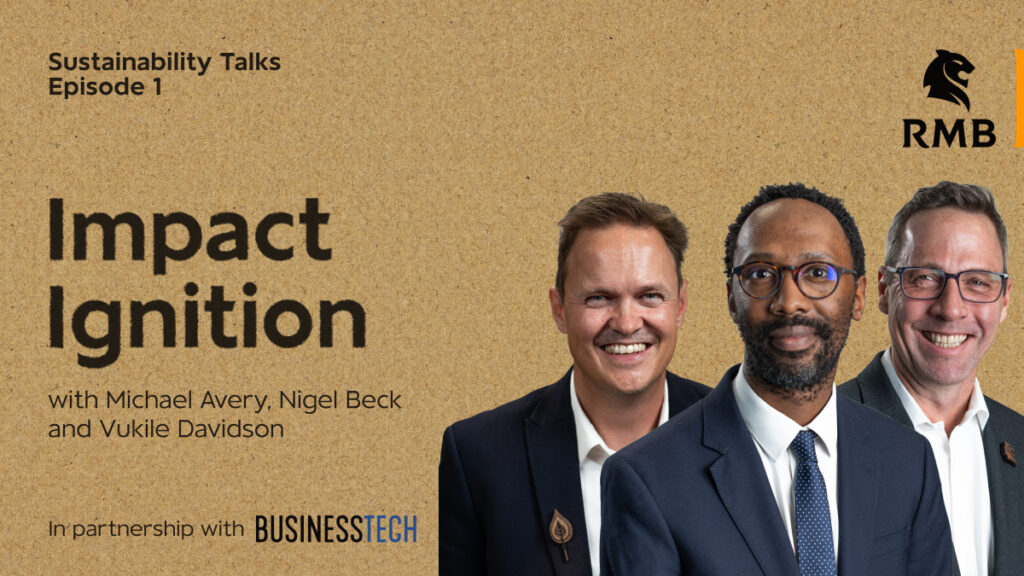
That is the focus of Episode 1 of Sustainability Talks, where Michael Avery speaks to Nigel Beck, Head of Sustainable Finance and ESG at RMB, and Vukile Davidson, Chief Director of Financial Sector Policy at National Treasury. Their conversation explores how sustainable finance is changing in practice—and why South Africa has a unique opportunity to shape that evolution.
Beyond green: where innovation really happens
Green and social bonds remain important, but they are often the outcome of innovation rather than its source. The deeper shift is happening upstream, in the design of financial structures that link capital to long‑term outcomes.
Markets are increasingly moving toward structured and performance‑linked instruments—including sustainability‑linked loans and transition finance—where pricing is tied to measurable progress. These tools recognise a fundamental reality: decarbonisation is not instantaneous, particularly in energy‑ and carbon‑intensive sectors such as steel, cement, petrochemicals, and power.
Innovation, in this context, means financing credible pathways, not overnight transformation.
Transition finance and the real economy
Transition finance is emerging as one of the most important developments in sustainable finance because it addresses the real economy as it exists today. Much of South Africa’s industrial base is not yet “green,” but it underpins jobs, exports, and economic stability.
Rather than withdrawing capital, transition finance focuses on measurable emissions reductions over time, supporting companies as they move along clearly defined decarbonisation pathways. As Davidson notes, this requires thinking in terms of journeys rather than step changes—shifting the economy gradually while maintaining global competitiveness.
Policy as an enabler
Sustainable finance does not operate in a vacuum. Policy plays a central role in shaping incentives and directing capital toward priority areas.
In South Africa, tools such as the carbon tax, the green finance taxonomy, and aligned disclosure frameworks are designed to provide clarity to investors while balancing ambition with economic reality. This balance is becoming increasingly important as global mechanisms like the EU’s carbon border adjustment begin to influence trade and investment decisions.
Countries that offer consistency and interoperability with international standards are better positioned to attract long‑term capital.
From mitigation to resilience
Another shift highlighted in the discussion is the growing emphasis on adaptation finance. As climate impacts intensify—through floods, droughts, and extreme weather—markets are recognising that mitigation alone is no longer sufficient.
Financing climate‑resilient infrastructure, water security, agriculture, and insurance solutions is becoming central to economic resilience. Transition finance, adaptation finance, and carbon markets are increasingly interconnected, requiring coordinated frameworks rather than isolated solutions.
A generational opportunity
Looking ahead, the conversation points to a rare opportunity for South Africa. With the right policy signals, credible frameworks, and public‑private collaboration, the country can position itself as a bridge between global capital and African opportunity.
Success will not come from copying global models wholesale, but from adapting them to local realities while remaining globally credible. Over time, sustainable finance becomes embedded across markets, sectors, and balance sheets.
As Sustainability Talks shows, the future of sustainable finance is shaped not by slogans, but by the ability to navigate complexity and mobilise capital in ways that deliver lasting economic, social, and environmental value.
Watch the first Sustainability Talks episode with Nigel Beck and Vukile Davidson below.

















 Loading ...