

SA behind Tunisia in Africa Web ranking


South Africa is ranked 36th out of 61 countries in a new global study that measures the use, utility and impact of the Web on the world’s people and nations.
The Web Index, designed and produced by the World Wide Web Foundation puts Tunisia in first place (30th overall) in Africa, while South Africa is second regionally, followed by Egypt and Mauritius. Kenya takes first place in terms of Economic Impact of the Web, though it ranks fifth in the region overall.
Globally, Sweden tops the rankings, followed by the US, the UK, Canada, and Finland.
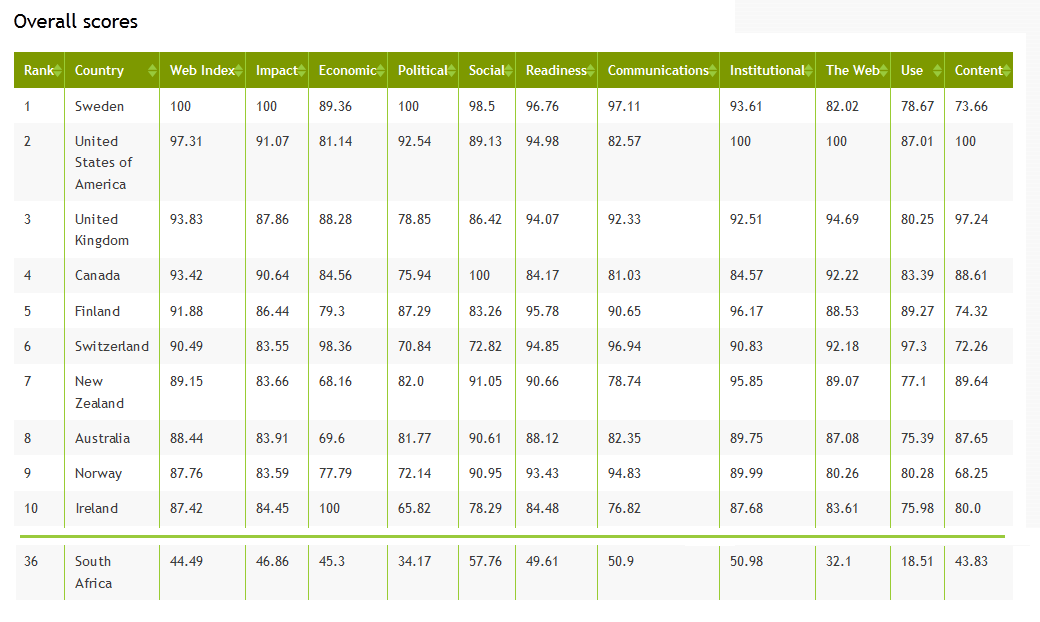
Web Index top 10 (Click to enlarge)
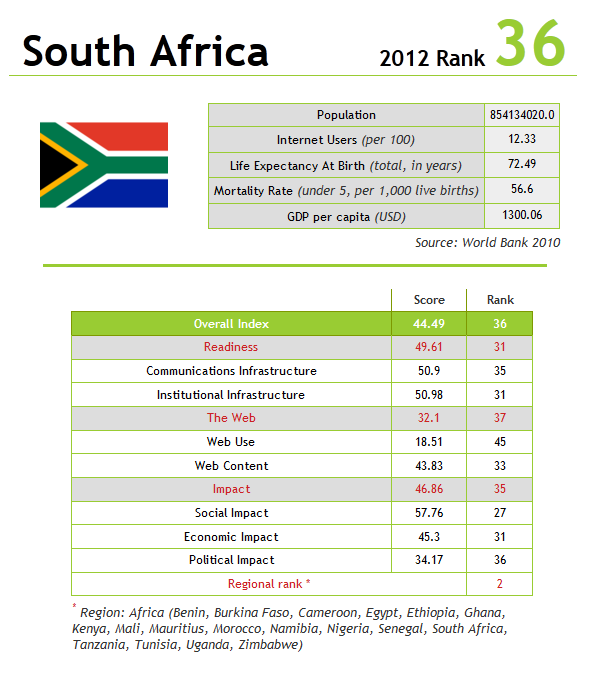
South African ranking
The Web Index is a composite measure that summarizes in a single number the impact and value derived from the Web in various countries.
Countries are ranked according to readiness (communication and infrastructure), Web usage, and impact (social, economic and political).
Of the countries that appear at the end of our ranking, seven are in Africa and two are in the Asia-Pacific region. These include Nepal, Cameroon, Mali, Bangladesh, Namibia, Ethiopia, Benin, Burkina Faso and Zimbabwe.
The country that ranks lowest on the Web Index is Yemen, which underwent a political uprising last year as part of the Arab Spring. “As a new constitution is rewritten in Yemen, steps are being taken to slowly improve available content on the Web,” according to the foundation behind the research.
According to the research, these low-ranking countries suffer from a vicious cycle of poor infrastructure and high costs of access.
The World Wide Web Foundation noted that with more than a trillion estimated public pages and roughly 3.4 billion users, the Web is no longer merely a place to seek content and information, but to actively connect with friends and peers, debate globally critical issues, collaborate and conduct business, and even create breakthrough innovations.
“And with the rapid global adoption of smart phones, tablets and other devices that are less expensive than traditional computers and laptops, the World Wide Web is increasingly accessible to an ever-growing population,” it said.
However, despite the increasing ease of access, more than 60% of the world’s population do not have access to the Web, and are therefore excluded from directly benefiting from it.
“We believe that if access to the Web increases dramatically, there will be significant social development and greater political representation among the billions of people who currently have no voice,” the group said.
SA online economy at 2.5% of GDP by 2016
SA online economy at R103bn by 2016












 Loading ...