

This is how coalition talks could play out in South Africa


Coalition discussions and upcoming ANC meetings are the focus in South Africa following last week’s municipal elections, particularly in the major metros.
According to financial analysts, Nomura, these local election results represent a real and immediate existential threat to the ANC as a party with control of metros, and it may lose control of up to 85% of municipal budgets.
They also threaten the loss of a majority in the 2019 provincial elections in Gauteng, it said.
“Overall, we view the swing away from the ANC as largely a protest vote that opposition parties must solidify into true support. We view it as a result of leadership problems, scandals, corruption, lack of growth, lack of jobs creation and lack of service delivery,” Nomura said.
Read: This is how coalitions work in South Africa
That said, the ANC remains the largest individual party nationally with 53.9%, but there was a substantial 8.2% swing away from it compared with the last municipal elections.
The DA increased its support to 26.9% nationally, while the EFF increased its vote share from the 2014.
Nomura noted that smaller parties like IFP and VF+ did very well nationally, not just in traditional strongholds.
Councils and metros had 14 days from Saturday’s official announcement of the results to elect a council speaker and an executive mayor. That is the time frame for coalition talks, which have already begun, with particular focus on the three major metros of Joburg, Tshwane, and Nelson Mandela Bay, in Port Elizabeth, where no party won an outright majority.
Joburg Metro
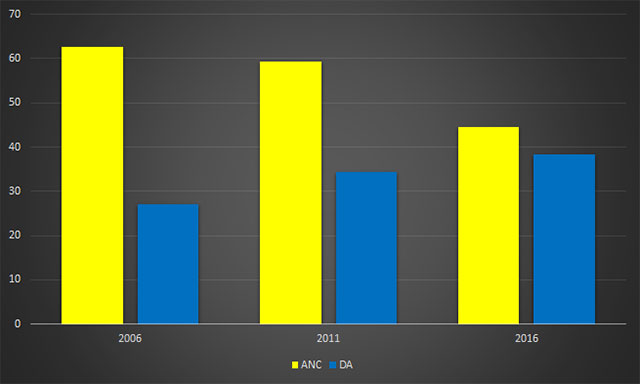
Tshwane Metro
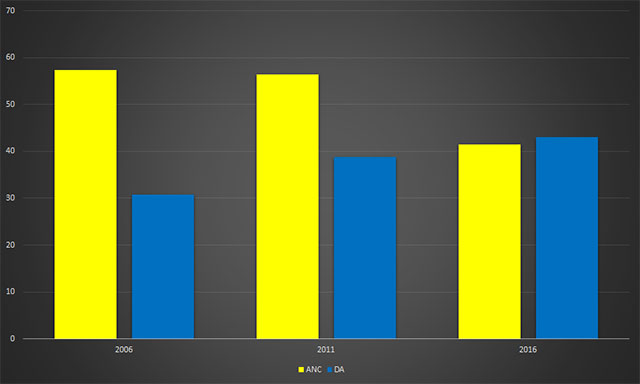
Nelson Mandela Bay Metro
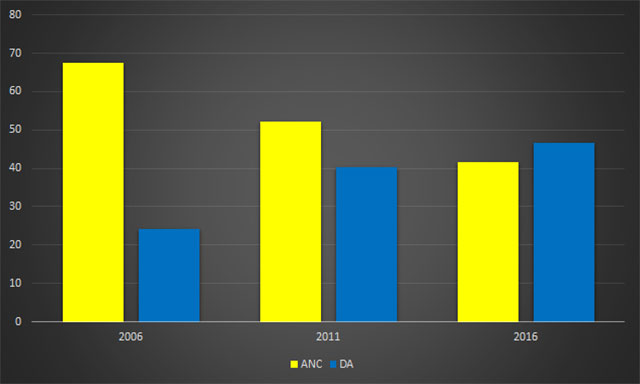
How will the coalitions unfold?
According to Nomura, if no coalitions can be formed a council can elect to rule by executive committee in a grand coalition where the mayor is basically a committee with representatives from each party by support level which is tasked with service delivery.
“If such a format doesn’t work the government can take over operations of a municipality. A new election should then be called. The same can occur if coalitions fall apart further down the line,” it said.
Talks underway
Nomura said it believes that the ANC and DA are approaching coalition talks in very different ways. “The ANC is attempting piecemeal agreements at the local and provincial level to secure support for individual metros and councils – especially JNB.
“However, the DA is seeking national-level agreements that strategically offer council vote support (though not necessarily governing coalitions) around the country for other parties in return for assistance in the major metros. This is especially relevant to the EFF, which could control a number of municipalities in the north,” the analytical company said.
It pointed out that the EFF has not fully closed itself off from coalitions with the ANC, though it has said they are unlikely, its membership base does not want them and the conditions it has set are too high – removal of President Zuma, a corruption trial for the Guptas, changes in ministers, and acceleration of national land reform policy.
Nomura warned that any ANC/EFF coalition would present a risk for investors. “And even without these conditions it would likely make demands regarding national government policy that are unlikely to be investor-friendly,” it said.
Read: 2016 Elections: How it all unfolded
Nomura said that DA policy agreements with the EFF (and smaller parties), however, are likely to be more solidly metro- and municipality-focused and therefore constrained by the limited policy powers available at this level.
It said that there could be significant agreement between the DA and EFF on giving tenure and land rights to townships and informal settlements from previously council-owned land without any messy issues around compensation etc.
“We believe the DA would seek to keep a tight rein on procurement in any coalition with EFF, and at a metro-level procurement is controlled a lot more by the Treasury function than it is at provincial or national level. However, some oversight would clearly be needed of EFF activities if it were allocated key portfolios that had an ability to tender or contract.
“As such, we would expect DA agreements to have regular reviews (maybe quarterly) and break clauses,” Nomura said.
The same might be said of the ANC, though there could be less oversight or formality if things are done on a piecemeal basis, it said.
Likely coalition outcomes
Overall, Nomura said it expects a DA-led coalition in Nelson Mandela Bay with smaller parties, though EFF may have to enter it as part of any national agreement.
In Tshwane, it expects a DA/EFF/smaller party coalition, with the DA using small parties to counterbalance EFF but also given the need for a national strategic view.
Similarly, in Joburg, it expects a DA/EFF/smaller party coalition is possible but this is the key one to watch for ANC possibilities.
“Broadly we expect the DA to welcome most smaller parties into the fold – especially COPE, UDM, VF+ and maybe IFP. Smaller parties will likely look to show governance experience,” Nomura said.
It views the EFF as pragmatic but unpredictable. “We think it will likely want to enjoy the credit for decent service delivery from DA heavy-lifting, but could be happy to blame failures on the DA and stage mass protest action in a way the DA is not as experienced with.
“We therefore view coalitions as inherently unstable and at risk of falling apart, and so see a moderately high likelihood of early municipal election reruns as well as court cases over attempted government takeover of municipalities and metros where coalition agreements fall apart. Coalitions are not unknown in South Africa but are rare, Nomura said.
The analysts at Nomura stressed that just as there are capacity constraints in the ANC, so too are there in the DA – and smaller parties. “Taking over so many new metros will stretch the DA’s capacity for governance and its pool of talent.”
The DA traditionally has been a Western Cape-focused party, but now it will have to utilise its connections to business, consultants and others to deliver on this scale.
Nomura said that the depth of ANC cadre deployment and capacity constraints of the civil service in the major metros is a key challenge and will constrain any rapid progress by the DA.
And ahead of the 2019 elections, time is not on the side of the blue party.
More on coalitions
ANC to defy Zuma by meeting EFF over a coalition – report
















 Loading ...