

1% of people control half the world’s wealth – and you’re probably one of them


A new report by charity group, Oxfam, highlights the deeply-rooted levels of wealth inequality in the world, with estimated that the world’s richest 1% now have more money than the rest of the world, combined.
The report has been released ahead of the World Economic Forum to be held this week – where the world’s richest and most influential businessmen and women meet to discuss a host of topics relating to the global economy.
It is often released as a damper on the WEF, which is often seen as a talk shop for the elite, with little regard for the real problems being faced by the vast majority of the world’s population.
According to Oxfam, total global wealth has reached a “staggering” $255 trillion. Since the end of 2015, more than half of this wealth has been in the hands of the richest 1% of people, the group said.
At the very top, this year’s data finds that collectively the richest eight individuals have a net wealth of $426 billion, which is the same as the net wealth of the bottom half of humanity.
These people are:
- Bill Gates – $75 billion
- Amancia Ortega – $67 billion
- Warren Buffet – $60.8 billion
- Carlos Slim Helu – $50 billion
- Jeff Bezos – $45.2 billion
- Mark Zuckerberg – $44.6 billion
- Larry Ellison – $43.6 billion
- Michael Bloomberg – $39.6 billion
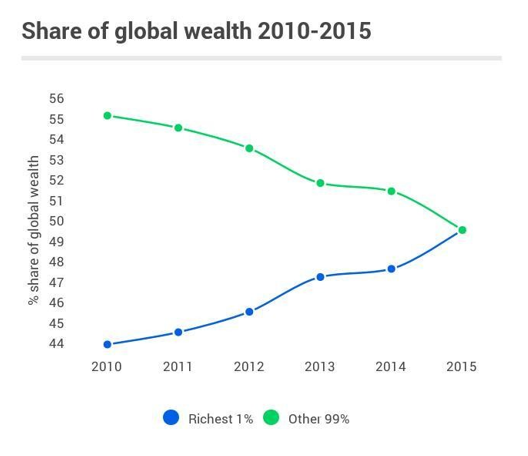
Oxfam’s calculations are based on the Forbes Billionaires list for 2016 and the 2016 Credit Suisse Global Wealth Databook.
While many will gawk at this shocking level of inequality, it will be without the realisation that they are likely part of the 1% of earners – rather than being in the poorer 99%.
According to the Global Rich List (which uses global wealth data from 2012), all it would take to join the top 1% of earners in the world is a net annual income of R176,000. However, this would only make you a top earner, not one of the world’s ‘richest’ people.
To crack the world’s richest 1% (in terms of total wealth), you would need a net worth of R4.15 million (including all equity, assets and investments).
Oxfam said that over the last 30 years the growth in the incomes of the bottom 50% is zero, whereas incomes of the top 1% have grown 300%. Further, the incomes of the poorest 10% of people increased by less than $3 a year between 1988 and 2011, while the incomes of the richest 1% increased 182 times as much.
“Left unchecked, growing inequality threatens to pull our societies apart. It increases crime and insecurity, and undermines the fight to end poverty. It leaves more people living in fear and fewer in hope,” the group said.
The WEF itself has highlighted inequality as one of the biggest global problem areas, but has pointed out that, while inequality within countries is rising, global inequality is actually falling.
In the last 15 years, extreme poverty has been halved, the group said.
Read: These 3 graphs show how South Africa’s wealth distribution has changed since apartheid







 Loading ...