

House prices vs income in South Africa’s major regions


House price comparisons between regions in South Africa can be flawed, because they do not take into account the differing structural characteristics, says First National Bank (FNB).
Using macro-affordability measures such as an average house price/per capita income ratio, the lender notes that Gauteng is the most affordable of the big provinces, with the Western Cape the second most affordable, despite recent surge in price growth.
KZN and the Eastern Cape are significantly less affordable due to their having far lower per capita incomes, FNB said.
“These affordability rankings, however, cannot be interpreted as saying that a “young professional” for instance in the Western Cape more easily affords a given level of home than the equivalent young professional in the Eastern Cape,” said household and property sector strategist at FNB Home Loans, John Loos.
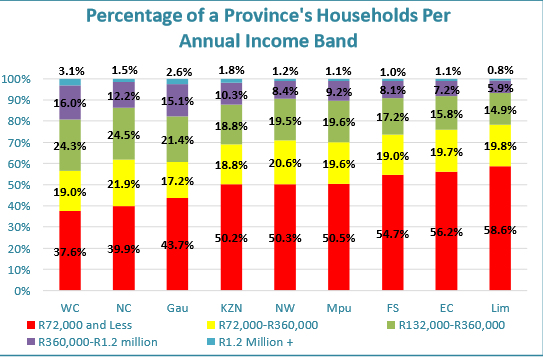
“Rather, they are probably saying that there are far more low income households in the Eastern Cape and KZN who live outside of the mainstream formal housing market.”
For the normal middle class candidates for the formal housing market, the affordability challenges in the Western Cape are actually probably more severe than in the Eastern Cape and KZN, which is reflected more in the rising (deteriorating trend) in that province’s house price/per capita income ratio in recent years along with a lower estimated 1st time buyer percentage in the Western Cape.
Gauteng, by comparison, seems to have the least challenging affordability situation for its inhabitants in recent times, Loos said, having the lowest house price/per capita income ratio, the highest per capita income, the highest estimated first time buyer percentage of major metro regions, and the lowest average home buyer age of the 9 SA provinces.
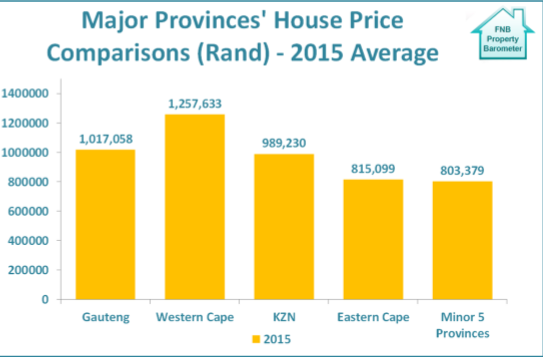
For many years, the Western Cape has had the highest average house price of any of the 9 South African provinces.
In 2015, the Western Cape’s average house price was estimated at R1.258 million. This was significantly higher than 2nd placed Gauteng with its estimated average house price of R1.017 million.
“However, this does not automatically imply that the Western Cape possesses the least affordable housing for its inhabitants of any of the major provinces.
“To the contrary, the Western Cape is theoretically one of the more affordable regions, if one uses certain standard “macro” affordability measures,” said Loos.
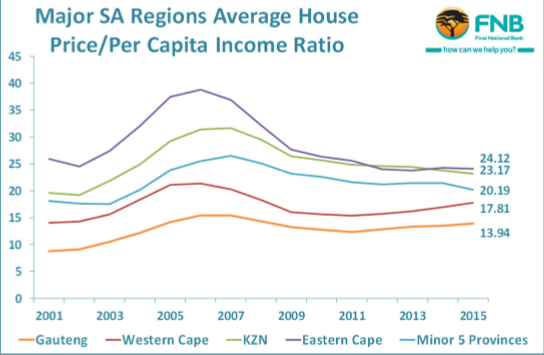
Using IHS Markit estimates for Annual Per Capita Income along with FNB Provincial House Prices Prices, FNB noted that the average house price/per capita income ratio for Gauteng was 13.94 as at 2015, with the Western Cape the 2nd most affordable with a ratio of 17.81.
KZN, with average house price of R989,230 in 2015) and the Eastern Cape (average house price of R803,379 in 2015) were less affordable, with significantly higher average house price/per capita income ratios of 23.17 and 24.12 respectively.
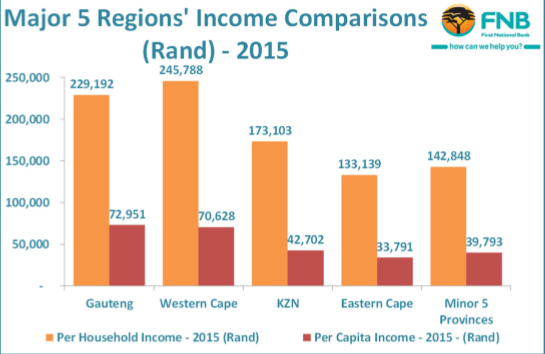
The reason for KZN and Eastern Cape having cheaper homes but being less affordable is far lower per capita incomes (R42,702 and R33,791 in 2015 respectively), compared to Gauteng (R72,951) and the Western Cape (R70,628), FNB said.
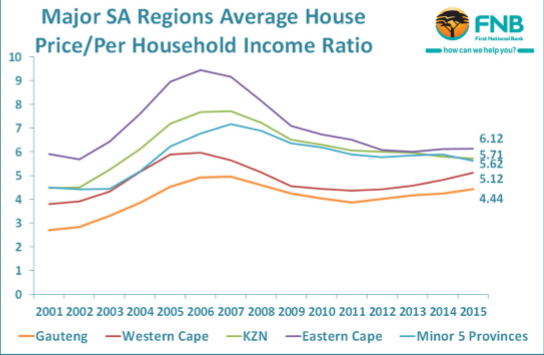
From 2010 to the present, FNB is of the opinion that the Western Cape’s housing market has become the most over-heated relative to the other major South African regions, despite its income to house price ratio, the property expert said.
“Our approach is firstly to examine cumulative house price inflation, where the Western Cape has out-paced other regions significantly.
“This has caused the province’s average house price/per capita income ratio to deteriorate (rise) more than those ratios in the other major provinces, from 2010 to 2015 – 2016 income data is not yet available,” Loos said.
The Western Cape home affordability ratio climbed from 15.4 in 2011 to 17.8 in 2015. Over the same period, the Gauteng ratio had deteriorated (risen) to a lesser degree, from 12.3 to 13.9.
The KZN ratio on the other hand had declined (improved) from 24.8 to 23.2, and the Eastern Cape had also improved (declined) from 25.6 to 24.1, FNB said.
Loos said that while the 2016 per capita income data is not yet available, the average house price growth in the Western Cape strengthened to 9.4% in 2016, from 2015’s 9.2%, while the next strongest growth rate was KZN with 3.1%, Gauteng 2.1% and Eastern Cape 1.8%.
“This suggests that the Western Cape’s affordability ratio probably deteriorated more than the others once again in 2016,” he said.
“Arguably faring the best in recent times in terms of affordability for its inhabitants is Gauteng, taking all of the indicators into account.
“Gauteng is one important factor in attracting the young skilled labour that is required to maintain the region’s status as the number one economy in terms of both sheer size as well as long term growth,” Loos aid.
Read: This is the average age of a property buyer in South Africa


















 Loading ...