

5 things tearing South Africans apart


The Department of Justice and Constitutional Development (DoJ) has released its National Action Plan (NAP) to combat racism, racial discrimination, xenophobia and related intolerance.
The NAP has been developed through a comprehensive consultation process involving government, the Chapter Nine institutions and civil society, and is in line with the UN’s commitment to tackle discrimination around the world.
One of the key focuses of the report was identifying the ‘fault lines’ between South Africans, with a chapter of the report dedicated to ‘what tears South Africans apart’.
“Poverty and inequality which entrench racial disparities constitute fault lines which South Africa will have to grapple with if it is to overcome the apartheid legacy,” the department said.
“People experience not only poverty and inequality which are structural and systemic in nature, but also, in many instances, discrimination on a variety of grounds.”
Below are the other problem areas identified by the report.
Land
The department said that land is an extremely emotive issue in South Africa and one that ‘requires that we descend into the repository of history to confront some uncomfortable truths about ourselves’.
“Land dispossession is the root of economic inequality and the dispossession of the African majority in South Africa,” it said.
“Land ownership patterns still reflect historical colonial and apartheid economic injustices.
“Despite land restitution programmes implemented by the democratic government, a vast majority of black persons still live in rural areas and crowded informal settlements, with no access to productive land.”
The department said that these people also remain excluded from ownership of bank-valued property and land for commercial farming and meaningful enterprise.
This places severe limits on the productive capacities of black persons and their ability to create wealth and escape the poverty trap, it said.
Poverty, unemployment and inequality
According to the report, the poverty in which millions of South Africans live in today is a direct result of our long history of colonialism and apartheid.
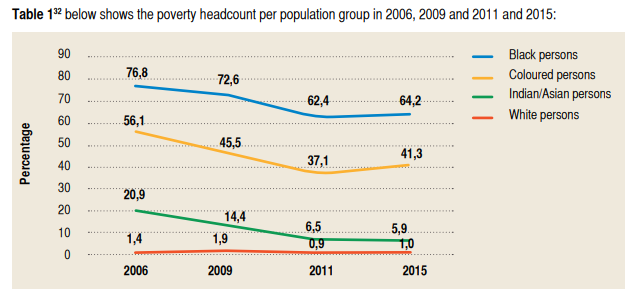
“Black South Africans consistently exhibit the highest poverty rates,” the DoJ said.
“In 2015, 47% of the households headed by Black South Africans were poor. This was very high compared to 23% for those in households headed by coloured persons, a little more than 1% for the population in households headed by an Indian/Asian South African, and less than 1% among those in households headed by white South Africans.
“Black persons carry the overwhelming share of poverty by representing more than nine out of every ten individuals living below the UBPL (upper boundary poverty line).”
Education
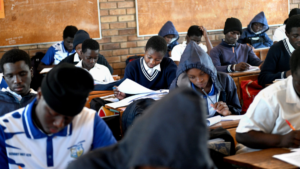
Historically, education was used as a tool of oppression in South Africa, the department said.
“Denial of quality and racism-free education to the majority of the population was one of the principal strategies of colonialism and apartheid to guarantee the underdevelopment of, and deny, black persons access to knowledge.”
The report’s authors said that research has consistently shown that the strongest determinant of educational outcomes in South Africa is socio-economic status.
“Given the history of South Africa, there is an overlap of poverty, race and historical disadvantage. Although education and economic policies are designed to be pro-poor the negative effect of home background factors cannot be completely eradicated.”
The DoJ added that it is ‘imperative to integrate anti-racism training and education into the curriculum’, particularly the values and democracy components and to develop curricula that deal honestly, objectively and truthfully with our painful past and to promote greater integration of schools.
Employment
The Commission for Employment Equity in its latest report indicates that representation of the white population group is more than six times their Economically Active People (EAP) and the Indian population group is more than three times their EAP at the top management level.
It also shows the representation of the African population group to be approximately one-fifth and the coloured population group approximately half of their EAP at this occupational level, the department said.

Housing
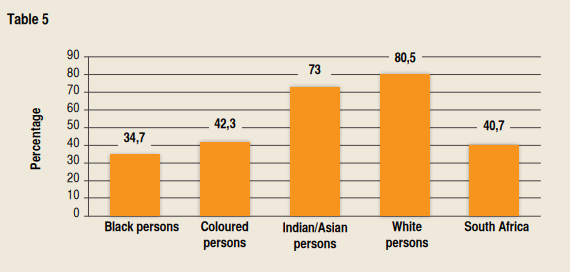
Findings from the latest General Household Survey show that the number of rooms in a dwelling reflects the standard of living of the household and can be tied to other characteristics such as education or perceived wealth status.
White-headed (80.5%) and Indian/Asian-headed (73.0%) households were much more likely to live in dwellings with six or more rooms than coloured-headed (42.3%) or black-headed (34.7%) households, the report’s authors said.
The below table shows which population groups typically have six or more rooms in their primary dwellings.
Read: The South African government wants to create a ‘racism database’















 Loading ...