

South Africa’s top 5% are leaving – and they’re choosing these 5 countries



Eighty20 Director Andrew Fulton warns that the loss of even a small number of the country’s top taxpayers has a massive economic impact on the local economy.
Data shows that these important income earners are choosing to move to Australia, the United Kingdom, the United States, New Zealand, and Germany.
Consumer analytics firm Eighty20 reported that one in seven South Africans lives in a different province from where they were born, over three million immigrants live in South Africa, and over one million South Africans are living abroad.
It added that South Africa is experiencing significant changes due to three main migration factors: an influx of regional labour, a loss of skilled citizens, and interprovincial movement.
The firm said that these factors affect businesses, talent pipelines, location strategies, consumer markets, and political risk.
Earlier this month, President Ramaphosa addressed the nation regarding issues surrounding migration.
He acknowledged the shortcomings in immigration management while condemning xenophobia, vigilantism, and the efforts by private groups to police foreign nationals.
The anti-immigration movement called “March and March” had set a deadline of June 30 for undocumented foreign nationals to leave South Africa.
A coalition of 27 civil society groups confirmed the plans for nationwide protests and has threatened to “shut down” the country if their demands are not met.
“South Africa is being reshaped by multiple migration forces that all have an impact on business decisions,” said Eighty20 Director Andrew Fulton.
“Whether it be skilled professionals leaving, regional labour arriving, or millions moving toward economic opportunity at the urban edge,” he said.
Fulton said that the businesses that read those signals correctly will find themselves where the markets and talent actually are.
He said that migration data is one of the most contentious issues in South Africa since the undocumented population is, by nature, uncountable. The Department of Home Affairs has not published immigration statistics since 2015.
Foreign nationals often have valid reasons for avoiding official surveys. Fulton said that emigration data is unreliable as Statistics South Africa relies on estimated models rather than actual departure records.
This has created a data vacuum that has been rapidly filled by exaggerated claims and political rhetoric.
According to Eighty20, the 2022 Census recorded 2.4 million immigrants, while the 2022/23 IES Survey, published in 2026 based on projected data, estimates the number at over 3 million, or 5.1% of the total population.
However, Fulton said the actual figure is likely higher, as many foreign nationals fear for their safety, resulting in systematic undercounting during Census enumeration. The extent of this undercount is currently unknown.
Nearly 64% of immigrants come from SADC countries, with the top five sending nations being Zimbabwe (48.5% of the foreign-born population recorded in the 2022 Census), followed by Mozambique (20%), Lesotho (10.9%), Malawi (9.5%), and the United Kingdom (2.9%).
According to the data, the immigrant population is predominantly male, of working age, and primarily concentrated in Gauteng and the Western Cape.
Over one million South Africans live abroad
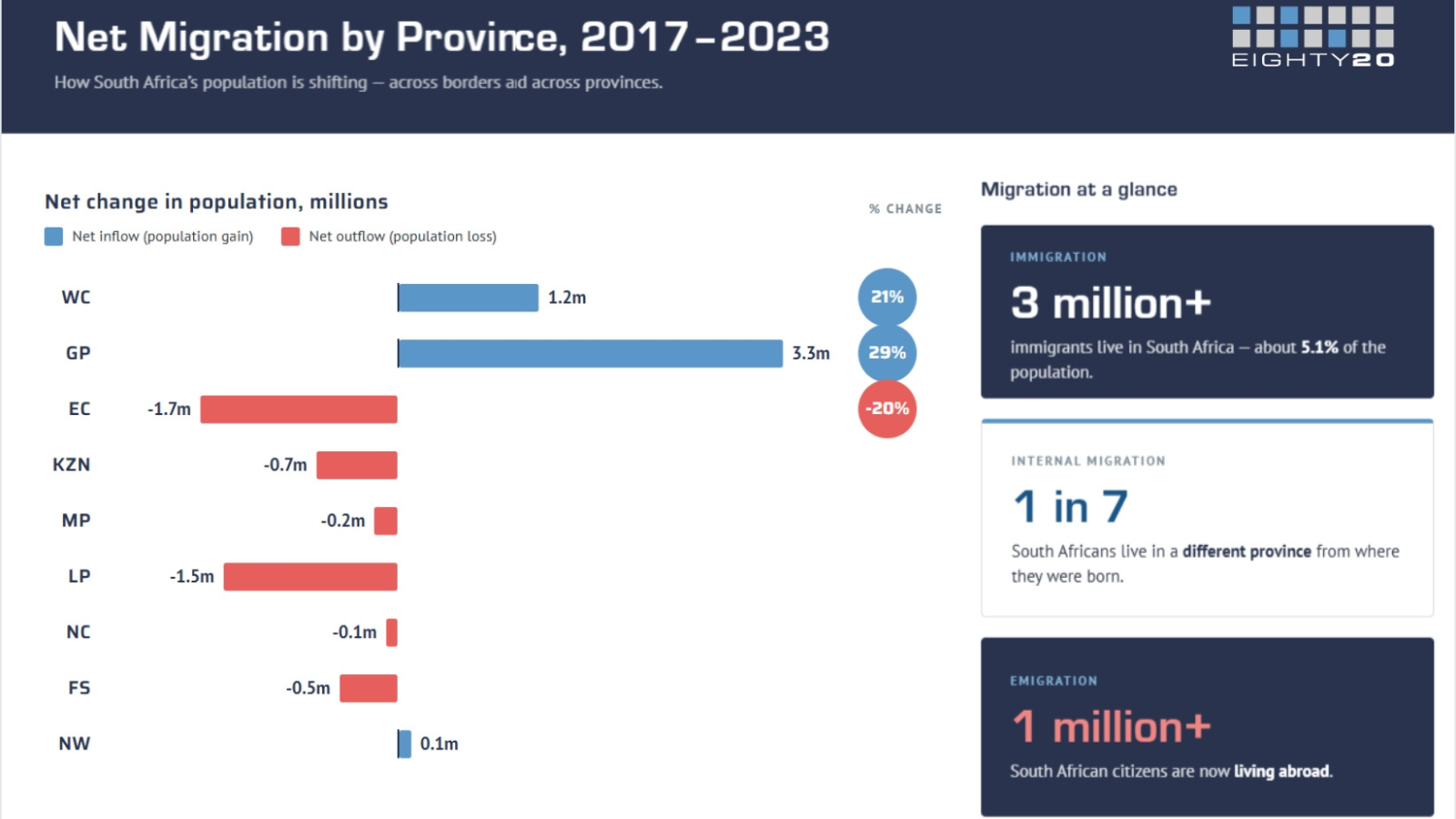
The outward migration of South African citizens is smaller in volume but has a disproportionate economic impact.
According to UN International Migrant Stock data updated to mid-2024, just over one million South African citizens are living abroad, a significant increase from 295,400 in 1990.
The majority of this population resides in Australia, the United Kingdom, the United States, New Zealand, and Germany.
The concern, explained Fulton, is not about the total number but rather the composition of the emigrants.
The top 5% of taxpayers, which consists of a few hundred thousand individuals, contribute approximately a quarter of all personal income tax revenue.
He said that losing even a few tens of thousands of high-earning professionals could have measurable fiscal consequences and directly affect the private-sector talent pool.
The healthcare sector is experiencing a noticeable shift. Recent OECD data indicates that over 23,400 South African health professionals are working in the UK, New Zealand, the United States, and Australia.
As a direct consequence, many public sector positions in South Africa have remained unfilled for years.
Additionally, BrandMapp, a survey of South African households with incomes over R10,000 per month, asks respondents about their likelihood of emigrating.
Approximately 27% of respondents consider emigration likely or highly likely, a figure that has remained unchanged since 2021.


















 Loading ...