

South Africa’s ‘model’ is broken – here’s how to fix it: PwC


Multinational professional services PwC has published a new report on the state of South Africa’s economy and the steps that government can take to address major issues.
In its report, PwC said that the Covid-19 pandemic has exposed issues with the government’s operating model that were already present before the crisis.
“South Africa was already on a rocky path, one on which economic growth was declining and inequality was rising. The outcomes of the current model go against the government’s very own goals and ambitions.
“The key challenges in our country: unemployment and inequality, which have now become considerably more severe through the pandemic, can no longer be approached in the traditional way. An entirely new approach is needed,” PwC said.
In its current model, PwC said that the government has taken control of key assets and redistributed from pockets of wealth in a divided economy.
“More people are reliant on social grants and transfers without opportunities to participate in the economy and without the financial and sociopsychological benefits of having a job.
“Meanwhile, state-owned assets have become liabilities for their ultimate owner: the public.”
PwC said that South African government needs to take on a new role to stay relevant in today’s world and to lead the country out of this crisis and onto a better path.
“Its role of controller and provider is no longer feasible in the modern world and certainly not in the economic reality we now find ourselves in,” the firm said.
“Instead, the government can do so much more to become an enabler of growth across the board, encouraging active participation of the majority of its citizens.”
Crisis
Some of South Africa’s key economic issue identified by PwC include:
- South Africa’s economy has had a decade of slow growth and started 2020 already in a technical recession. Quarterly growth was -0.8% in Q3 of 2019, -1.4% in Q4, and -2.0% in Q1 of 2020;
- Business confidence, as measured by the Bureau of Economic Research (BER) Business Confidence Index, has been on a downward trend;
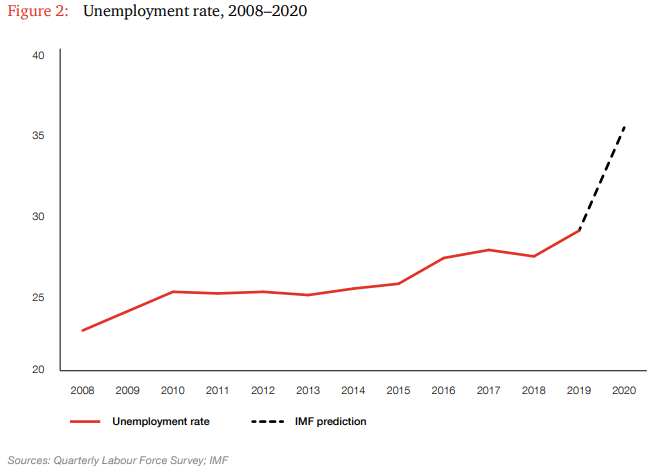
- Unemployment rose to a historical high of over 35% in Q1 of 2020 with unemployment among the youth reaching approximately 50%;
- The major rating agencies have all downgraded South Africa’s rating to below investment grade.
- The gap between revenue and expenditure was widening and public debt has been steadily increasing;
- Core government services of water and electricity provision were increasingly unreliable;
- More state-owned enterprises called for large bailouts following years of mismanagement, further weighing on public finances;
- South Africa’s divided economy continues to have among the highest rates of inequality and poverty.
“GDP per capita is expected to decline in the medium term as the population continues to grow while GDP contracts, meaning South Africans will on average become poorer over the next few years,” the firm said.
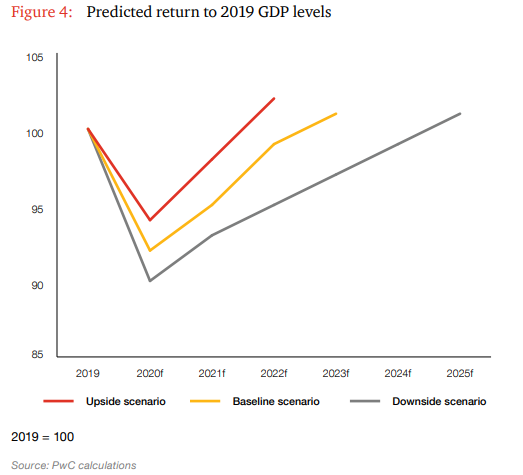
PwC’s calculations of different scenarios suggest it could take between two and five years for GDP and employment to return to pre-lockdown levels.
How to fix it
As part of its analysis, PwC said that there are six priorities for government to consider to drive growth and restore the economy.
- Reprioritising spending to focus on what’s most important. This includes taking the recovery period to optimise government balance sheets and gear expenditures towards top priorities. These priorities include kickstarting the economy by expediting network infrastructure spending and focussing on getting foundation services like water and electricity right, which affect households of all income levels and businesses of all sizes.
- Ensuring that the encouragement of growth and investment becomes a shared priority across government. Joint government strategies to this end should be established and implemented. These could encompass measures that build trust between government and business, address impediments to investment, both local and foreign, and help firms reap new opportunities and comparative advantages coming out of the crisis.
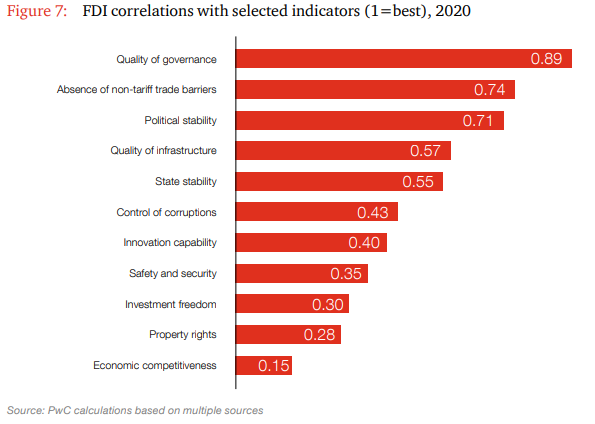
- Creating an innovation and pro-growth ecosystem. An improved regulatory environment and strengthening partnerships with civil society, private sector organisations, university and research hubs could create an enabling environment for broad-based growth, innovation, and opportunities for a wide majority of the population.
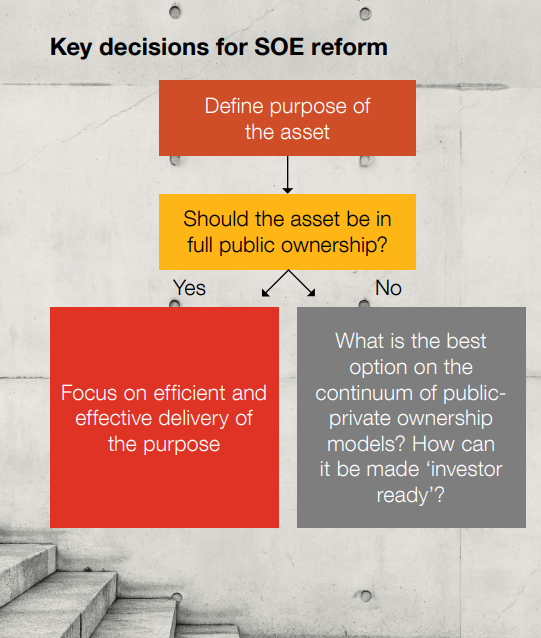
- Revisiting the role of public enterprises. State-owned enterprises require a re-examination of their purpose and strategic goals in light of the new reality. The crisis provides the opportunity for an urgent relook at where government ownership and operations are necessary, and where developmental goals can be better achieved through alternative delivery models that do not further burden the general public with debt.
- Transforming the government’s operating model. A sweeping change in operations is required to significantly enhance efficiency and ensure that government can stay relevant and provide more for less.
- Emphasising quality of governance and accountability to build trust and benefit the poor. This includes embracing technology and more efficient practices to enhance the government’s ability to respond to the majority of its citizens and to practice open and participatory governance.
Read: Can you fly to the high-risk countries South Africa has banned from entry?














 Loading ...