

Absa defers dividend after 51% earnings drop


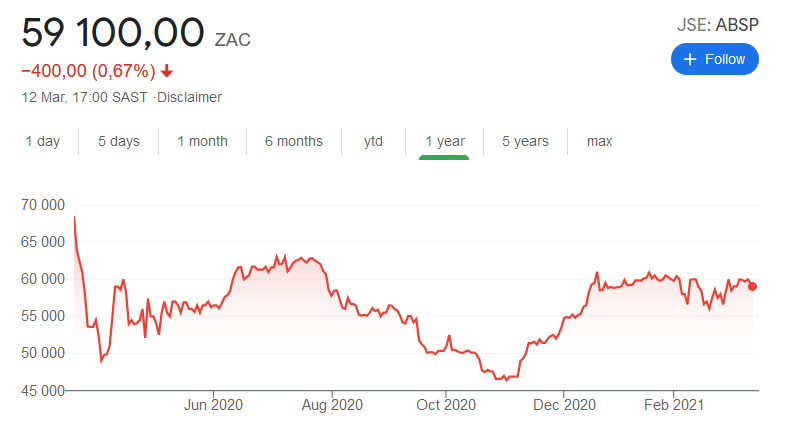
Absa Group on Monday (15 March) reported a 51% decline in normalised headline earnings for the year ended December 2020, to R8 billion, after impairments nearly trebled to R20.6 billion amid the economic downturn that was precipitated by the Covid-19 pandemic.
Revenue increased 2% to R81.4 billion, Absa said; however, impairments increased 163% to R20.6 billion.
Diluted headline earnings per ordinary share declined 58% to 730.9 cents per share, while the group decided against a dividend declaration to preserve capital in the current environment.
The lender said that earnings and returns improved materially in the second half of the year as lockdown restrictions eased, particularly in South Africa, which accounts for more than 80% of the group’s earnings.
Group headline earnings fell 82% in the first half of 2020 compared with the first half of 2019. Headline earnings in the second half of last year were 19% lower than in the second half of 2019.
“We believe we offered the most comprehensive relief programme in the South African banking sector, providing approximately R9.8 billion in cash-flow relief to 613,000 retail and business banking customers,” said Daniel Mminele, the chief executive officer of Absa Group.
“I was really pleased with our 7% rise in pre-provision profit as this is an important indicator of positive underlying performance. I believe that we have appropriately prioritised balance sheet strength balanced against selective targeted growth during these uncertain times,” said Jason Quinn, Absa Group financial director.
While Retail and Business Banking South Africa (RBB SA) saw earnings decline 55%, strong pre-provision profit growth of 6% largely cushioned the business against an increase in impairments, the bank said.
It said that it continues to invest, particularly in digital to improve operating efficiencies and the overall customer experience. This is illustrated by a 23% increase in digitally active customers to 1.9 million, largely driven by the mobile app.
Corporate and Investment Banking (CIB) headline earnings declined by 17% as impairments increased six-fold. Pre-provision profit increased by 22%, supported by income growth of 14%, with all core operating business units delivering solid revenue growth, the lender reported.
CIB’s completion of separation from Barclays, which involved 44 projects, was a significant milestone, freeing up management time and facilitating the introduction of newer systems, it said.
Absa said it undertook an in-depth review of the group strategy in 2020, two years after the launch of the 2018 growth strategy, to evaluate execution progress, and to assess relevance given the changes in the operating environment.
“The review process concluded that, while our strategic choices from the 2018 strategy remain relevant, the world in which we seek to achieve them has changed,” said Mminele. “As a consequence, some shifts and accelerations are required to drive the modernisation our business, not only to maintain relevance but to thrive and advance as a business.”
Absa said it aims to become even more customer-centric in meeting the specific needs of clients, embrace digital-first distribution channels to match customers’ changing behavioural patterns, and diversify market reach to match customers’ points of presence.
Areas targeted for acceleration include:
- Developing and nurturing a more entrepreneurial culture;
- Creating more competitive digital, data, technology and innovation capabilities;
- Leveraging strategic partnerships to create market leading capabilities.
Absa said it will invest in strategic capabilities including leadership, a more modernised technology architecture that powers digital transformation.
“The group has delivered respectable progress over the last two-and-half years against the strategy journey that was adopted in 2018, and we have seen good traction in some parts of the business.
“Our refreshed strategy enables us to become more precise in expressing how we want to embed customer-centricity at the heart of our business, how we will evolve our digital maturity, and what it means to be purpose-led,” said Mminele.
Looking ahead, the bank said it forecasts 3.1% growth in South Africa during 2021 and expects GDP to only recover to 2019 levels by 2024.
“While there is some way to go before economies stabilise, the roll-out of vaccines globally hold the promise of greater stability and we look forward to playing our role in the recovery and re-setting for the future,” said Mminele.
Read: Standard Bank declares dividend despite drop in earnings














 Loading ...