

The average take-home pay in South Africa right now


Average salaries in July have taken a knock due to soaring inflation; however, early indications and data from the monthly BankservAfrica Take-Home Pay Index (BTPI) offers some good news for South Africans.
“The nominal take-home pay slipped to R14,340 in July, compared to the R14,618 in June 2022 and down from the 2022 high of R15,593 recorded in February,” said Shergeran Naidoo, BankservAfrica’s head of stakeholder Engagements. “The July nominal salaries were also 0.9% lower compared to a year earlier.”
These figures arrive as South African households, and consumers have been challenged by the economic realities over the past months, brought by higher consumer inflation, which peaked at a 13-year high of 7.8% in July, and as the South African Reserve Bank hiked interest rates by a further 75 bps.
Ongoing electricity supply issues have become part of the ‘new normal’, and prices of basics like food items and fuel have escalated. All of these have contributed to further strain on the average salaried worker.
“This is also reflected in the notable 7.6% year-on-year drop in the real average salary recorded in the BTPI in July,” said independent economist Elize Kruger.
“But we could be reaching a turning point as our forecast suggests that July’s 7.8% headline CPI print will be the upper turning point of the current inflation cycle. The pressure should start to alleviate somewhat as inflation moderates towards year-end. We forecast inflation could be around 6.6% by year-end.”
Growth in real BTPI vs headline CPI
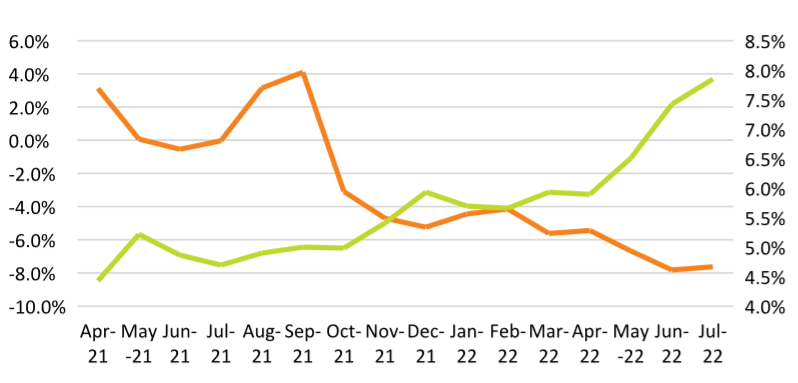
While the BTPI does suggest that consumers’ average earnings are under severe pressure, BankservAfrica’s data signals more people have been receiving salaries compared to a year ago.
The actual data, reflected in StatsSA’s latest Labour Force Survey, published on 23 August, reported a notable 648,000 jobs were created in Q2 (vs Q1’s 370,000), despite the challenging economic environment.
“The gradual relaxation of Covid-19 restrictions on gatherings, initially from 30 April, and the final removal of all remaining lockdown restrictions, effective from 23 June, clearly provided much-needed support to the local economy and fostered a further recovery in employment opportunities,” said Kruger.
After adjusting for weekly workers, the BankservAfrica data suggests that this trend is likely to prevail into Q3, though July’s data indicates that the pace of new job creation is likely to moderate somewhat.

The focus on rising living costs has accentuated the question of whether salaries in South Africa have kept up with inflation. Comparing BankservAfrica BTPI data from 2017 – July 2022 to consumer inflation, it is evident South Africans’ take-home pay (after tax and other salary deductions) managed to keep up with inflation between 2017 and 2021.
However, in the first seven months of 2022 (actual data), BankservAfrica’s take-home pay data has lagged on the year-to-date average headline CPI (at 6.4%), and this is the reality that households are currently experiencing.
Meanwhile, the BankservAfrica Private Pensions Index (BPPI) showed the average nominal private pension reached R10,000 per month for the first time in June and remained above this level in July, representing a 10.9% growth on a year-on-year basis. In real terms, the average real private pension was R9,773 per month, 2.8% higher than a year earlier, noted Naidoo.
Although there were a few monthly real declines recorded in the first half of the year, average real pensions have held up well despite rising inflation, preserving the purchasing power of pensioners, the clearing house said.
The total take-home pay and private pensions processed in value terms increased by 3.8% in real terms and by 12.0% in nominal terms compared to a year earlier, not seasonally adjusted, it said.
Read: Warning over higher costs for motorists in South Africa


















 Loading ...