

Massive blow on the way for South African households


Energy regulator Nersa has published its latest discussion document containing the proposed municipal tariff hikes for 2023.
The regulator proposes a 15.1% hike for municipal customers from 1 July 2023. The hike is based on the bulk supply tariff increase for municipalities of 18.49%, announced last month.
According to Nersa, bulk purchases represent 74.23% of total costs incurred by municipalities. Other costs include repairs and maintenance, salaries and wages, finance cost, etc.
The increase for 2022 was 7.49%, so the proposed increase for 2023 is close to double last year’s rate.
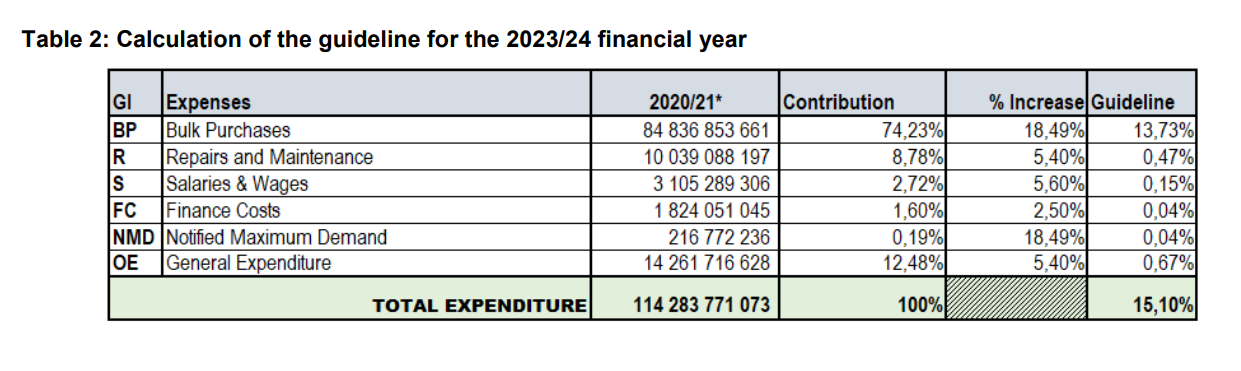
“There will always be a difference between Eskom’s increase and that of the municipalities due to the Municipal Finance Management Act time lag,” Nersa said.
The municipalities’ implementation date is 1 July, whereas Eskom’s financial year starts on 1 April. Due to the MFMA requirements, Eskom can only increase its prices to municipalities from 1 July 2022 rather than 1 April 2022.
For the 2022/23 financial year, this time lag led to an under-recovery by Eskom from sales to municipalities, which required a higher price increase to municipalities, the regulator said.
“The higher price increase results from the fact that the outstanding revenue must be recovered within nine months instead of twelve months,” it said.
In January, Nersa granted Eskom an 18.65% price hike for the 2023/24 financial year – far higher than the increase granted in 2022, but still well below Eskom’s application for 32%-38%.
Eskom direct customers would have been subjected to this price hike from the start of the month.
The electricity price hikes come in tandem with a host of other price hikes, and are expected to push inflation higher when CPI surveys are conducted by Stats SA in April and July.
According to Efficient Group chief economist Dawie Roodt, the current and coming electricity price hikes will put consumers under even more pressure and may limit the South Africa Reserve Bank’s range to continue hiking interest rates.
The Reserve Bank hiked rates by 50 basis points at the end of March, surprising markets.
As more households push more of their income towards debt repayments and basic essentials like electricity, there is less money to be spent in the wider economy, dampening growth.
However, the Reserve Bank has given no indication that it will stop hiking rates, saying at its last meeting that it will continue using the tools at its disposal (rate hikes) to meet its mandate (bringing inflation into the 3%-6% range).
Economists expect that the rate hiking cycle has come to an end, but some outliers believe that at least one more hike of 25 basis points could be on the way.
Unfortunately for South Africans, local inflationary pressures like electricity tariff hikes are exacerbated by global markets – like oil, which is being artificially boosted by production cuts in oil-pricuding nations.
According to Invested chief economist Annabel Bishop, rising oil prices are likely add external inflationary pressure on South Africa, which may necessitate further action from the Reserve Bank to bring under control.
She said that South Africa would have to see the rand strengthen to under R16 to the dollar to counteract the rising oil prices. However, the only way to achieve this would be a 100 basis point hike from the Reserve Bank – which most households would not be able to stomach.
South African households are already heavily indebted, with around two-thirds of a middle-class household’s income going to servicing debt.
Despite this, industry reports point to growing credit usage among South Africans, as consumers seek ways to make ends meet.
















 Loading ...