

The best suburbs for solar in Gauteng, Durban and Cape Town


Higher stages of load shedding are expected to hit South Africa over the upcoming winter months, which has led to a significant increase in the demand for solar generation solutions for households across the country.
Many South Africans are also turning to solar to protect themselves from the large increase in electricity prices.
According to Standard Bank’s LookSee.co.za, residential properties in just 30 suburbs could produce 25-gigawatt hours a month with the implementation of solar installations.
Although South Africa offers a great platform for solar power due to high levels of sunshine, potential generation varies across suburbs, cities and provinces.
LookSee has thus developed a solar score for residential properties.
“The Solar Score system has enabled us to analyse the solar potential of various suburbs in Gauteng, KwaZulu-Natal and the Western Cape and identify how much electricity could be generated by various suburbs,” said Marc du Plessis, LookSee’s executive head.
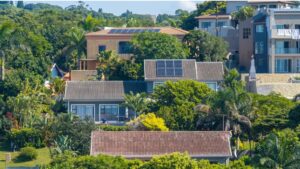
According to the LookSee platform, Kloof in KwaZulu-Natal (KZN) has the best solar generation potential of all suburbs in South Africa, with the ability to produce 4,245-megawatt hours (MWh) per month of solar generation each month.
Atholl (2,462MWh per month) in Gauteng is in second place, while Winston Park (1,530 MWh per month) in KZN is in third place.
Currently, the LookSee platform only uses solar scores for metropolitan cities in Gauteng, KwaZulu Natal and the Western Cape, with work still underway to extend coverage to other areas in the country.
Moreover, the dataset did not include sectional title properties or agricultural-type suburbs, with work on the former still underway.
The top suburbs in Gauteng, Western Cape and KZN with the highest potential to generate solar power are below:

“The number and size of houses in a suburb obviously has a significant impact on the amount of solar power can be generated. However, Gauteng suburbs generally perform better on the solar generation scale. This is due to the level of photovoltaic emissions or solar irradiance lowering as you move away from the equator,” du Plessis said
He added that the solar Score had seen major interest, with roughly 30,000 users in the first three months of the year.
Long-term energy warning
Although several energy experts have warned that load shedding during this winter will likely be the worst the country has ever experienced, load shedding will not disappear after the worst of Winter is over, potentially increasing the need for solar generation.
Electricity minister Kgosientsho Ramokgopa said that open-cycle gas turbines (OCGT) could be used to lessen load shedding in the near term.
However, the opposition Democratic Alliance has warned that OCGTs should only provide a short-term solution when Eskom is doing maintenance or experiencing breakdowns and should not be used as a permanent solution.
It also noted that Eskom would need to spend its entire roughly R30 billion proposed diesel budget for the whole financial year over six months to keep load shedding at lower stages during winter months.
“When pressed on how Eskom would source more funds for diesel for the balance of the financial year, (Ramokgopa) suggested that a portion of the funds generated through the 18.65% electricity tariff increase could be used to fund diesel purchases,” said the DA.
“While it seems a feasible solution, it is deeply concerning that the tariff increase, which should be used for the upgrading and development of electricity infrastructure, would be used to buy diesel.”
The DA said that using such a large amount of funds for diesel in winter will also present issues in the future, with the embattled power utility likely to ask for more money on top of the over R250 billion bailout from National Treasury.
“While it is of some comfort that the minister is alert to and focused on the increased demand during winter – there are other seasons in a year,” the party said.
“We are currently in autumn, and load-shedding is lurching between stages, hitting stage 6 with regular monotony. It doesn’t help to limit the stages in winter only to be unable to mitigate for spring and summer, especially when we are looking at a depleted budget and limitations on the ability of the OCGTs to burn large quantities of diesel.”
Read: How SARS will deal with anyone trying to abuse new rooftop solar tax breaks














 Loading ...