

South Africans want Eskom to be privatised – or at least lose its monopoly


Electricity supply ranks third among the most critical issues South Africans want the government to address, and just over half of them say it’s time for Eskom to be privatised.
This is according to the latest Afrobarometer survey, which compiles data on African experiences and evaluations of democracy, governance, and quality of life.
The Afrobarometer team in South Africa, led by the Institute of Justice and Reconciliation, interviewed 1,600 adult South Africans for its latest survey – yielding a representative sample with a 95% confidence level.
While the survey results reflect the dismal performance of the government and power utility Eskom, there is one positive.
According to the report, more than nine in 10 South Africans (95%) live in zones served by the national electric grid – up 9% since 2006 (86%).
This means that more South Africans have access to the national electricity grid, which shows that the government’s efforts have achieved some success in this regard.
However, the rest of South Africa’s sentiments towards the government are not so positive.
According to the report, almost nine in 10 South Africans (87%) said the government is doing an abysmal job of providing a reliable electricity supply, a 24% increase from the last Afrobarometer survey in 2021.
Seven in 10 (69%) describe the government’s performance as “very bad”, while only 12% consider it “fairly” or “very” good.
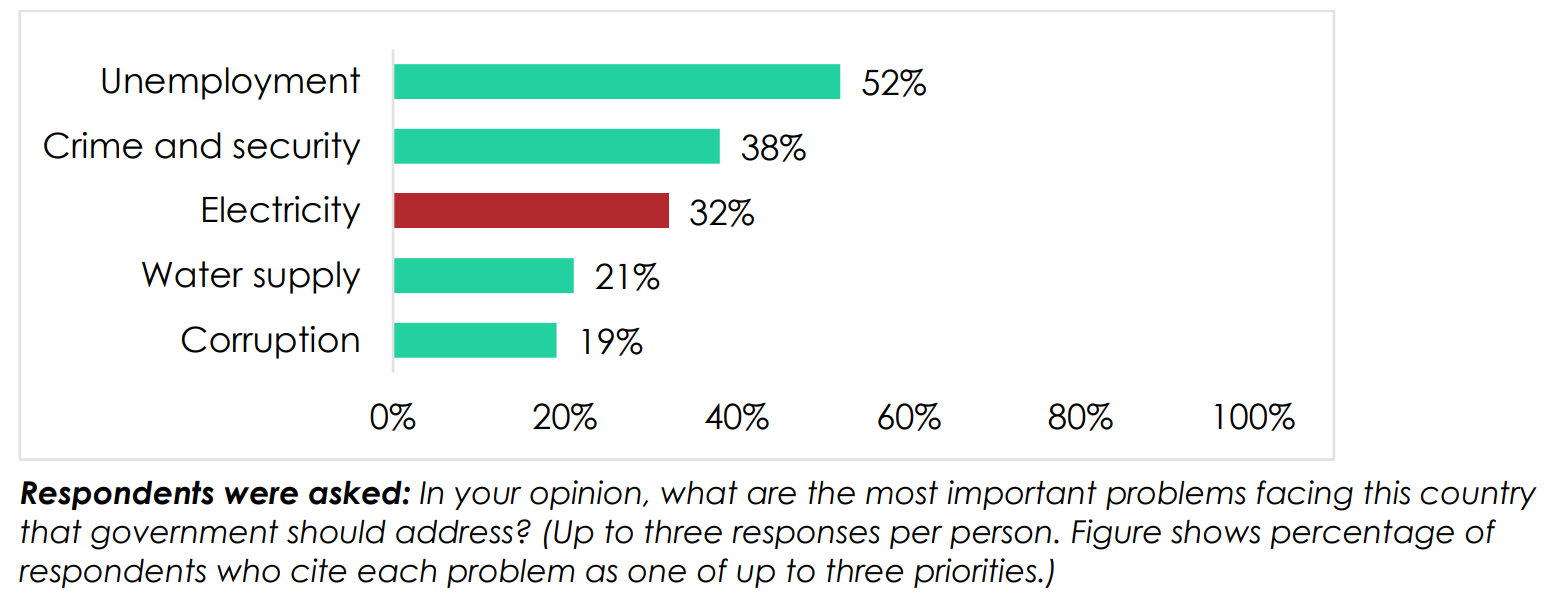
The provision of electricity ranks third among the most critical problems South Africans want the government to address, cited by 32% of respondents as one of their three priorities, trailing only unemployment (52%) and crime/security (38%), noted the report.
As a result of these findings, respondents were then asked whether they would prefer to pay more for electricity in exchange for better services rather than paying less and receiving poor services.
A slim majority (51%) of South Africans “agree” or “strongly agree” that they would be willing to pay more, while about one-third (32%) disagreed.
KwaZulu-Natal (66%) registers the highest support for this proposition, while only 37% of Eastern Cape residents agree, noted the report.
An interesting observation is that support for higher prices in exchange for better services increases with respondents’ economic status and education level.
According to the report, the data ranged from lows of 33% of those with no formal schooling and 41% of the poorest South Africans to highs of 54% among those with post-secondary qualifications and 58% among the economically best-off respondents.
Privatisation
Stemming from the sentiments that Eskom and the government are doing a poor job of providing a reliable electricity supply – and in support of better service – citizens indicate they want an end to the government monopoly on electricity provision.
The report showed that around six in 10 citizens (59%) say that to ensure an adequate electricity supply, Eskom must be privatised.
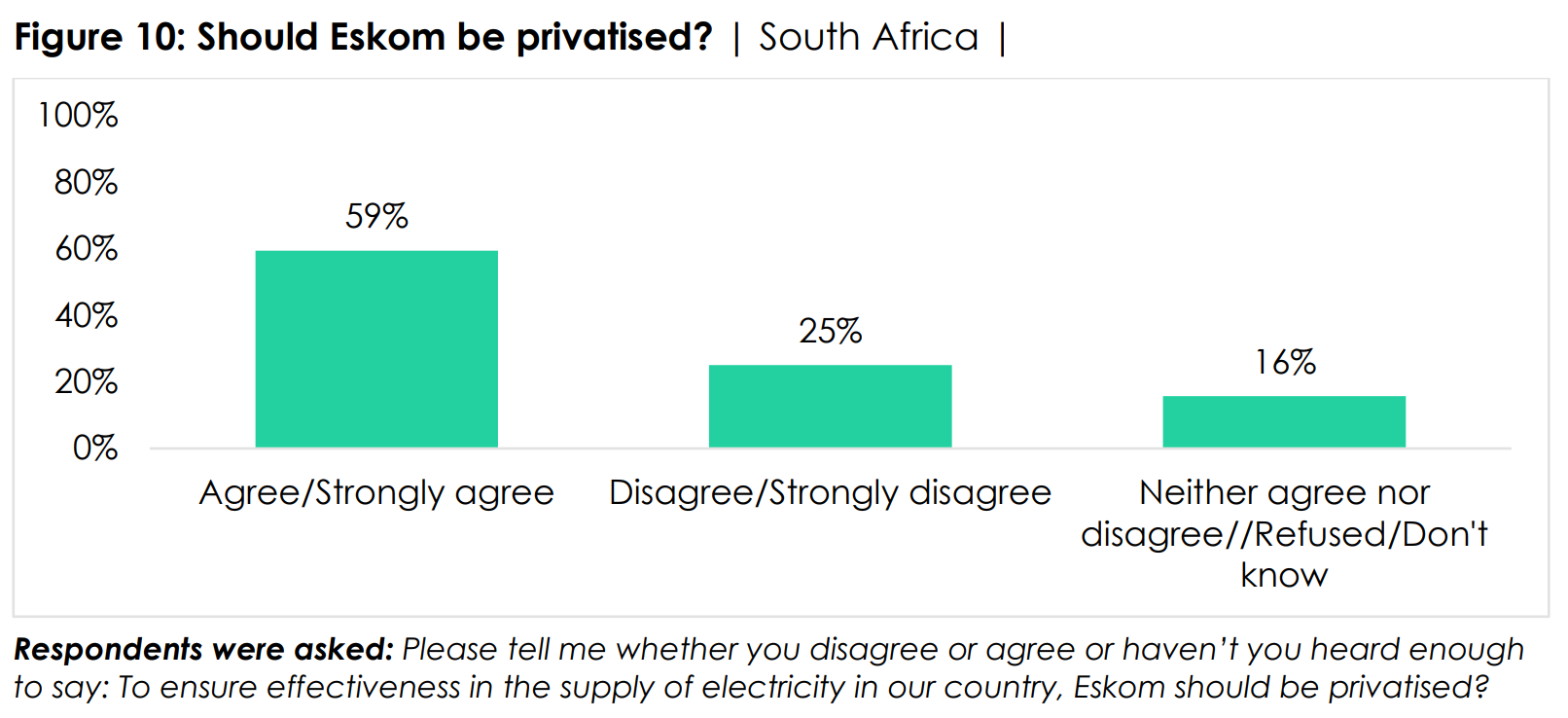
Residents of the Western Cape (73%) record the strongest support for this proposition, while only about half of respondents agree in the North-West (49%), Mpumalanga (51%), and Gauteng (52%).
It noted, however, that support for privatisation is relatively weak among poor citizens (50%) and those with no formal schooling (47%).
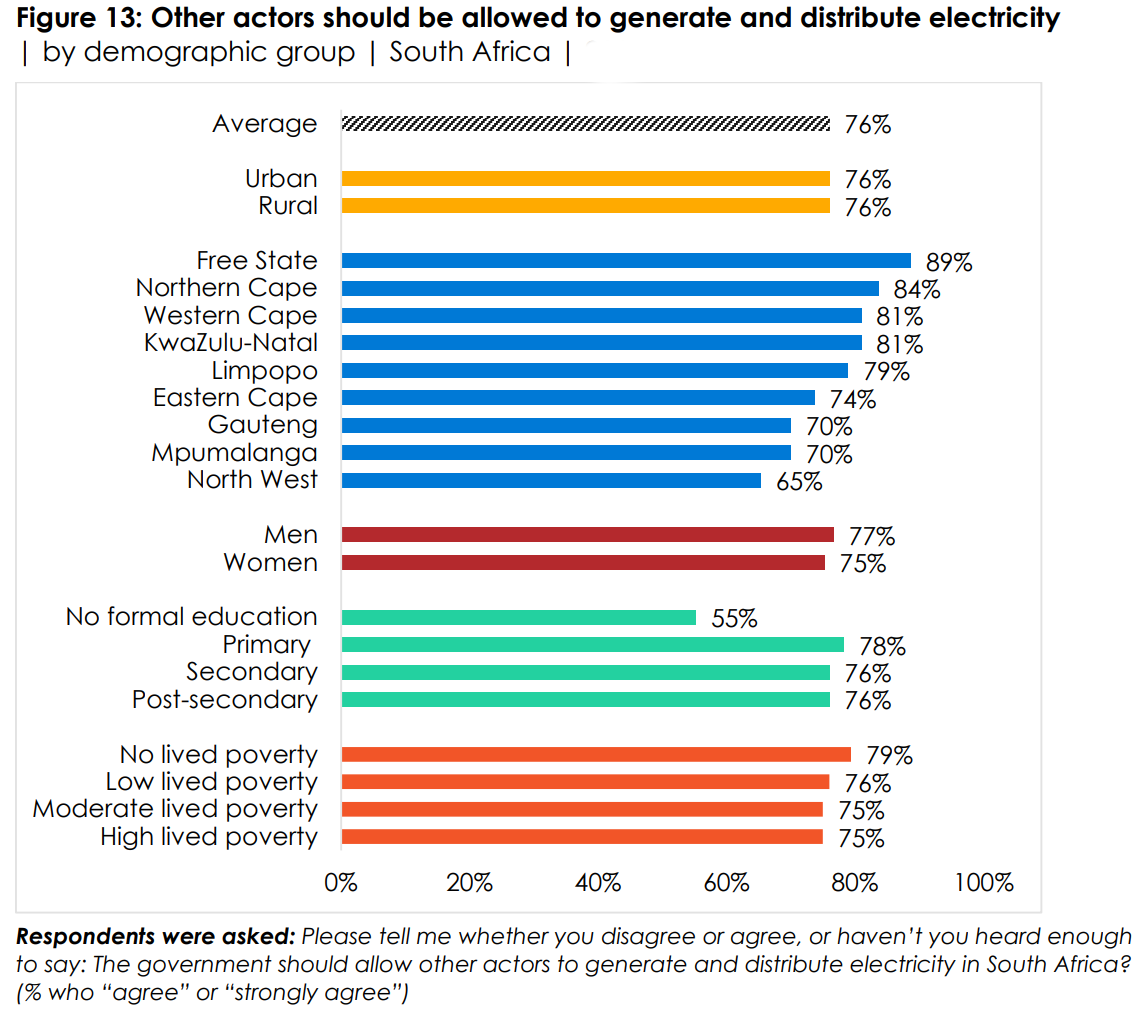
While some may have felt that the complete privatisation of Eskom is a bit extreme, the report further highlighted that a more significant majority (76%) of citizens support ending Eskom’s monopoly. It said the government should allow other actors to generate and distribute electricity in South Africa.
Support for opening up the electricity market is highest in the Free State (89%) and the Northern Cape (84%), while again, citizens with no formal education record the least support (55%).
Only 13% of South Africans disagree with this idea.
Load shedding horror show
South Africa is experiencing unprecedented levels of load shedding in 2023. In fact, the electricity load shed this year has just surpassed the entire total for 2022.
According to the South African Reserve Bank (SARB), looking over the past couple of years, load shedding quintupled (4.7x times) between 2021 and 2022 when measured in Gigawatt hours, and the Gigawatt hours load shed in 2022 was 11 679 GWh in total.
So far in 2023, as of 21 May, we have experienced approximately 13 000 GWh that has been shed, confirming that the first five months of 2023 have seen more GWh shed than in the whole of 2022.

It has become clear that both home and business owners can no longer rely on Eskom to provide reliable electricity.
Read: Eskom looking into new power station that could cut load shedding by 3 stages















 Loading ...