

Government racks up R18.5 billion in unauthorised spending


National departments have racked up over R18.5 billion in unauthorised spending since 2005, National Treasury reports – funds which will now need to be recovered through budget cuts, or charged against the National Revenue Fund.
Presenting its findings to the Standing Committee on Public Accounts on Tuesday (19 September), Treasury outlined the unauthorised spending that has accrued at 13 different government departments and entities over the years – with five entities still being processed.
Treasury defines unauthorised spending as overspending or spending that is not for the purpose it was intended.
In terms of South Africa’s finance laws, this spending needs to be recovered. While departments may be tempted to claim the funds from the National Revenue Fund – the Public Finance Management Act makes it clear that this can only be done when overspending occurs because of a vote in parliament or provincial legislature.
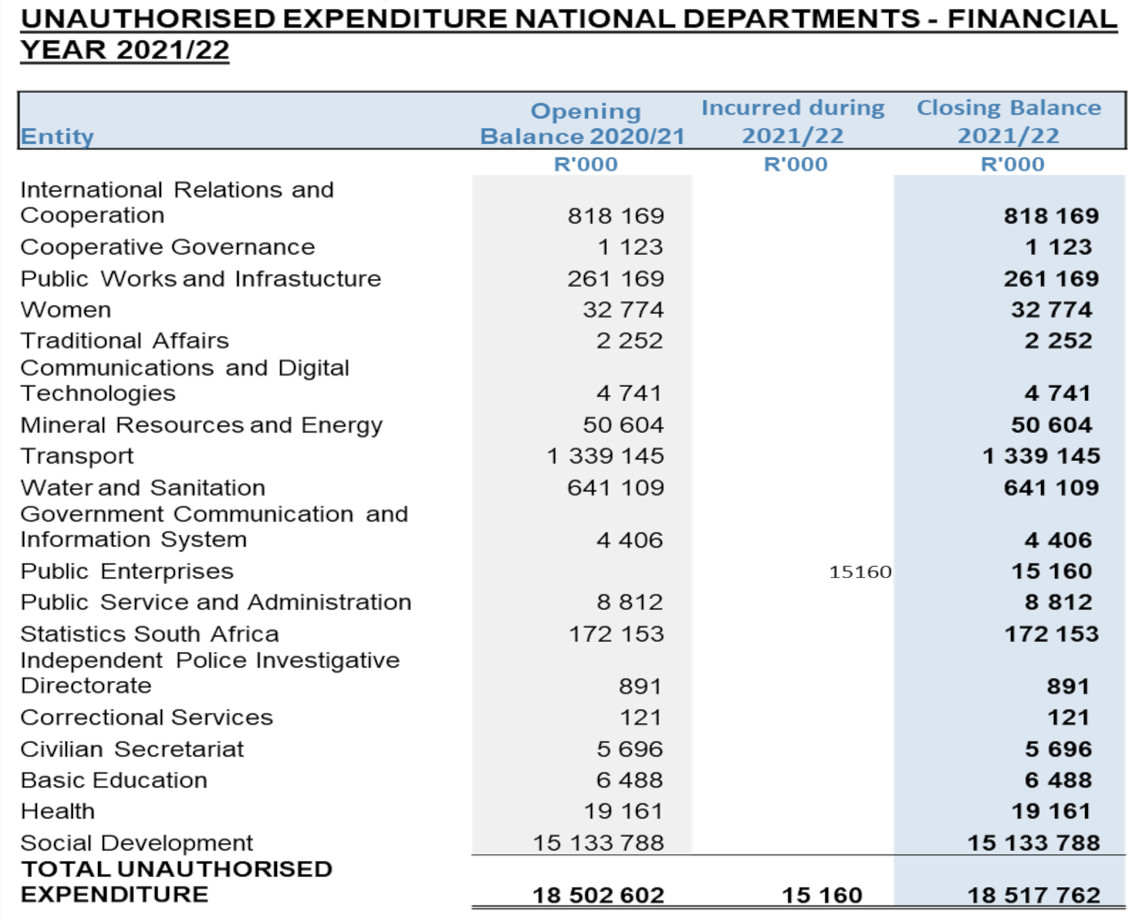
According to Treasury’s data, approximately R15.2 billion of the unauthorised spending identified so far qualifies, mostly related to the Department of Social Development (R15.1 billion), due to president Cyril Ramaphosa’s declaration of a National State of Disaster due to the Covid-19 pandemic.
The R15.1 billion was paid towards social grants in April 2020. These early payments resulted in over-spending in the 2019/2020 budget.
The only other spending that qualifies for recovery from the National Revenue Fund is R120 million for Stats SA due to previous budget cuts that led to overspending (a further R20 million will be recovered by future budget cuts at the entity), and R3.7 million at the GCIS, related to the state funeral of former president Nelson Mandela in 2013/2014.
The rest of the overspending needs to be recovered from the departments and entities themselves – through budget cuts.
Worst offenders
While the biggest overspending occurred due to the Covid-19 pandemic and state of emergency, South Africa’s government departments still overspent by almost R2.1 billion over the years.
The biggest offender in this regard is the Department of Transport, which overspent by R1.34 billion between 2013 and 2016.
This overspending was directly tied to the department appointing a service provider to develop, operate and maintain the eNaTIS system.
Treasury noted that money was supposed to be collected by the Road Traffic Management Corporation (RTMC) and paid into the National Revenue Fund to be claimed by the department – but challenges by the service provider in court resulted in the RTMC stopping these payments in 2012.
Over the next three years, R1.34 billion was overspent. The eNaTIS system was later ceded to the RTMC, and no remedial action was taken. Treasury now recommends that the unauthorised spending be financed from both the DoT and the RTMC through budget cuts.
The other big overspender on the books is the Department of Water and Sanitation, which accrued unauthorised spending totalling R686 million.
This relates to a couple of projects the department launched with no budget – specifically the bucket eradication programme and “war on leaks”. Due to a “period of weaker governance and internal control” at the department, these projects ran over-budget, and Treasury blocked further payments.
The matter is now subject to further investigations by the SIU – and Treasury recommends recovering the unauthorised expenditure through future budget cuts.
Recovering the funds
The full scope of how the unauthorised spending (so far) will be recovered can be seen in the tables below:
Recommended recovery of unauthorised expenditure through cuts to the budget over the medium term
| Government department / entity | Year | Unauthorised spending | Recommended recovery |
| Department of Cooperative Governance | 2006/07 | R1 123 000 | R1 123 000 |
| Department of Telecommunications and Postal Services | 2013/14 | R4 740 999 | R4 740 999 |
| Department of Energy | 2010/11 | R14 860 000 | R14 860 000 |
| Department of Transport | 2013/14 | R768 355 000 | R768 355 000 |
| 2014/15 | R392 842 000 | R392 842 000 | |
| 2015/16 | R176 968 000 | R176 968 000 | |
| Department of Water and Sanitation | 2016/17 | R292 300 000 | R292 300 000 |
| 2017/18 | R393 800 000 | R393 800 000 | |
| Government Communication and Information System | 2014/15 | R710 195 | R710 195 |
| Statistics South Africa | 2017/18 | R37 842 000 | R11 378 000 |
| 2018/19 | R56 739 000 | R7 839 000 | |
| Department of Basic Education | 2014/15 | R6 488 000 | R6 488 000 |
| Department of Women, Youth, and Persons with Disabilities | 2011/12 | R27 388 000 | R27 388 000 |
| Department of Correctional Services | 2015/16 | R121 000 | R121 000 |
| Independent Police Investigative Directoriate | 2005/06 | R91 000 | R91 000 |
| 2008/09 | R800 000 | R800 000 | |
| Sub Total | R2 099 754 194 |
Recommended recovery of unauthorised expenditure through a charge against the National Revenue Fund
| Government department / entity | Year | Unauthorised spending | Recommended recovery |
| Government Communication and Information System | 2013/14 | R3 696 000 | R3 696 000 |
| Statistics South Africa | 2017/18 | R37 842 000 | R26 464 000 |
| 2018/19 | R56 739 000 | R48 900 000 | |
| 2019/20 | R47 617 000 | R47 617 000 | |
| Department of Social Development | 2019/20 | R15 134 000 000 | R15 134 000 000 |
| Sub Total | R15 260 677 000 | ||
| Total | R17 360 431 194 |
Read: Treasury’s desperate plan to keep South Africa from the edge










 Loading ...