

Eskom profit surges to R18 billion


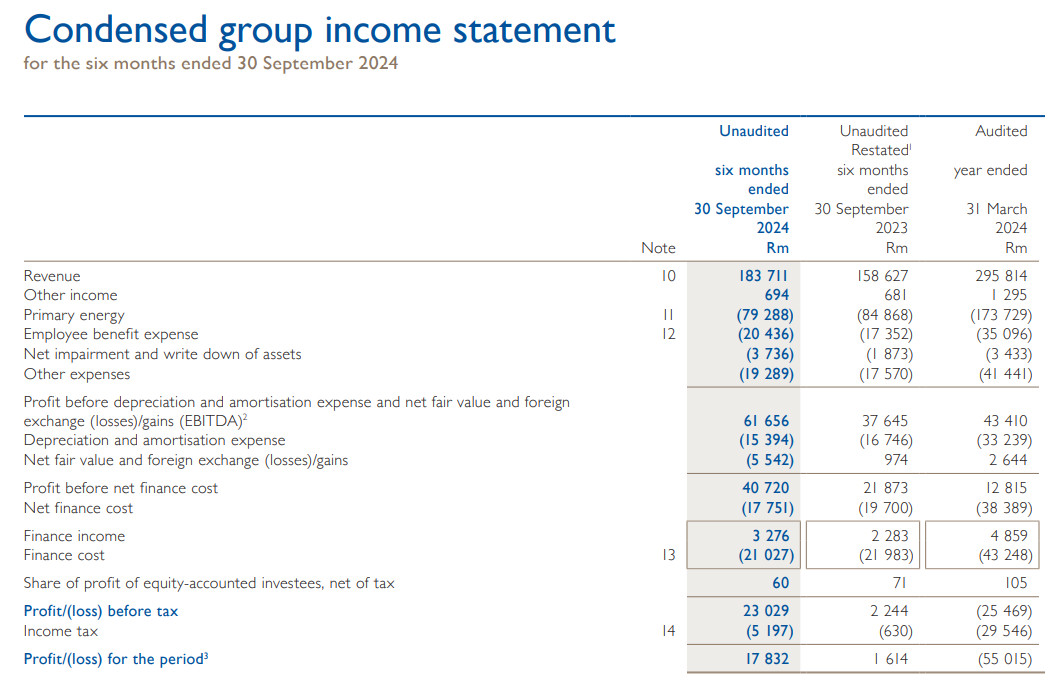
Power utility Eskom has reported a massive surge in profit for the first half of the 2024/25 financial year, hitting over R17.8 billion, up from a profit of R1.6 billion over the same period in 2023/24.
The profits reflect the massive turn in operations that happened at the start of the group’s financial year, which included the extended (and ongoing) suspension of load shedding, as well as significant price hikes for consumers.
Revenue was up 16% to R183.7 billion, while energy costs were down 6.6% to R79.3 billion.
Eskom noted that its revenue from electricity sales and the related value added tax impact are normally higher during the first six months of the financial year—being winter months—compared to the summer months because of the high demand season tariff increases.
Primary energy costs associated with renewable IPP purchases are lower in the winter months due to a lower proportion of power being produced from renewable sources during this time.
The period typically also sees less routine maintenance work, and consequently lower costs.
However, repairs and maintenance still increased for the six-month period to 30 September 2024 due to extensive planned and unplanned maintenance performed to address plant performance challenges aligned with the generation recovery plan.
Other factors that boosted its finances over the period include the improved performance of coal-fired power stations, which resulted in a lower need for the use of Open Cycle Gas Turbines, and the aforementioned suspension of load shedding.
The group’s cherry on top was the tariff increase of 12.74% for the 2025 financial year, which resulted in an increase in sales and revenue.
It should be noted, though, that the picture can change dramatically by the full year results.
Eskom posted a R1.6 billion profit in the first half of 2024 and ended up reporting a staggering loss of R55 billion by the end of the year.
A large chunk of this was due to the unbundling of the group’s new transmission company, but even without that after-tax knock, the group’s FY loss was still R25.5 billion.
More positively, though, the group does not expect to see such a dramatic swing in 2025, hoping for a full year profit of around R10 billion for the year.
That does not mean there aren’t challenges, however.
While the Eskom board said the group can continue as a going concern for the foreseeable future, it flagged several key risks that will impact its liquidity in the longer term—especially after the government’s debt relief period ends.
The remaining portion of the R250 billion debt relief support from the government will amount to R66 billion in 2025 and R40 billion in 2026.
However, the group warned at its FY24 results that if its biggest risk factors aren’t addressed, it will invariably end up back at Treasury’s door asking for more money.
These risks include things like an inadequate tariff path, high debt service costs, escalating municipal arrear debt, operational inefficiencies, the impact of fraud and corruption and continued focus on addressing plant performance as well as sourcing of funding for the Transmission Development Plan.
















 Loading ...