

Dark clouds for Shein and Temu in South Africa


While low-price importers like Shein and Temu have disrupted South Africa’s online retail space, their rapid growth is facing major headwinds as local regulations and competitors catch wise.
This is according to the latest Online Retail in South Africa 2025 report, produced by World Wide Worx (WWW) in collaboration with Mastercard, Peach Payments and Ask Afrika.
The report shows that online retail in South Africa is on a booming trajectory, set to reach R130 billion in sales in 2025—nearly 10% of the country’s total retail market.
The study revealed that online retail grew by 35% in 2024, reaching R96 billion, representing 8% of total retail sales.
Growth has continued through 2025 at an annualised rate of 38%, far outpacing physical retail, which increased by just 2.5% in 2024 and 1.6% by mid-2025.
This has led to a structural realignment of South African commerce, with digital platforms now embedded in everyday consumer behaviour.
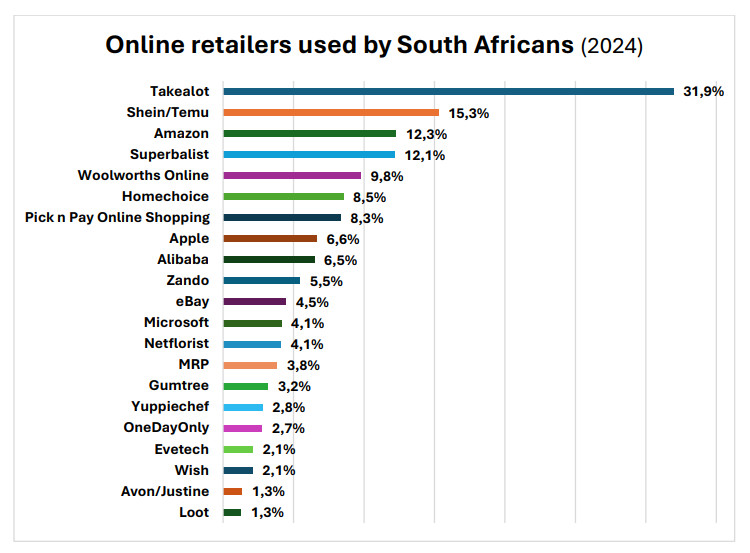
Importers like Shein and Temu captured a lot of the South African retail mindspace during this time, offering products at often unbelievably low cost, disrupting the low-cost fast-fashion market in particular.
“When Shein and Temu entered South Africa, they were more than merely new players in a crowded fashion market,” the researchers said.
“They introduced a different kind of retail altogether: direct-to-consumer imports, bypassing local wholesalers and store networks.”
According to World Wide Worx, by 2024, the two platforms had reached an estimated combined R7.3 billion in sales.
This represented about 3.6% of the national CTFL (clothing, textiles, footwear and leather) market, and almost 40% of online sales in the category.
On the surface, those numbers suggest a sudden and dramatic disruption. However, WWW said that there is a wider context to this.
Official import data from the South African Revenue Service (SARS) showed that imports under the three CTFL-related HS sections totalled about R92 billion in 2024, up 11.4% from 2023.
Of that, R65.5 billion came from textiles and clothing, R21 billion from footwear, and R5.5 billion from leather goods and handbags.
This means that the estimated R7.3 billion in Shein and Temu sales represent less than a tenth of the value of imported CTFL goods.
Notably, SARS’ statistics represent customs value (at cost, insurance, and freight), while the Shein and Temu figure represents retail turnover, which includes shipping fees and margins.
WWW added that the categories also aren’t perfectly aligned
“Even so, the comparison suggests that Shein and Temu’s penetration, while real, is not overwhelming when placed within the broader trade flows,” the group said.
Trouble ahead
What’s more, South African regulators and local retailers have responded relatively quickly to the impact of the importers.
Because of this, WWW said that the retailers will likely face headwinds as tax and custom changes by SARS close the loopholes that allowed them to import so cheaply.
This means compliance costs will increase and delivery times will come under pressure with more admin at the ports. As a result, the group said the quick and easy gains made over the past few years are unlikely to be repeated.
“Local players are also adapting. Domestic retailers have posted strong sales growth despite offshore competition, aided by their ability to offer faster delivery, easier returns, and familiar payment methods,” WWW said.
More broadly, however, the state is getting involved, hving already intervened to protect local industry, and local lobbyists pushing for more changes.
“Any projections of runaway growth by Shein and Temu must be tempered by regulatory realities,” WWW said. “Shein and Temu’s arrival has reshaped consumer expectations for low-cost, fashion-forward online shopping, but the story is not one of outright dominance.”
“Their market share figures sit within an import landscape already worth nearly R100 billion a year. As government tightens enforcement and local retailers sharpen their digital offerings, the more likely scenario is coexistence.”
Shein and Temu will likely remain influential, the group said, but they do not eclipse South Africa’s domestic CTFL sector.

















 Loading ...