

South Africa bleeds 230,000 jobs


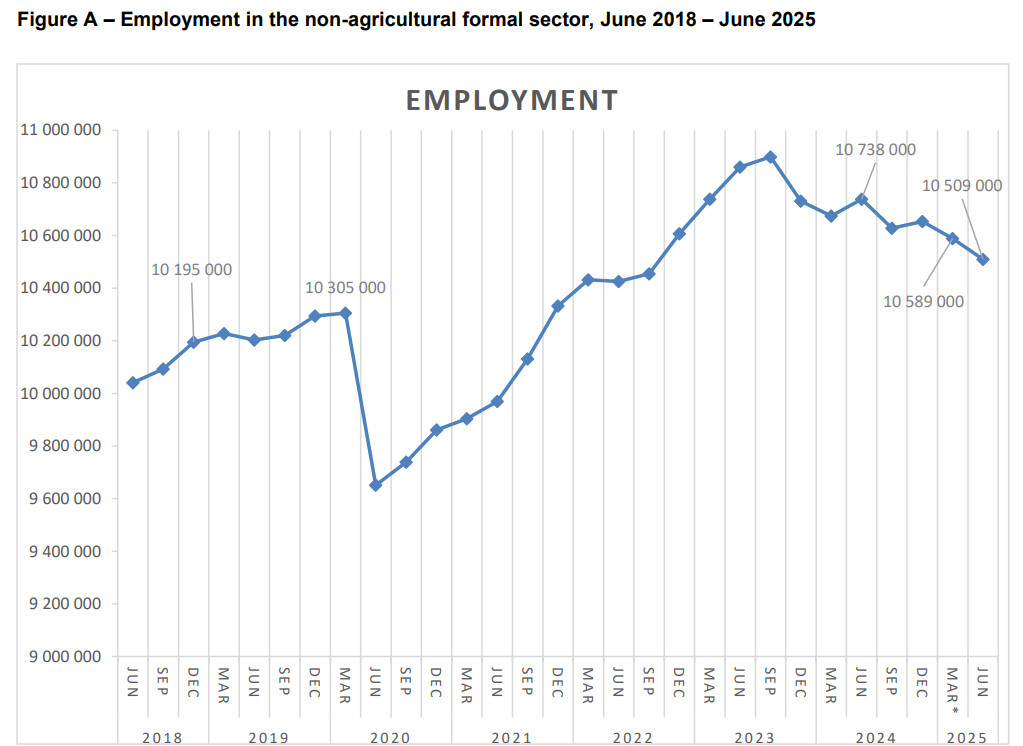
Formal employment in South Africa dropped by 229,000 jobs year on year in the second quarter of 2025, shedding 80,000 jobs from the first quarter.
The latest data from Stats SA’s Quarterly Employment Survey (QES) shows that formal employment in the country is under severe strain, particularly in the community services sector.
Total employment decreased by 80,000 or 0.8% quarter-on-quarter, from 10,589,000 in March 2025 to 10,509,000 in June 2025.
This was largely due to a decrease in the following industries: community services (-53,000), trade (-10,000), manufacturing (-9,000), construction (-7,000), transport (-2,000) and business services (-2,000).
However, there was an increase in mining (+2,000) and electricity (+1,000).
Total employment decreased by 229,000 or 2.1% year-on-year between June 2024 and June 2025, down from 10,738,000 last year.
Year-on-year job losses were mostly recorded in community services (-225,000), followed by manufacturing (-18,000), mining (-6,000), transport (-3,000) and trade (-1,000).
Job gains year-on-year were recorded in electricity (+1,000) and business services (+23,000), with a flat result for construction.
The QES is an employer survey that tracks the number of formal jobs in the country, excluding agriculture, hunting, forestry and fishing and private households.
This differs from the Quarterly Labour Force Survey (QLFS), which is a broader household survey that captures various employment types, including informal and domestic work, and unpaid family workers.
The QES gauges the health of South Africa’s formal business environment, while the QLFS focuses on the labour side, and is used to determine the official unemployment rate.
That said, the QLFS for the second quarter of the year also recorded a 140,000 more workers becoming unemployed in the quarter, with the official unemployment rate ticking up to 33.2%.
Both data sets point to a deepening jobs crisis in the country, with the QES in particular pointing to a worring trend, marking the third consecutive quarter of declining numbers.
Prospects for the remaining quarters of the year are also dim, with South African businesses facing increasing risks due to internal and external pressures on the economy.
Average salaries
While thousands of jobs were lost over the quarter, those who remained employed and on payrolls would have seen higher earnings.
TheQES overs eight key industries or sectors in South Africa, which is split further into 20 sub-categories, mainly made up of various manufacturing sectors, as well as a split between government and non-government community and social services.
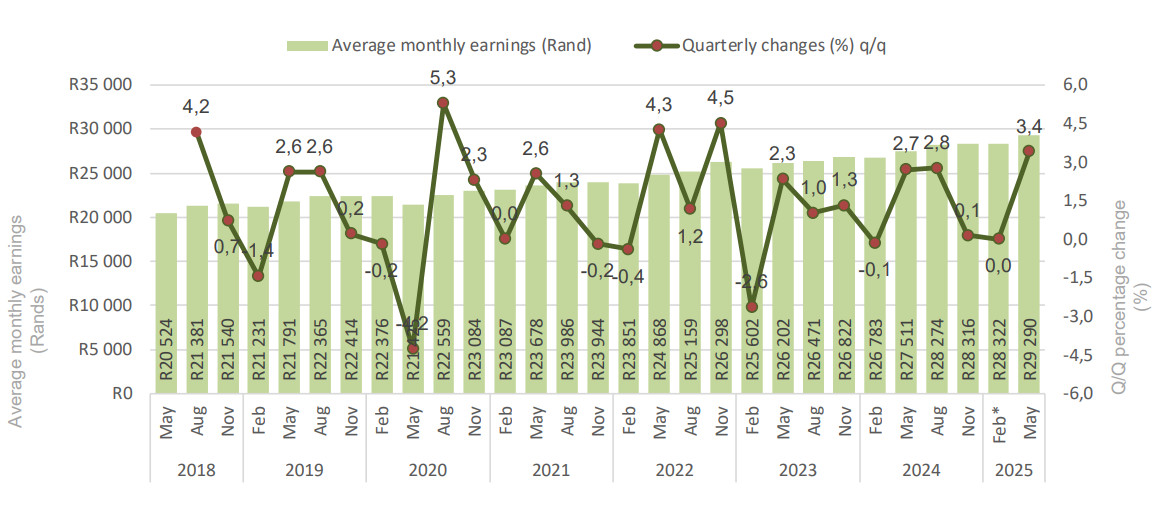
The average monthly earnings paid to employees increased by 3.4% from R28,322 in February 2025 to R29,290 in May 2025.
Year-on-year average monthly earnings paid to employees increased by 6.5% between May 2024 and May 2025, Stats SA noted.
Gross earnings increased by R2.2 billion or 0.2% from R984.7 billion in March 2025 to R986.8 billion in June 2025.
This was largely due to an increases in community services, trade, construction, transport, mining, electricity and manufacturing—despite the jobs shed.
However, there was a decrease in earnings the business services industry.
Basic salary/wages increased by 2.5% over the quarter, while bonuses decreased by 25.4%. This reflects the expected change in seasonal bonus pay. Overtime, however, also declined by 1.0% over the period.
Year-on-year, basic earnings paid increase by 3.6%, in line with inflation, while bonuses paid increased by 5.1% versus the same time last year. Overtime paid decreased by 4.5%.


















 Loading ...