

New university officially opens in South Africa


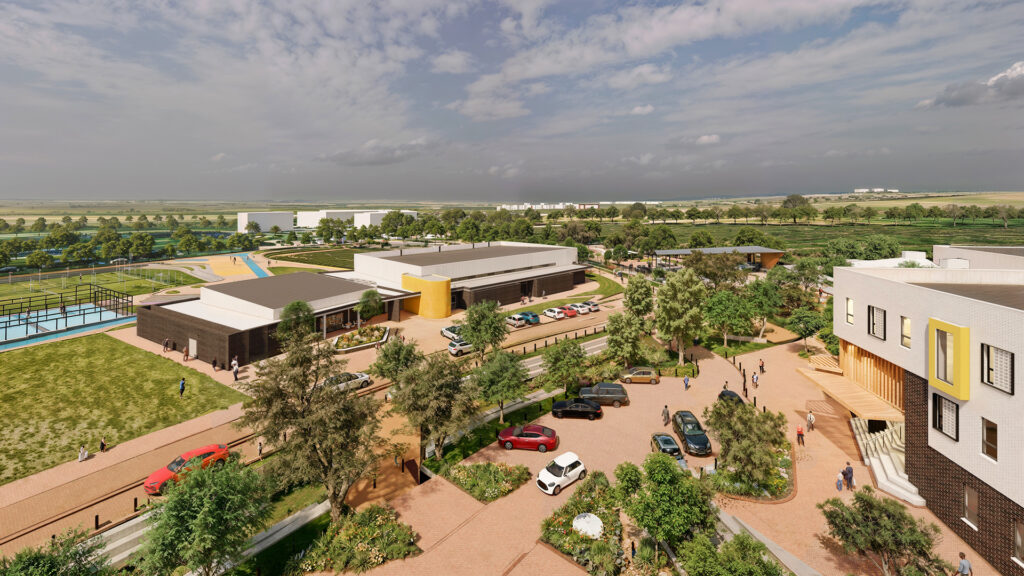
STADIO Higher Education has opened its new Durbanville Campus in Cape Town, with the first set of students set to arrive in February 2026.
The new private university will have a capacity for between 4,000 and 5,000 contact-learning students. It will offer higher certificates, undergraduate and postgraduate degrees.
It will offer 20 qualifications across seven schools, including Education, IT, Law, Media and Design, Commerce, Architecture and Engineering.
The campus has 29 classrooms, laboratories, and a multi-purpose hall, accommodating 1,000 students.
It also has a ground-floor “Centre for Academic Success,” which includes a library, study rooms and support services.
An IT lab is set to be an interactive, technology-rich environment, while two engineering laboratories come equipped with 3D printing, mechatronic and renewable-energy systems.
The engineering labs will support the launch of Higher Certificates in Mechatronics and Renewable Energy in 2026, with further labs and degrees to follow in 2027.
On top of the academic resources, the campus also focuses on student wellbeing, with facilities including netball courts, multi-use artificial courts and competitive rugby.
Designed by BPAS Architects, the campus will incorporate water-wise landscaping, rainwater harvesting and pedestrian-friendly circulation.
The campus forms part of a long-term plan to develop a vibrant tertiary-education hub in the northern corridor of Cape Town.
STADIO CEO Dr Stan du Plessis said that private higher education plays an important role in South Africa’s development story.
“We can experiment with new academic models, work closely with industry, and introduce flexibility that traditional universities often can’t,” he said.
“We’re not competing against public universities; we’re complementing them – expanding national capacity and providing choice.”
The flexibility extends to STADIO’s blended and distance-learning model, which remains central to its strategy, allowing students who can’t relocate or study full-time to access quality education.
“Durbanville strengthens our contact-learning capacity, but it also anchors a hybrid network that reaches students everywhere,” said Du Plessis.
South Africa’s education problem

The CEO added that South Africa’s higher education sector doesn’t lack investment, but rather the outcomes that follow.
He added that the private higher-education sector can help close that gap by designing for efficiency and aligning qualifications to the world of work.
“Instead of many small, fragmented sites, STADIO invests in a few strategic campuses that can deliver full academic ecosystems,” he added.
“The Durbanville campus demonstrates what it means to invest wisely – to create world-class infrastructure that will serve thousands of students for decades.”
He noted that South Africa spends more on post-school education as a share of the national income than many wealthy countries.
“Yet our graduate output and employability rates remain stubbornly poor. The challenge isn’t funding; it’s how efficiently and effectively we use the resources we already have.”
However, he noted that efficiency is not synonymous with cost-cutting, and rather about freeing resources to expand access and maintain affordability.
“We deliberately don’t price for the elite end of the market. To serve the nation, we must keep the access price competitive, which requires smart systems behind the scenes.”
Renderings



















 Loading ...